
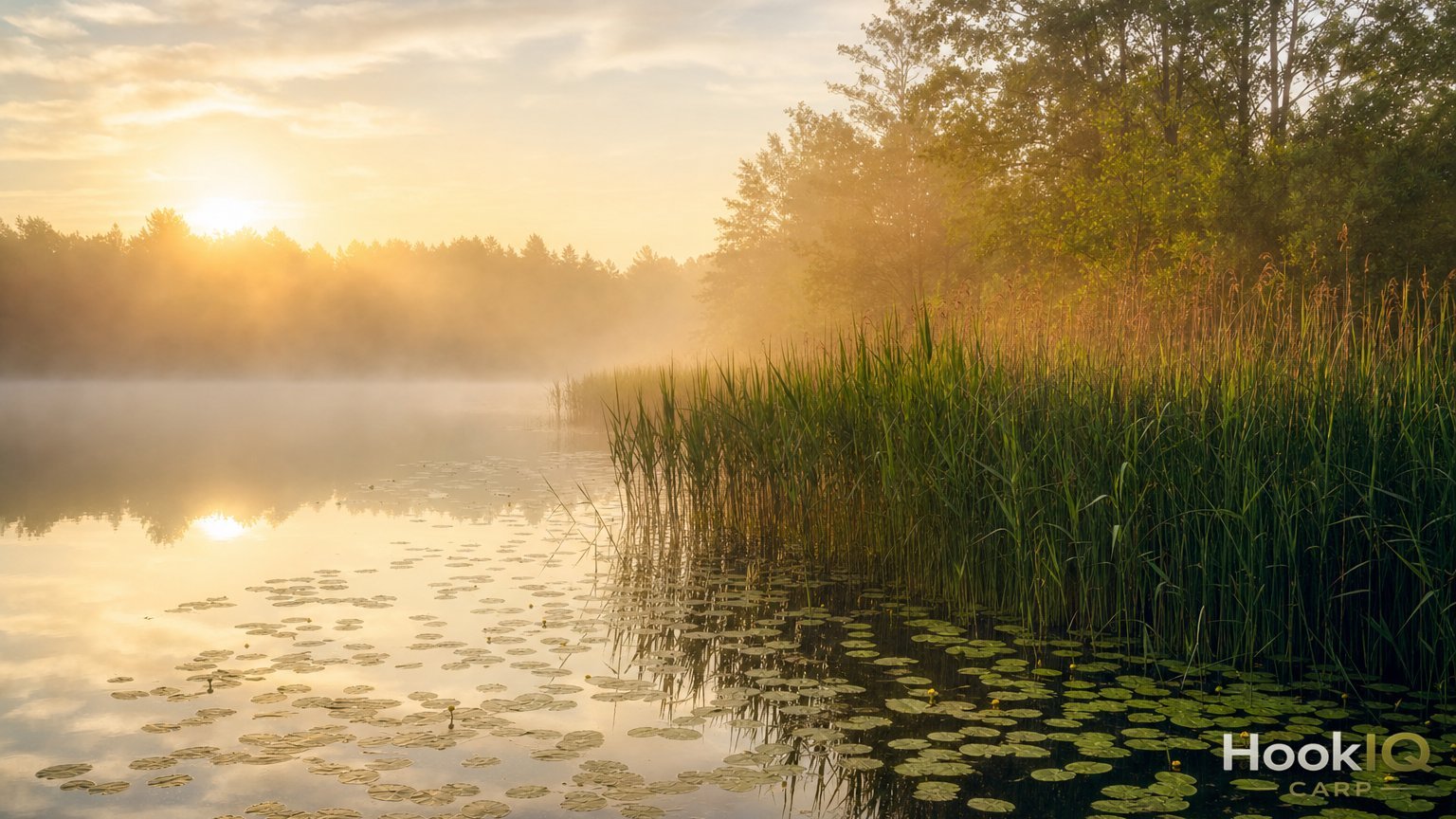
It's five in the morning. You're standing on the bank of your favourite lake. The sun is already pushing through the haze, the water sits at 19 degrees, and suddenly all hell breaks loose in the shallow bay to your left. Carp are rolling through the weed, spraying water up onto the bank, chasing each other through the lily pads. Your first instinct: get the rods out, they're clearly there. But that reflex would be a mistake.
What's Actually Happening Beneath the Surface?
Carp don't just spawn at random. Their bodies follow a remarkably precise biological schedule. It's known as the 1,000 degree-day rule: from the point when water temperatures hold steadily above 10 °C, the fish's body accumulates the daily average temperatures. Only when roughly 1,000 to 1,200 degree-days have been reached are eggs and milt fully mature. A sudden temperature spike to 18–20 °C then acts as the final trigger and kicks off the spawning event.
In practice, this means: on shallow, quick-warming lakes it can start as early as late April. Deep gravel pits or reservoirs often hold off until June or even July. And if you fish a water near a power station or treatment works, you may see spawning activity weeks ahead of everyone else.
One practical tip I've picked up over the years: when the bream start spawning, the carp are usually a few weeks behind. Bream are your natural countdown timer on the bank.
How to Recognise Spawning Carp
If you've ever stumbled into a full-blown spawning event, you won't forget it in a hurry. But it's not always that obvious.
The telltale signs:
- Several males chasing a single female through the shallows. It looks like a chaotic pursuit — complete with splashing, crashing through the reeds, and the occasional leap clear of the water. - Males develop spawning tubercles: small, rough, whitish-yellow bumps on their flanks and pectoral fins. If you catch a carp and can feel or see these tubercles, the fish is right in the middle of spawning. - The fish show themselves without any shyness right along the margins, sometimes in as little as 30 cm of water. - Peak activity runs from first light through to late morning. By early afternoon, things often go noticeably quiet.
The actual spawning process lasts two to five days, with the first 48 to 72 hours being the most intense. In some years there are multiple spawning waves, especially when a cold snap pushes the temperature back down in between.
Where Carp Hold During Spawning — and Where You Should Leave Them Alone
Carp choose very specific areas for spawning. These are exactly the spots you need to know so you can avoid them.
| Typical Spawning Spot | Characteristics | Your Response | |---|---|---| | Weedy shallows | Water depth 30–80 cm, dense plant growth | Avoid — don't fish here | | Reed beds and rushes | Warm, sheltered water with plenty of cover | Avoid — keep your distance | | Lily pad fields near the margins | Ideal egg-laying surfaces | Don't cast into them | | Sun-exposed bays | 1–2 °C warmer than the rest of the lake | Observe, but leave alone | | Flooded bankside areas | After rain or snowmelt — shallow and warm | Stay away |
Where you can still fish: Deeper areas away from the shallows, open water over 2 metres deep, stretches on the opposite bank from spawning activity. Not all carp in the lake spawn at the same time. There are always fish that aren't involved in spawning and are feeding normally. You'll find them away from the hotspots, often on features at medium depths.
Why Restraint Isn't Weakness — It's Responsibility
Here's the crux of the matter. In many countries carp have no statutory closed season. No ban, no legal protection during spawning. But the absence of a legal closed season doesn't mean everything that's technically allowed is the right thing to do.
Regulations vary by country and region — always check your local fishing laws for closed seasons and minimum size limits.
Many clubs and syndicates have long recognised this and impose voluntary bans of one to three weeks once spawning kicks off properly. That's sensible. The numbers speak for themselves: a female carp produces between 50,000 and one million eggs, but the survival rate to adulthood sits at just 1 to 2 percent. Every disturbance during spawning pushes that rate even lower.
Scientific studies also show that carp caught and released during spawning display altered movement patterns. They cover roughly a third less distance and need significantly longer rest periods than under normal conditions. In plain terms: a carp you catch and return during spawning will very likely abandon or at least interrupt its spawning activity.
Five Rules for Fair Practice During Spawning Season
I've been fishing for carp for over three decades, and during that time I've revised my own attitude to spawning season more than once. Today I stick to these five principles:
1. Observe before you set up. Walk the lake first. Where are fish rolling? Where can you see activity in the shallows? Those zones are off limits. Full stop.
2. Move to deeper water. Fish your normal approach in areas that don't serve as spawning grounds. Beyond 2 metres of depth, you're generally in the clear.
3. Use the window after a weather change. When a cold snap interrupts spawning, carp briefly resume feeding. Bright pop-ups in 10–16 mm — white, pink, or orange — work surprisingly well during this phase.
4. No heavy baiting near the margins. Large quantities of bait in the shallows draw spawning fish onto your rig where it has no business being. If you're fishing, use single hookbaits or minimal bait on deeper spots.
5. If you catch a fish with spawning tubercles, act fast and handle with care. Quick landing, wet hands, unhooking mat right at the water's edge, no lengthy photo sessions. That fish needs to get back to business. And one more point many people forget: keep your bivvy well back. Setting up camp right on a spawning area disturbs the fish through your presence alone — torches, footsteps, bank-side noise. A hundred metres of distance often makes the difference between an undisturbed spawn and an abandoned one.
After Spawning: When Does the Fishing Pick Up Again?
The post-spawn window breaks down into three phases, and it's worth understanding them.
Phase 1 — Immediately after spawning (1 to 3 days): The carp are exhausted and retreat to deeper, quieter areas. They barely feed. Patience is what's needed now, not action.
Phase 2 — The recovery week (4 to 14 days): Appetite slowly returns. The fish hold along weed bed edges, under overhanging trees, and near features. Small helpings of high-protein bait — 10 mm fishmeal or krill boilies, for example — bring the first bites now. Solid PVA bags with a handful of crushed boilies and a few pellets are worth their weight in gold during this phase. Don't cast to the obvious spots — look for the edges and transitions between weed and hard bottom. That's where the fish love to sit during this phase.
Phase 3 — The feeding frenzy (from about 2 weeks post-spawn): Now they're refuelling. The carp have burned enormous amounts of energy and they're clawing it back. High-protein boilies, pellets, and particles can be applied more generously now. Fishmeal boilies in 15–20 mm with a solid bed of hemp and sweetcorn draw fish in reliably. You can comfortably put out 2–3 kg over 48 hours, provided the stock supports it. This phase is among the most productive of the entire year. I've had some of my best ever sessions during exactly this window.
Post-Spawn Checklist
- [ ] Measure water temperature (stable above 18 °C = spawning likely finished) - [ ] No more spawning activity visible in the shallows? - [ ] Set up baited spots on features at 2–4 m depth - [ ] High-protein baits: fishmeal boilies, krill pellets, hemp - [ ] Favour smaller hookbaits (10–12 mm) - [ ] Stay mobile: follow the fish, don't wait
What This All Means for You
Spawning season isn't an obstacle to be overcome. It's a pause the stock needs — one you can actively support. At a time when many regions offer carp no legal protection, the responsibility falls on us as anglers. Show restraint now, and you're helping to ensure that big fish are still swimming in your lake ten years from now.
Observe the water, learn the spawning areas, move to other spots. And when you come back two or three weeks later with the post-spawn phase in full swing, you'll be rewarded with bites that more than make up for the wait.
How do you handle spawning season on your water? Have you had your own experiences with post-spawn sessions? Drop it in the comments — I'd love to hear your stories.