
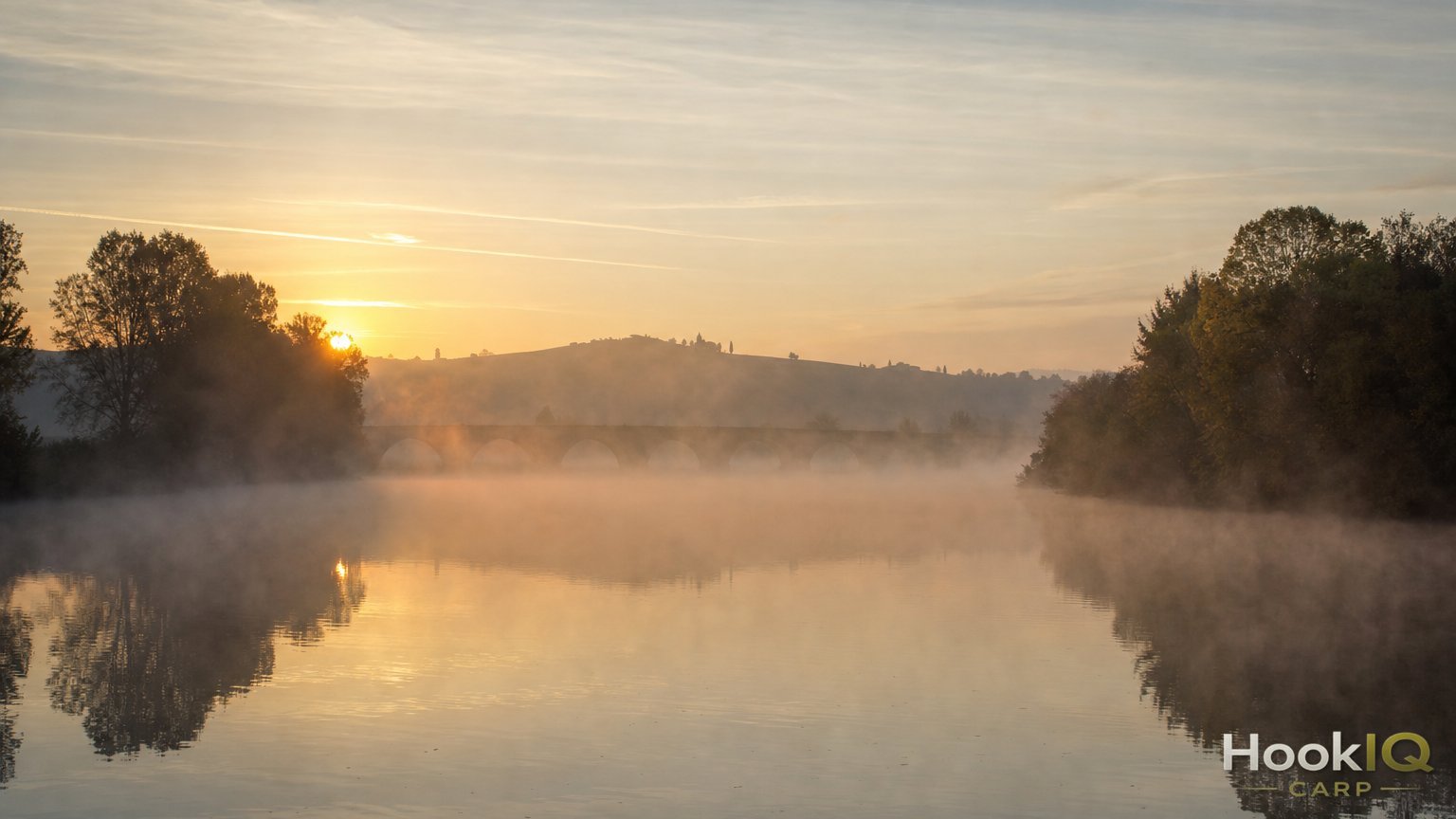
Some rivers roar, and some rivers whisper. The Saône whispers. Stand on her bank for the first time, somewhere between Chalon and Mâcon, and your first thought is: this is basically a lake. Barely a hint of current, a broad, calm sheet of water, vineyards and old stone bridges behind it. And that is exactly the trap. Because this gentle river can show you within two days that you have read her pace completely wrong. I've got to know the Saône over several trips, and I'll tell you straight away: she is one of the most rewarding — and at the same time most underrated — river-carp venues in France.
In this piece I'm taking you to the public stretches. We'll talk about the current and its moods, about whether there are even any groyne fields here, about heavy lead that holds on the bottom, and about the French law you need to know before you spend your first night on the water.
A Slow Giant With a Winter Temper
The Saône is around 480 kilometres long. She rises in the Vosges and joins the Rhône at Lyon. On the way there she loses almost no height. Between Corre and Lyon there is only about 30 metres of fall over roughly 400 kilometres. That averages out at around four centimetres per kilometre. No wonder the water seems barely to move most of the time.
Anglers roughly distinguish three sections. The Haute Saône right at the top, then the Petite Saône, a narrower, quieter stretch. From Verdun-sur-le-Doubs, where the Doubs joins, people talk about the Grande Saône. From here she widens — up to 300 metres in places near Mâcon — and she carries commercial shipping. Big péniches push their way through, and you always have to keep them in the back of your mind while you fish.
The mistake travellers make is trusting that gentle first impression. At low water, the flow at Lyon might be around 30 cubic metres per second. In the winter floods, the crues, the discharge can climb to many times that, locally up to something like a hundred times the low-water figure. Then it suddenly pushes hard, the water turns brown, and debris comes down with it. That is exactly why on the Saône you rig for the flow that can arrive at any moment. The calm surface you see on arrival day will mislead you. Turn up in November with 90 grams of lead and you'll be packing up again on day two.
Groyne Fields? The Honest Answer
A lot of river carp anglers focus on groyne fields, the kind you know from the Rhine or the Elbe. Those long rows of stone groynes that create calm back-eddies. On the Saône you have to rethink that a little.
Épis — groynes and training walls — do exist. In the 19th century the Saône was forced into a navigable channel with driven piling and rock fill. But these structures don't shape the river anywhere near as extensively as the classic groyne fields of the big German rivers. If someone sells you the Saône as a pure groyne venue, they've mixed her up with the Rhine.
What really counts here is a whole range of other features. And they are every bit as exciting.
| Feature | Why it produces |
|---|---|
| Enrochements (rock revetments) | Bank reinforcements of coarse stone, full of mussels and crayfish; carp patrol the edge |
| Ports and harbour basins | Calm water, warm in spring, a gathering point during floods |
| Bridge piers | Create current seams and calm zones behind them, a classic holding spot |
| Bras morts (backwaters) | Stillwater character, the first warm zones in early spring |
| Tributary mouths | Food input, temperature differences, they concentrate fish |
| Plateaus de galets (gravel bars) | Hard bottom in or near the shipping channel, rich in zebra mussels |
The gravel plateaus are the quiet highlight for me. These hard areas near the shipping channel are studded with zebra mussels and small crayfish. Exactly the larder that big river carp cling to. When you crank a bare lead or a marker setup across a plateau like that and feel the hard, rattling feedback, you've found one of the best spots on the whole river.
Fish Like Nomads: The Art of Choosing a Spot
On the Saône you're chasing movement. River carp travel. They don't sit in one place for weeks like they do in a lake. An experienced river angler once summed it up like this: you never know exactly where the fish are, but when you're sitting among them, they're nowhere near as suspicious as the constantly-pressured lake carp. That's both the appeal and the challenge.
So my approach is always the same. I search first, then I feed, and I don't get bogged down on a spot that gives me nothing back. Here's how I work the water:
- I test a promising spot with two or three small baitings and wait for a first sign. If nothing comes, I move rather than stubbornly keep feeding.
- I watch in the mornings. The most reliable bite phases often come in the first hours after sunrise, when a group of fish moves through my area. Sometimes two or three takes come one after another.
- In early spring I look for the first warm zones: shallow bays, backwaters, harbour basins. Carp gather here before the main river comes up to temperature. Activity is best around 15 to 16 degrees water temperature.
- In the summer heat, with 30-plus degrees in the water, I dial back my expectations. Then I fish early, late and at night, not in the midday glare.
When it comes to feeding in a river, it's more a case of going big than trickling in — but only once you know the fish are there. I'd rather start visually with a pop-up in the backwaters, where a lot of bait only gets in the way, and save the bigger helpings for where I've got genuine fish contact. A bucket of particles and boilies in the wrong place gets you nothing but a clean, fishless spot.
Heavy Lead and a Rig That Takes the Current
On the Saône your lead decides the outcome more often than your rig does. In calm low water, moderate weights are fine. But the moment wind, boat draw and — above all — a rising level come together, the rig has to sit rock-solid on the bottom. A lead that slowly drags pulls your hooklink into nowhere and eventually piles everything into a useless tangle.
As a rough guide for moving river water, these weights have proven themselves. These are general river rules of thumb, not Saône figures set in stone, but they give you an honest direction:
| Condition | Lead weight | Lead shape |
|---|---|---|
| Calm low water, close in | 100 to 130 g | Flat lead / distance lead |
| Normal current, medium range | 150 to 200 g | Flat lead, gripper lead |
| Strong current, high water, long casts | 250 to 300 g | Gripper lead (plomb à grappin) |
Gripper and flat leads are the key. A round pear lead will roll away on you in a current; a flat model with edges or small grippers digs in and holds. French anglers swear by the notched plomb rivière for exactly this reason.
Just as important as the weight is the rest of the rig. From plenty of conversations and my own experience, a few points crystallise out that are worth their weight in gold on the Saône. Line that's too thin is a real risk on the river. Go after a 15-kilo river carp in the current on 0.20 mm mono and you're playing the lottery. Step up clearly here.
> My setup for the Saône in a current > > - Mainline: 0.35 to 0.40 mm mono or a robust braid; if in doubt, thicker > - Shock leader: essential with the heavy leads and long casts > - Lead: 150 to 300 g gripper or flat lead, depending on the level > - Rig: lead clip fished as a bolt or semi-fixed setup, so the lead drops on a snag and the fish isn't anchored to the bottom > - Lead attachment: a short weak-link of a few centimetres, so a snag costs you only the lead and the rest comes back > - Hooklink: stiff, abrasion-resistant material to prevent tangles from boat draw and wash > - Hook: strong and sharp, size 4 to 6; over a mussel bottom, go a notch stronger
The lead clip does two jobs. It drops the lead during the fight or on a snag, and it makes sure you leave as little as possible in the water if you crack off. On a public river used by many people, that's a matter of decency for me. On top of that, the hard mussel and stone bottom on the enrochements and gravel plateaus grinds away at your hooklink mercilessly, so check it after every fish.
And then there are the péniches. When a barge comes through, first there's a draw that pulls the water away from the bank, then a wave rolling back. Your rig gets shaken about, and thin or soft hooklinks tangle reliably in the process. A stiff hooklink and a lead that stays put ride out this business far better.
Public Stretches and French Law
The good news first: the Saône has plenty of public water, the domaine public fluvial. You don't have to rely on expensive private lakes to fish for big carp in France. But you need the right paperwork and you have to know the rules, or the trip gets expensive.
The core of it is the carte de pêche, which you can easily get online or through the local clubs (AAPPMA). For travellers, the Interfédérale reciprocity card is almost always worth it — around 114 euros in 2026 — bundling the CPMA, URNE, CHI and EHGO stamps. With it you fish the reciprocity stretches across a large share of France's departments, and on the Saône that means across several administrative boundaries. For a trip where you want to follow the fish up and down the river, that's the most relaxed solution.
The most important point for us carp anglers is night fishing. In France, pêche de nuit for carp is only permitted on designated stretches, the parcours carpe de nuit. These are set by prefectural decree (arrêté préfectoral) and managed by the Fédérations. A few things you need to keep firmly in mind:
- Night fishing only on second-category waters and only on the officially approved sections.
- From half an hour after sunset until half an hour before sunrise, strict no-kill applies. No carp may be retained or transported during this time — everything goes straight back.
- At night, plant-based baits only, and you fish from the bank.
- Carp over 60 centimetres may not be transported alive in any case. That protects the big fish in a very practical way.
The Saône really does have stretches like this. Verifiable examples on the Ain side, managed by clubs from Saône-et-Loire, are the parcours near Feillens/Replonges and near Cormoranche-sur-Saône. But this list changes every year. Never rely on an old forum post; check the current authorisation directly with the responsible Fédération or via the Geopêche maps before you put up your bivvy. A check in the middle of the night on an unauthorised stretch will cost you more than the whole trip. Regulations like these are specific to France — always confirm the local rules for the country and stretch you're fishing.
A quick honest word on stock. The Saône is no runs water where you haul fish out one after another. She's a sprawling, demanding river with a good head of fish and a realistic shot at genuinely big ones. As a bycatch, the catfish is lurking too. The Saône has an excellent silure reputation: a specimen of 2.70 metres and over 110 kilos has been caught here. If something like that climbs onto your carp tackle, you won't miss your 0.20 mm line.
Conclusion
The Saône rewards anyone who doesn't take her gentle first impression at face value. Gear up for the flow that can roll in at any time in high water: heavy gripper leads, strong line, a safe lead-clip system. Forget the hunt for classic groyne fields and read the real features instead — the rock revetments, ports, bridge piers and above all the gravel plateaus. Move with the fish instead of sitting it out on a dead spot. And sort out the French night-carp law before you set off, not once you're on the bank.
What takes the most mental load off me on trips like this is the way the conditions interact. Level, water temperature, time of day — on the river it all meshes together and decides the short bite windows. These days I let the HookIQ app pull those factors together, so I don't have to juggle everything in my head on an unfamiliar river and don't miss the promising windows. But in the end, what counts is that you go, read the river and listen to her.