
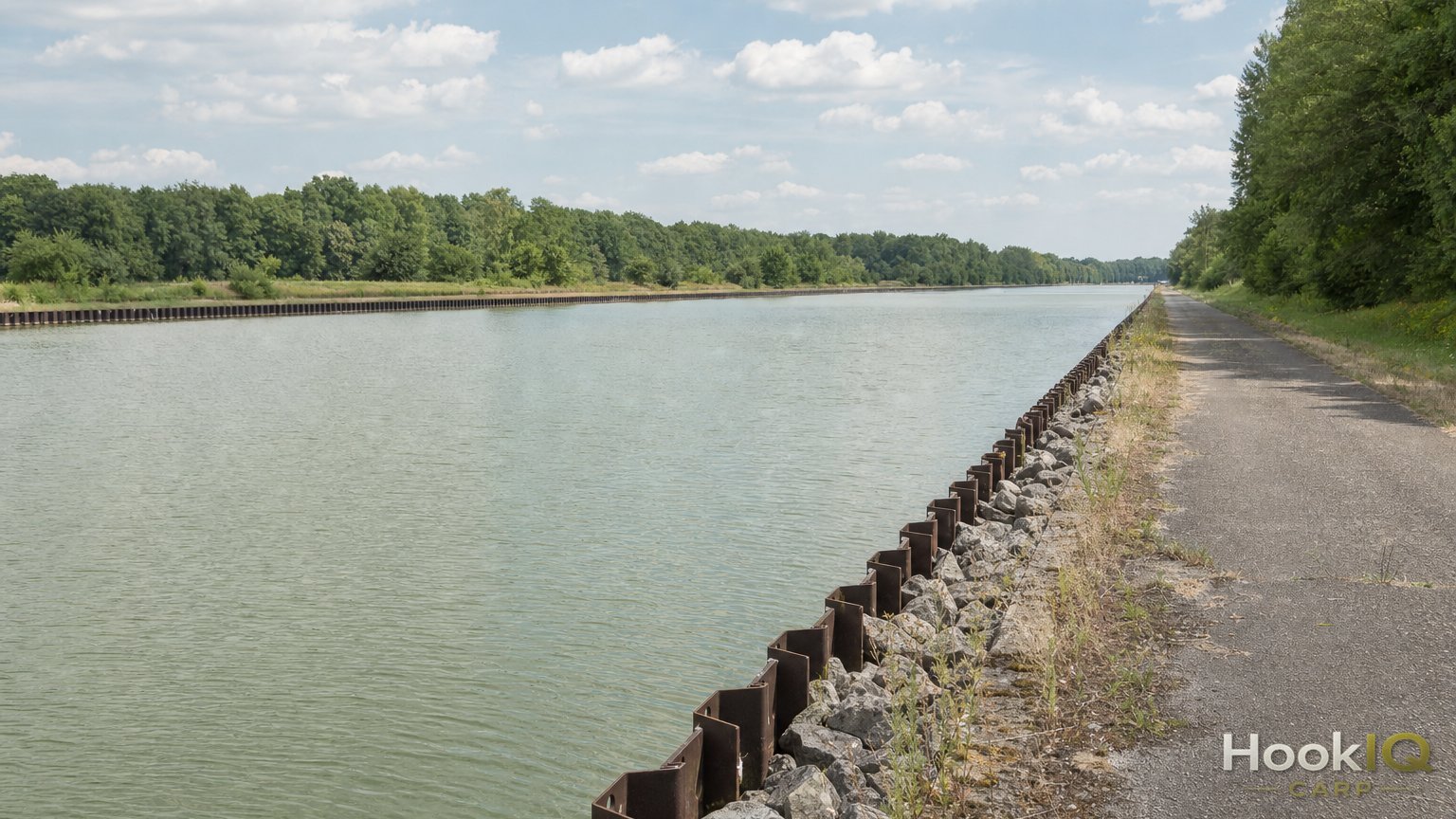
You're standing on a metre-and-a-half strip of concrete between the towpath and the quay wall, rods set at 45 degrees to the fairway, when you hear it: the deep drone of a push-tow unit grinding through the bend. Twenty seconds later, the water visibly drops away from your feet. Welcome to the canal. No other venue forces you to work with the infrastructure instead of against it quite so directly.
I've fished canals regularly for several years now, from the Mittellandkanal down to smaller branch canals, and I can tell you this: anyone who thinks canal fishing is just lake fishing with straight banks has never stood beside commercial shipping in a 40-metre-wide channel.
Why the Canal Plays by Its Own Rules
On a lake, you react to wind, light and water temperature. On a canal, a fourth factor muscles in and overrides everything else: shipping traffic. It decides when you can place a bait, what your rig needs to look like, and even how you lay out your rods. The shipping line's timetable sets the pace here, and your feeding window has to fall in line with it. One seasoned canal angler in the community once put it to me this way: on some stretches, exactly two vessels fit side by side in the canal — and that's precisely what makes the swim a challenge. The narrower the cross-section, the harder the water reacts to every passing boat.
Three structures define the picture on almost every major shipping canal: the sheet pile wall as a reinforced bank, the turning basin where vessels pivot, and the mooring as a waiting or anchoring zone. All three are, first and foremost, waterway engineering — not angling infrastructure. But that's exactly why they create the conditions carp love: depth, current shadows, and bait that gets endlessly redistributed by passing traffic.
Draw and Surge: The Physics That Rework Your Swim
Before you lay out a single rod, you need to understand what a passing vessel does to the water. A moving cargo ship displaces water. In a narrow canal cross-section, that water can't simply push aside, so the level drops next to the hull. That's the draw. The tension builds in the surface roughly one boat-length before the bow arrives, often measurable as several centimetres. After the vessel passes, the counter-movement follows: a stern wave that lifts the level back up, trailed by a backfill current. On the bank, you'll usually notice the water receding first, then slamming back with real force shortly after.
This isn't a cosmetic detail. In Germany, the federal waterway authority explicitly warns anglers and walkers that water levels on some stretches can rise by roughly a metre within about 30 minutes. Sit too close to the water or leave your tackle box right on the edge, and you can get it soaked — or swept away — within minutes.
What Draw and Surge Do to Your Swim
| Phase | What happens | What it means for you |
|---|---|---|
| Before the pass (bow build-up) | Surface tension builds slightly, usually unnoticed | Bait and feed sit undisturbed |
| During the pass (draw) | Level drops beside the hull, current pulls toward the fairway | Loose bait and feed get dragged along |
| After the pass (surge) | Stern wave lifts the level again, backfill current follows | Margins can briefly flood |
A baited spot on a canal is never truly stable. Every passing vessel redistributes loose feed — sometimes a metre or two, sometimes a lot further. That's why I bait with boilies instead of loose particles when fishing right on a main fairway: round baits simply offer less surface area for the draw to grab than corn or pellets.
Sheet Piling: Productive, But Tricky to Land Fish From
Sheet piling is the steel construction that reinforces most canal banks. Over time it grows a coating of algae and plankton, and that growth zone is exactly what draws in baitfish — and, in turn, carp. Where the sheet piling meets the rock armour in front of it, small ledges often form, sometimes only 30 to 40 centimetres wide, acting as a reference point for travelling fish. That's exactly where I place my first rod; the second goes about two metres further out toward the fairway, and the third sits just half a metre from the wall, tucked into the current's dead zone.
The catch only shows up once the fish is on. You're often standing a metre or two above the waterline on the wall, and your landing net handle won't reach down far enough once the fish is in the net, because you'd need to lift it straight up the face of the wall. A sheet-pile landing net with a short mesh and a long drop cord can help here, but it's often not rated for really big fish. What works better is a combination: an unhooking mat down at the foot of the wall, a sling on a rope that you lower under control, and a rope temporarily tied off to a bollard. That way the fish stays in the net while you climb down the steps or ladder yourself. Plan this sequence into your setup from the start — not once the rod's already bent double. There's no time for it at three in the morning in the rain.
Turning Basins and Moorings: Two Very Different Spot Types
A turning basin — what UK canal boaters would call a winding hole — is a trapezoid, usually one-sided widening of the canal. It lets vessels turn freely without having to moor up first. As an angler, that gives you a lot more open water and noticeably calmer current than the main channel, and feed holds there longer than right in the canal bed. The catch is its legal status. Turning basins belong to the waterway authority's operational grounds, and fishing there is restricted or banned outright on many stretches. Check the signage on site and the local waterway bylaws before you even unpack a rod there.
Moorings and berths are a different category altogether. A mooring is the whole facility for tying up outside a harbour; a berth is the specific slip allocated to one vessel. A waiting berth is a berth without any cargo handling — just a spot where vessels hold up ahead of locks or tight passages. Cargo vessels can sit here for hours with the generator running, which keeps the water in gentle, constant motion but without the hard draw-and-surge cycles of the open fairway. For night sessions, swims near waiting berths are often a good compromise: enough water movement for oxygen and feed dispersal, without the unpredictability of a live fairway.
Canal Spot Types Compared
| Spot type | Current | Access | Typical productivity |
|---|---|---|---|
| Sheet piling on the fairway | Strong draw during passes | Usually open access | High, thanks to growth and the ledge |
| Turning basin | Calm, little draw | Often restricted — check signage | High, if accessible |
| Waiting berth / mooring | Moderate, from generators | Usually open access, keep clear of vessels | Medium to high, stable feed spots |
| Wider canal section (passing place) | Reduced vs. main channel | Open access | High, since the draw spreads out |
Rigging Up in Tight Spaces
Most canal stretches leave you no more than two to three metres between the towpath and the bank edge. A classic rod pod with three widely splayed legs often won't fit there without blocking the path. In spots like this, I use a narrow pod with a minimal footprint and line my rods up parallel to the bank instead of fanning them out. That saves width and keeps the towpath clear for walkers and cyclists.
For lead choice, I size up to the shipping traffic on that particular stretch. On quiet branch canals, 80 grams is plenty; on busy main waterways, I go up to 200 grams so the rig holds its ground through the draw instead of creeping toward the fairway. During the day, I deliberately keep the rod tip up high rather than angled flat to the water, so the line doesn't come under too much sudden tension when the current shifts — and so the bite alarm doesn't false-trigger on every wave.
Setup Box: Rig Layout on a Busy Canal
- Rod 1: right on the sheet-pile edge, lead 100–150 g
- Rod 2: about two metres further out toward the fairway, lead 150–200 g
- Rod 3: just 0.5 m from the wall, tucked in the current's dead zone, lead 80–100 g
- Narrow-footprint pod, lined up parallel to the bank
- Unhooking mat, sling and rope staged at the foot of the wall before the first cast
- Barrow or trolley for transport — canal car parks are often a long walk away
One thing a lot of newcomers trip over: whether you reel in during a pass or leave your rods out depends on how close you are to the fairway. If your rig sits near the rock armour and a push-tow unit grinds past with a strong draw, your line can get pulled into the rocks and jam there. On spots like that, I reel in just before the vessel passes and cast back out once the surge settles. On wider stretches, where the draw spreads across the whole width of the canal, the rig usually rides it out undisturbed.
Safety and Rules: What to Watch for on the Canal
In Germany, canals fall under the Inland Waterways Regulations (Binnenschifffahrtsstraßen-Ordnung), which affect anglers indirectly too. Section 7.03 bans anchoring in canals and lock approaches outright, and near an A.6 sign, that ban extends a further 50 metres on either side of the marker. That's primarily aimed at boats, but it shows how tightly shipping authorities control the area around pinch points like locks or turning basins. Regulations like this vary from country to country, so check the bylaws of your own local waterway or canal authority before you set up near a lock, turning basin or restricted marker.
Safety also means respecting the sheer size of these vessels. A barge's blind spot can extend more than 100 metres ahead of the bow, and its stopping distance runs into several hundred metres. The skipper can almost certainly see you and your rods on the bank, but even if there's a hazard, there's little they can do about it. Keep your gear as far from the edge as you can without ruining your bait presentation, and never bring kids or dogs right up to the sheet-pile edge when vessels are expected.
Bottom Line
A shipping canal isn't an ordinary still water, and it doesn't reward the same approach. Sheet piling gives you an edge and growth to fish; turning basins give you calm refuge zones; moorings give you stable feed spots — but every one of these structures comes with its own rules, both legal and physical. Once you've properly got your head around draw and surge, rig your rods tight and secure, and plan your landing at the wall instead of improvising it, these underrated waters will give up some of the hardest-fighting fish I know.