
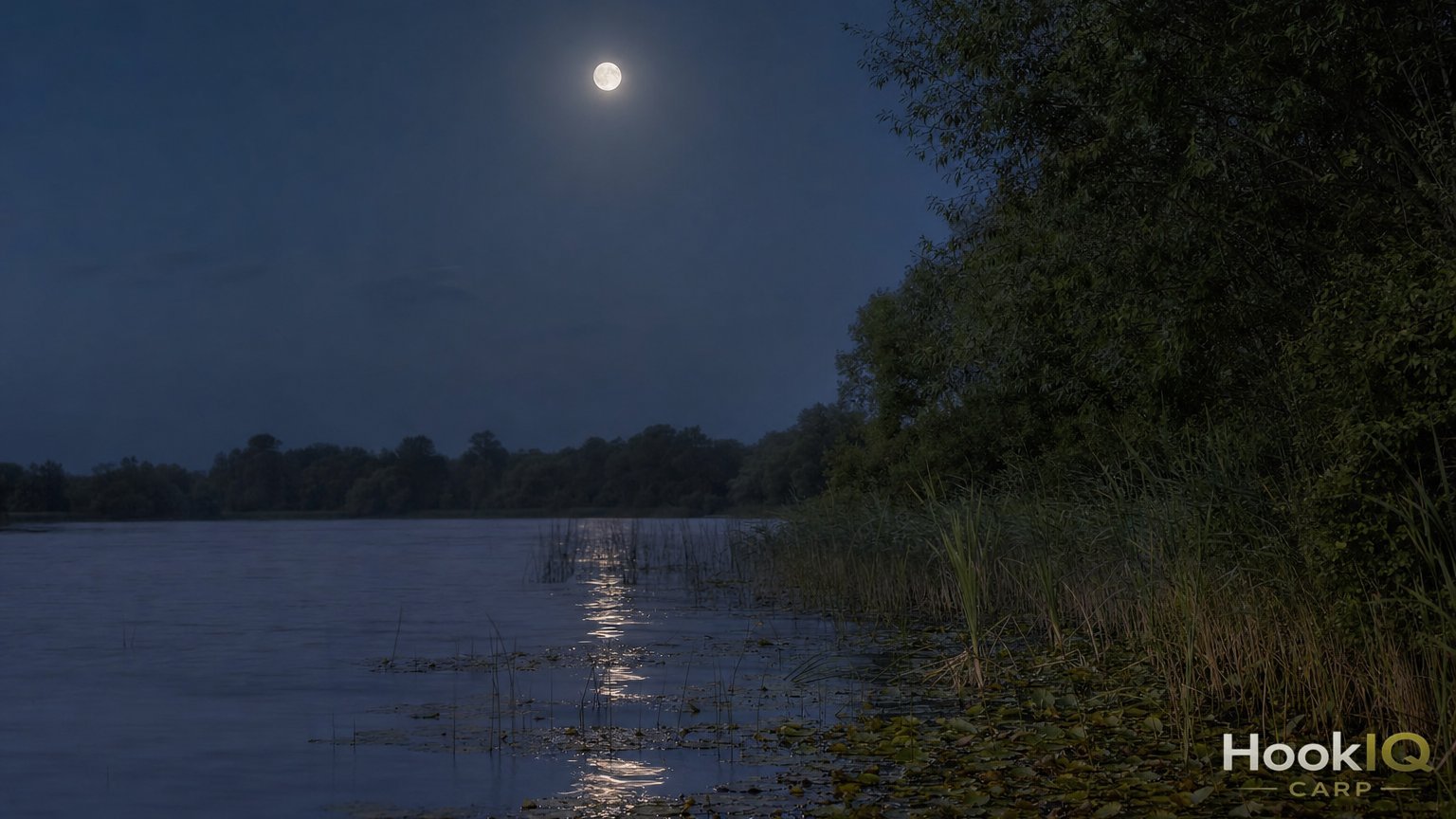
I was once fishing a small club water when, at one in the morning, a car door slammed three times in a row, immediately followed by a torch beam sweeping across the lake as if someone was searching for a lost aircraft. Two hours later, I was sat behind dead-quiet rods, with a neighbour less than twenty metres away talking my ear off about his last catch. Neither of them was a bad angler. They'd simply never learned that on a carp lake, several people are trying to do the same thing at the same time, ideally without getting in each other's way.
Consideration on the bank isn't some soft topic for club meetings to tick off. It decides whether you get to keep fishing a good water, whether other anglers give you a heads-up next time a top swim becomes free, and whether you get to fish in peace when you need it most. I've been fishing waters I don't have to myself for three decades now, and that's exactly where I learned what actually matters.
Choosing Your Swim: How Much Space Is Enough?
Most German club waters set out a minimum spacing rule in their water regulations, even though almost nobody reads them until the first argument breaks out. Ten metres bank-to-bank is the most common guideline, and for spinning or fly fishing that jumps to around fifty metres because of casting range. Boat anglers should give occupied bank swims roughly forty metres of clearance, if only so nobody rows straight through someone else's baited area. Almost everywhere, there's also the unwritten rule that whoever arrives first chooses first — regardless of how long someone's been a club member or how stacked their tackle box is.
I treat these distances as a minimum, not a target. On a busy lake with six or eight anglers spread along a hundred metres of bank, the difference between "technically allowed" and "decent human behaviour" often comes down to just five or six extra metres. If I arrive and there's a free swim next to an occupied one, I'll have a quick word before casting out. It costs thirty seconds and saves a whole night of tension.
On larger, more organised carp fisheries — particularly in England — this principle goes a step further. Fixed, numbered swims are allocated, often colour-coded: a double swim for two anglers with four rods between them, a single swim capped at two rods. Radios, open fires and excessive drinking are usually banned outright in the rules, and quiet hours often kick in at a set time. It looks strict at first glance, but it solves exactly the problem that German club waters usually leave informal — and sometimes simply unresolved: too many rods crammed onto too little bank.
Quick Reference: Minimum Spacing
| Situation | Typical Minimum Distance | Source of the Rule |
|---|---|---|
| Static/bottom fishing, bank to bank | approx. 10 m | German club water regulations |
| Spinning or fly fishing | approx. 50 m | German club water regulations |
| Boat to occupied bank swim | approx. 40 m | German club water regulations |
| English carp fishery, double swim | fixed allocation, 2 anglers / max 4 rods | Fishery rule books (e.g. UK syndicates) |
Noise: What Bothers Carp and Neighbours Alike
Carp pick up vibrations in the water and along the bank through their lateral line, but for swim etiquette, something else matters more: noise is complaint number one that gets clubs restricting or banning night fishing altogether. Car doors slamming on a late arrival, loud music from the bivvy, a barking dog, a generator running all night. All of it carries astonishingly far over water, especially on still nights when there's nothing to dampen the sound.
A handful of rules I've stuck to for years cost almost nothing and change a lot:
- Park at least fifty metres from the actual swim and walk the last stretch in with the barrow, rather than driving right up to the water.
- Turn bite alarms down to the lowest practical volume at night — a notch or two quieter than during the day.
- Keep conversations with fellow anglers after 10pm at indoor-voice level, not at "we're the only ones here anyway" volume.
- Use landing net poles, bank stick mallets and unhooking mats in a way that avoids metal clanging on metal. A rubber mallet instead of a steel one for bank sticks makes a noticeable difference.
- Skip generators running all night when a power bank or solar panel can do the same job more quietly.
This list sounds obvious until you're woken at three in the morning by a neighbour reparking his car for the third time. Considerate noise habits are the reason some waters are still allowed to permit night fishing at all. If local residents complain often enough, it's the whole club's membership that loses the privilege — not just the one loud angler.
Litter and Breaking Down Camp: More Than Just Politeness
On the subject of litter, I often hear the argument that a handful of leftover rig bits or a forgotten PVA bag isn't the end of the world. That holds up right until you look at what actually happens to that stuff. According to Leave No Trace guidance, monofilament line takes around five hundred years to break down. In that time, it tangles around swans' feet, ducks' bills and herons' legs. In Leipzig and Delitzsch, swans have repeatedly been found in recent years with hooks caught in their bills or line wrapped around their tongues, and one grey heron is known to have died from exactly this kind of entanglement.
Lead weights are the second big issue. The European Chemicals Agency (ECHA) estimates that two to six thousand tonnes of fishing lead end up in waters across Europe every year, through lost rigs and leftover tackle. Waterbirds like swans and diving birds swallow lead fragments directly, mistaking them for grit, and poison themselves in the process; birds of prey and herons are affected indirectly through the food chain. The EU is currently discussing a far-reaching ban on lead in angling because of this. Anglers who already break down camp cleanly won't need to change any habits if and when that ban arrives.
My own breakdown routine has settled into a few fixed steps over the years:
- Every session ends with a walk around the entire swim, not just the spot where the chair was.
- Rig offcuts, cut line and packaging go into their own small bag, separate from general rubbish, so nothing slips out of an overstuffed bag during transport.
- Loose boilies and leftover bait that didn't get eaten come home with me rather than getting left "for the fish." All that really does is attract rats and wild boar, not more carp.
- Bank stick holes and landing-net divots get roughly filled back in before I leave.
- One last torch check across the whole swim in the dark, including wherever the bait boat or spod sat.
Checklist: Leaving a Clean Swim
| Area | What I check |
|---|---|
| Rig and line offcuts | Own bag — never left in the grass or water |
| Lead fragments | Take all of it, no crumbs left in the bank mud |
| Leftover bait | Don't overfeed and leave it — attracts pests, not carp |
| Holes in the ground | Fill back in before the next angler or dog walker steps in one |
| Packaging | Straight into the bag you brought, not left until you reach the car |
Consideration Extends Beyond Your Own Swim
One thing a lot of anglers underestimate is what the English carp scene likes to call "guesting etiquette." Keeping your own swim clean and quiet isn't enough. If you tell someone exactly where the fish were holding up on your way out, or post a catch photo with a recognisable background, you might send a whole crowd of anglers straight to that spot the next day. I've personally kept the exact location of a good catch off social media for precisely this reason — simply out of consideration for the other members on that water. The same goes for someone else's baited spot: if you can see that somebody's been feeding a swim for days, find your own corner rather than moving in the moment they take a night off.
When Friction Happens Anyway
However good a rule sounds, not everyone sticks to it on the bank. Sooner or later you'll end up next to someone who, despite the ten metres, casts straight into your baited area, or whose bite alarm is still at party volume at midnight. Over the years I've learned that a calm word almost always works better than a complaint to the committee the next morning. A short "hey, mind turning that down a bit, I'm trying to sleep here" works surprisingly often, mostly because very few anglers actually mean to cause disruption. A lot of them simply don't realise how far their noise carries over still water, or how close their cast actually landed to someone else's baited spot.
Only once a direct word gets nowhere is it worth checking the water's rules and, if necessary, talking to the committee. Document facts rather than feelings when you do: time, distance in metres, exactly what happened. That helps the club far more than a vague complaint about "the inconsiderate bloke on the far bank," and it protects you too if things turn into a dispute. This pays off most in autumn especially, when the pre-winter feeding spell pulls a lot of anglers to the water at once and swims get tighter. Anyone who acts like a fair neighbour now usually gets the same courtesy back when the best swims get redrawn next spring.
At a Glance
| Topic | CarpIQ's Rule of Thumb |
|---|---|
| Distance to your neighbour | At least 10 m — ask rather than assume if unsure |
| Noise after dark | Park the car further away, turn bite alarms down, keep chat to indoor-voice level |
| Litter when breaking down | Take everything that didn't come out of the water, including lead fragments |
| Someone else's baited spot | Avoid it, even when they're not around |
| Sharing location info | Keep it to yourself, especially on small, heavily-fished waters |
The Bottom Line
At the end of the day, a carp lake only stays a good water for as long as the people fishing it look out for each other. Ten metres of spacing, a quiet bite alarm after ten at night, and a litter sweep before you pack up cost you only a few minutes on any given session. What you get back in return only becomes clear the next time a neighbour gives you a heads-up that the top swim's just come free, instead of wondering why you're still getting invited back at all.