
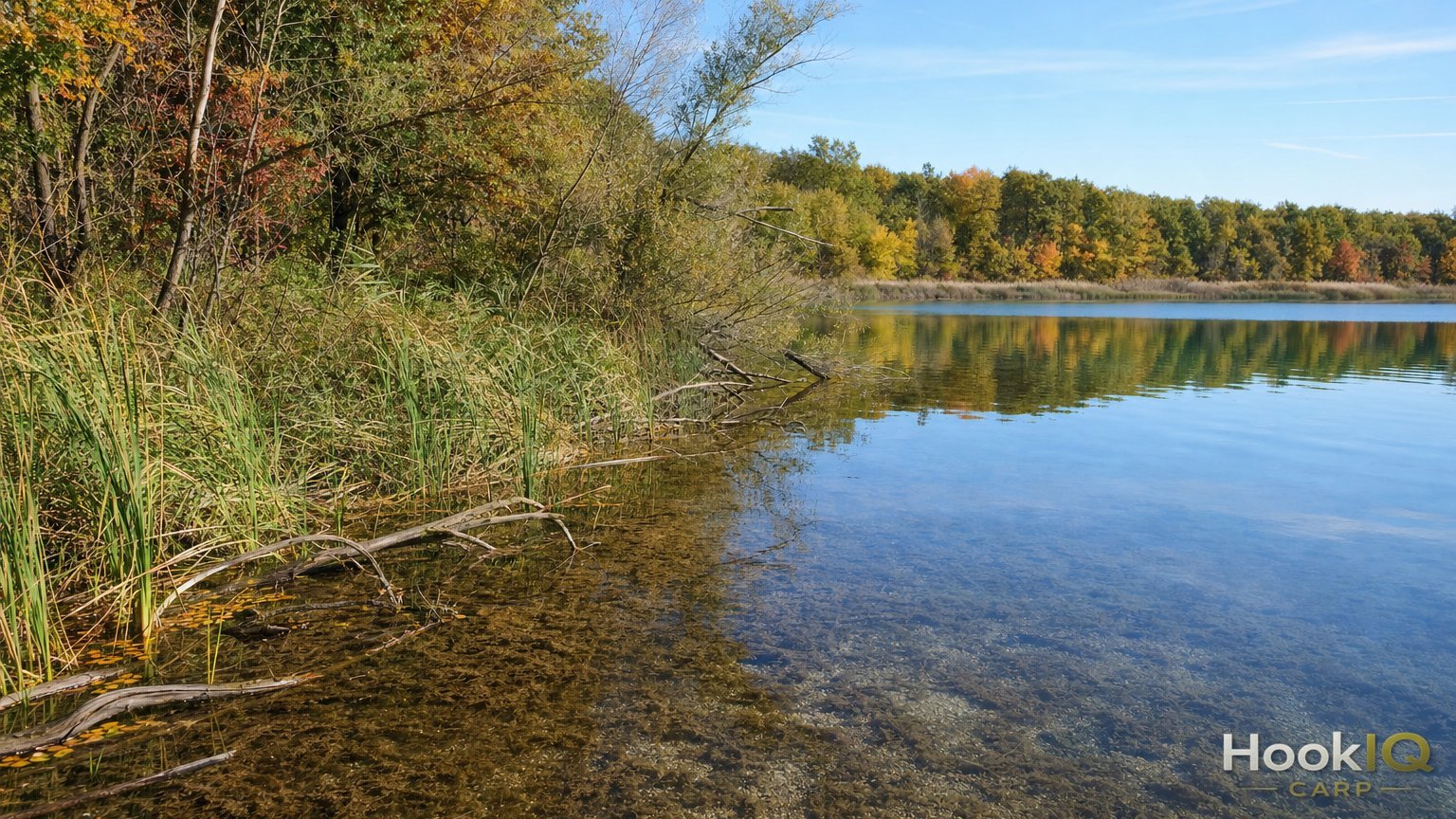
In August, the bay was a no-go area for me. A solid carpet of weed, with zero chance of a clean presentation — short of lobbing a chod rig over the top of the green canopy. When I went back over it with the marker rod in mid-October, there it was: a patch of gravel, about the size of a garden table, sitting right in the middle of what had been a jungle of weed. Nobody had ever fished that spot. It simply hadn't existed before.
That's exactly what happens every year, between late September and November, on almost any water with a decent amount of weed growth. The weed retreats, dies back or collapses flat, and underneath it, areas that had been hidden all summer suddenly come into view. If you don't get the marker rod back out now, you're leaving some of the best spots of the whole year on the table.
Why the Weed Collapses Now
Aquatic plants respond directly to temperature, not the calendar. Milfoil pulls back once the water temperature drops below 10°C (50°F) for good. If the water stays warmer, the plant hangs on — which is exactly why you get a late weed die-back in mild years and an early one in cold years. Stonewort can't handle sustained temperatures above 18°C (64°F) and dies off slightly earlier than hardier species. Pondweed takes it a step further: in autumn it forms small overwintering buds, known as turions, which break away from the parent plant, sink to the bottom and overwinter there at around 4°C (39°F). The above-ground growth dies off completely and breaks down.
That breakdown isn't just a visual change. Rotting plant matter pulls oxygen straight out of the water right at the bottom. What was an oxygenated, aerobic habitat all summer tips locally towards decay and methane production. For carp, that's a clear signal to clear out. They head for fresher, more oxygen-rich water — and that's often found right next to the dying weed, exactly where the die-back has just exposed ground that was covered before.
So two things happen in parallel: the plants disappear, and the fish move out of the stagnant zones into freshly accessible ground. Whoever finds these new areas first gets a few weeks of spots with zero rig history.
Finding the Gaps: Your Lead Choice Makes the Difference
In autumn I swap my standard marker setup for one built specifically for feeling through dying weed. A grapnel lead is the wrong tool to start with. It snags on the first bit of dying plant matter it touches, drags a trail of weed back with it, and you lose any reliable feel at all. You're far better off with a streamlined, barbless lead that pulls — almost "plucks" — free of debris instead of biting into it.
For this I use a lead around 113g, roughly 4oz, on braided mainline. The weight matters: a lighter lead gives you a vague, washy signal, while a heavier one gives a sharp, unmistakable drop. The feedback you get on the retrieve varies clearly by bottom type.
| Bottom Type | What It Feels Like on the Retrieve |
|---|---|
| Gravel | Sharp, hard chattering — almost like pebbles knocking under the lead |
| Sand | Smooth, with light, even resistance |
| Silt | A heavy, slow drag, almost sticky, like pulling the lead through treacle |
| Dying Weed | Soft and spongy at first, then a sudden resistance that feels like hard bottom, even though there's still plant debris sitting on top |
Once I've found an area that feels clean, I clip the line at that distance and cast several more times around it to pin down the size and shape of the spot. Only after that do I switch to a grapnel lead to double-check. If it comes back trailing weed or debris, the spot isn't as clean as it felt. If it comes back bare, the area's confirmed.
Autumn Spot-Finding Setup
- Lead: streamlined, barbless, roughly 100–115g
- Mainline: 20lb braided marker line for maximum sensitivity
- Check lead: grapnel lead to confirm once you've located the spot
- Method: feel the area out roughly first, clip up on the suspected spot, cast several times around that point, and only then confirm with the grapnel lead
Hook Link Length: Why You Need to Rethink It Now
This is the part most anglers miss in autumn. A freshly exposed spot under dead weed is almost never as hard and clean as a classic gravel spot in high summer. More often than not, there's a thin layer of plant debris, decaying silt or loose sediment sitting on top, even if the lead gave a fairly clean read when you felt it out.
On genuinely hard, clean bottom like gravel or firm sand, I fish short, stiff hook links between 15 and 20cm — a D-rig or a Flipper rig, for example. The shortness gives you aggressive hook orientation and a fast self-hooking effect as soon as the carp draws the bait in.
On the softer transitional bottom under freshly dead weed, I lengthen the hook link considerably, to around 38–46cm. The reason is simple: a short, stiff hook link effectively pushes the hookbait straight into the soft bottom — it sinks in, looks unnatural to the fish, or simply doesn't get found. A longer hook link gives the bait more freedom of movement over the soft material and sits more naturally, even if the lead sinks in slightly.
| Bottom Type | Hook Link Length | Suitable Rigs |
|---|---|---|
| Hard, clean (gravel, sand) | 15–20cm | D-rig, Flipper rig |
| Soft, weed debris, silt | 38–46cm | Helicopter rig, Multi-rig |
| Unknown, mixed | 4–7cm hook section | Chod rig |
The chod rig plays a special role here. Its logic sits outside this table entirely, because it doesn't rely on overall hook link length — it works through a very short, stiff hook section of 4–7cm running freely on a long leader. The lead can sink into soft bottom while the hook section stays presented above it. For the transition zone between old weed and newly exposed ground, the chod rig is often the safest choice, especially when you're still not entirely sure what the spot is actually made of.
On genuine silt, it's also worth thinking about material. A stiff fluorocarbon hook link that sits perfectly clear of the bottom on gravel will partially sink into soft silt and lose its effect. A softer, coated braid hook link, on the other hand, lies more naturally across the surface of the silt instead of digging in.
Rig Choice for Freshly Exposed Spots
For the first casts to a new spot where I don't yet know exactly how firm it really is, I almost always reach for the helicopter rig. The principle is simple: the lead sinks into soft silt or debris while the hook link stays presented at the surface via a bead or tubing stop. If the bottom turns out siltier than expected, I just slide the stop a few centimetres higher up the leader so the hookbait doesn't disappear too deep into the material.
For lighter transitional bottom, where there's still thin weed debris but no real silt, I've had great results with the snowman rig: a bottom bait with a small pop-up on top. The slightly lifted bait sits cleaner on thin debris and gets sucked in more easily by the fish than one that disappears completely into the debris.
Once I'm confident over several sessions that a spot is genuinely clean and the last of the weed debris has broken down, I switch back to shorter, more aggressive rigs like the D-rig to benefit from faster self-hooking. For me, that switch usually happens somewhere between mid-October and mid-November, depending on how cold the autumn turns out to be.
Quick Facts
- Milfoil retreats for good once water temperature drops below 10°C (50°F)
- Stonewort dies off at sustained temperatures above 18°C (64°F), well before the first frost
- Pondweed forms turions that overwinter on the bottom at around 4°C (39°F)
- Hard-bottom hook link: 15–20cm, soft-bottom hook link: 38–46cm
- Chod hook section stays at 4–7cm regardless
Common Mistakes When Switching Over
For me, most missed chances on freshly exposed spots have nothing to do with bait choice — they come down to the technique beforehand and the hook link choice afterwards.
| Mistake | What Works Instead |
|---|---|
| Starting the spot search with a grapnel lead | Feel the area out with a streamlined lead first, use the grapnel lead only to confirm afterwards |
| Short, stiff hook link on untested transitional bottom | Helicopter rig or chod rig, until the spot's confirmed clean over several sessions |
| Calling a spot safe after a single clean cast | Multiple casts around the clipped point to pin down the size and edges of the area |
| Stiff fluorocarbon hook link on genuine silt | A softer, coated hook link material that lies on the surface instead of sinking in |
| Fishing the same spot unchanged for weeks | Check it again with the marker rod every two to three weeks, since further breakdown keeps changing the area |
That last point is often underrated. A spot that was still surrounded by weed debris in early October can have grown noticeably bigger by mid-November, simply because more plant matter has broken down. If you only check once and leave it at that, you're potentially leaving even more water on the table than you found in the first place.
Making the Most of the Window
These newly exposed areas aren't permanent. Once a thin layer of sediment has settled over the broken-down debris in early winter, many of these spots start to feel like completely ordinary bottom again — and by then they're nowhere near as exclusive, since anyone with a marker rod can find them. The real opportunity sits in those few weeks when the weed is still visibly breaking down, but the ground underneath is already accessible.
When I'm on the bank, I keep half an eye on the weather alongside what I'm feeling through the rod, because a sudden temperature drop speeds up weed breakdown even further and can open up new gaps within just a few days. For exactly this interplay of falling water temperature, air pressure and the fish's activity windows, I now use the HookIQ app, which pulls the relevant conditions together at a glance instead of me having to log every value by hand. It's no substitute for a marker rod, but it helps me judge when a second pass with the lead is worth the effort.
Conclusion
For a lot of anglers, dying weed is a sign to cast somewhere else. For me, it's a signal to get the marker rod back out. The areas that come into view now, under the collapsing carpet of weed, are often the cleanest, most untouched spots of the whole season — you just need the right lead to find them, and a hook link matched to the bottom that's actually there, not the one you expected.