
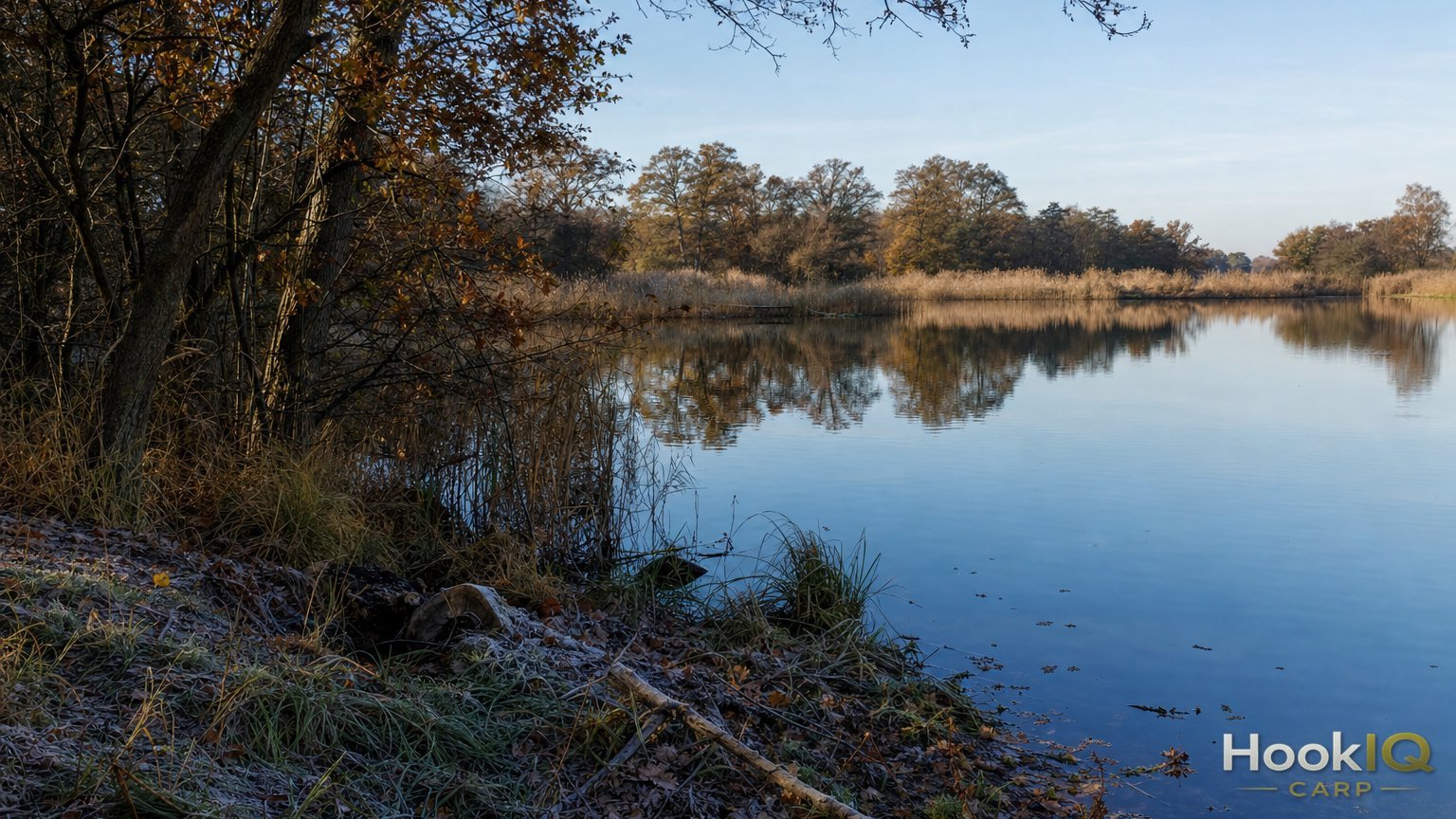
You arrive at the lake in the morning and the grass is white, there's a thin skin of ice on the bivvy, and the water is steaming gently in the first sun. The night has properly bitten for the first time this season. While you're warming your fingers around the flask, you start wondering what's actually happening two metres under your rod tip. The answer is simpler than most anglers think, once you know what to look for.
What Actually Happens Overnight
Water has one property that's crucial for understanding autumn and winter fishing: it's at its densest at 3.98°C, not at 0°C. Once the surface of a lake drops below that mark, the coldest water stops sinking and stays on top instead. The warmer, denser water around 4°C settles on the bottom. This is exactly why a lake freezes from the top down in winter, while deeper areas keep a relatively stable cushion of water all year round.
Getting there, though, is still a process through October and November. As long as the surface temperature stays above 4°C, every cold night and every gust of wind keeps mixing the water column. The summer stratification, with warm water on top and cooler water below, breaks down during this stretch. Limnologists call this autumn turnover, and depending on depth and weather it can run on into November or even December. For you as an angler, that means the lake isn't just getting colder after the first frost — it's actively on the move. The temperature layers you got used to in September simply don't exist anymore.
At the same time, the oxygen picture shifts in the carp's favour. Cold water holds far more dissolved oxygen than warm water. At around 4°C you're looking at roughly 13 milligrams per litre, compared to barely 7.5 at a summery 30°C. The oxygen squeeze that made some swims unfishable back in August resolves itself naturally come autumn. That's one of the reasons deep water stops being an oxygen trap after the first frost and becomes the preferred bolt-hole instead.
Why Carp Move Deeper Right Now
Carp are cold-blooded. Their body temperature tracks water temperature almost instantly, and their entire metabolism follows suit. At 21-25°C, digestion runs flat out and the fish feeds on whatever it finds. As the temperature drops toward 10°C, it gets noticeably sluggish. Below 8°C, metabolism slows so much that regular feeding turns into short, infrequent bursts. Around 6°C you're looking at something close to cold-induced torpor with feeding cut right back, and below 4-5°C many carp go almost completely inactive for extended spells.
Shallow water loses heat fastest on clear, windy nights — often much faster than deeper areas. That's exactly why carp retreat to 5-6 metres after the first hard frost, and in very deep lakes, down to 10 or even 13 metres. On shallower venues without that kind of depth, the rule is simple: the deepest spot you can reach is your first port of call, even if that's only two or three metres more than the rest of the lake.
There's a second factor at play. Wind pushes cooled surface water against the downwind bank and mixes it in further there. If you're sat on the downwind bank after a frosty, windy night, you're often fishing the coldest water in the entire lake. Sheltered bays facing south or south-west, on the other hand, warm up noticeably faster during the day and hold their heat better overnight. Shallow, dark-bottomed areas also soak up more solar warmth than pale, open stretches. After the first frost, these bays are often the only places where you'll still find measurably warmer water during the day.
Quick Reference: Choosing a Swim After the First Frost
| Factor | What to look for |
|---|---|
| Depth | 5-6m as a baseline, up to 10-13m on very deep lakes |
| Contours | Fish right on the shallow/deep ledge, not out in the middle of the basin |
| Wind | Avoid the downwind bank, favour sheltered bays |
| Aspect | South and south-west facing bays warm up most during the day |
| Bottom | Shallow, dark silt and clay hold solar heat better than pale, open bottoms |
The First 24 to 48 Hours: Patience, Not Panic
There's a point that gets missed a lot when anglers talk about the "post-frost feeding window": right after a sharp, hard temperature drop, carp effectively shut down for a bit first. In the first 24 to 48 hours after a sudden cold snap, bite activity is almost always at its weakest, regardless of time of day or swim choice. The fish needs to adjust to the new temperature before it starts feeding with any regularity again.
The reliable afternoon window that experienced winter anglers talk about usually only kicks in from the second frosty night onward, or after a few days settled at the new, lower temperature. Anglers who pack up disappointed straight after that first white, frosty morning often quit at exactly the moment feeding patterns are starting to settle back in. It's worth watching the other way too: if a milder front rolls in from the south-west after that first frost, bringing rising overnight temperatures for a few days, that can trigger one of the most productive feeding spells of the whole autumn — often stronger than the steady afternoon bite you get right after the cold snap itself.
The Afternoon Feeding Window
Once carp have adjusted to the new temperature regime, a very consistent pattern emerges. Water temperature doesn't peak for the day until the sun has been working on it for several hours, typically between 2pm and 5pm. That's the window — not first light — where you've got the best odds of active feeding after the first frost. This goes against the classic autumn rule that dawn and dusk are the prime hours, but that rule mainly holds while water temperature is still above 13-16°C.
After the first frost, the pattern flips. Early morning is often the coldest point of the last 24 hours and correspondingly unproductive, while late morning through early afternoon is the warmest. If you build your whole session around dawn and dusk, you're often fishing exactly the wrong part of the day once that first frost has hit.
Comparison: Feeding Windows Before and After the First Frost
| Phase | Best Time Window | Water Temperature | Feeding Behaviour |
|---|---|---|---|
| Late summer/early autumn | Dawn and dusk | 13-18°C | Regular, spread through the day |
| Right after first frost (day 1-2) | No reliable window | Highly variable | Reduced, adjustment phase |
| After first frost (from day 3) | 2-5pm | 6-10°C | Short but reliable window |
| Prolonged cold, below 4-5°C | Rare, mostly single bites | Below 5°C | Near-total inactivity |
Adjusting Bait and Feed to the New Window
With a shorter feeding window, your bait strategy needs to change too. Heavy baiting after the first frost works against you, because it fills a fish with a slowed metabolism rather than keeping it interested. In this phase I drop boilie size down to 10-16mm and cut the amount per rod back to a handful plus a bit of PVA mesh, instead of the big spod loads from early autumn. Soluble, high-attraction flavours work better than rich, oily mixes for keeping a sluggish fish interested without overloading its gut capacity. Size 6 or 8 hooks on a medium-length, supple hooklink present the bait calmly and without unnecessary resistance, which can make all the difference with cautious, cold-water carp.
One thing that's easy to overlook: not every carp reacts the same way to a cold snap. Bigger, older fish with more energy reserves often keep feeding for longer than smaller fish, which feel the cold shock more. The common myth that it's basically game over after the first frost doesn't hold up fully, then. It's precisely the biggest fish in the lake that reward sticking it out through this phase.
Five Practical Tips for the First Frost Week
- Don't expect too much in the first 24-48 hours after the cold snap — watch and wait before moving swims.
- Target 5-6 metres of depth, or the deepest spot you can reach on shallower lakes.
- Shift your session focus to the 2-5pm window instead of relying purely on dawn and dusk.
- Drop boilie size to 10-16mm and cut feed to a handful per rod.
- Avoid the downwind bank and look for sheltered south or south-west facing bays with a dark bottom.
What This Means for Your Next Session
That first overnight frost isn't a reason to pack the gear away. It's a signal to rethink swim, depth and timing. The lake changes faster during this phase than at any other time of year. Anglers who move with that shift, instead of sticking to their September autumn routine, keep catching long after everyone else has gone home.
On days like this, I'm not just checking the thermometer on the rod bag — I'm watching wind, cloud cover and how the last few nights have trended, because it's the interplay of all those factors that tells you when a short session is actually worth it. For that exact kind of read, I now use the HookIQ app, which pulls water temperature trends, wind and the most likely feeding windows for my lake into one view, instead of me piecing it together from the forecast and gut feel alone.
Pull your gloves on, give it a day or two after that first frost, and get on a sheltered, deep ledge in the afternoon on day three. The odds are better than that white, frosty morning makes you think.