
You've baited your swim, the rig is spot on, and the bite alarms are armed. Then a triangular dorsal fin slices through the surface, barely ten metres in front of you. The fish veers off. Your swim stays empty. Welcome to the world of grass carp — a fish that looks like a carp, fights like a bull, and feeds like a cow.
The Vegetarian That Isn't Actually a Carp
Let's start with a misconception that's more stubborn than a weed-tangled leader: the grass carp is not a carp. Its scientific name is Ctenopharyngodon idella, and it belongs to the family Xenocyprididae. The true common carp (Cyprinus carpio) sits in an entirely different taxonomic drawer. No barbels, a terminal mouth, a torpedo-shaped body with a strikingly large tail fin. Once you've seen a grass carp next to a common carp, you'll never confuse them again.
The grass carp originates from the Amur River system in East Asia. During the 1960s, it was introduced across Europe as a biological weed controller: a fully grown grass carp devours more plant matter per day than its own body weight. Hornwort, water lily shoots, milfoil — everything gets mowed down. Here's the kicker: it only digests around 10% of what it eats. The rest is excreted as fertiliser. In plant-rich waters, a single group of grass carp can strip the vegetation bare within a few years.
Growing up to 150 cm in length and 50 kg in weight, the grass carp ranks among the largest freshwater fish in European waters. The current record stands at 42.10 kg, caught in September 2024 in France. Fish well over the 20 kg mark are no longer uncommon in club lakes across the continent.
Why Your Carp Setup Fails on Grass Carp
If you fish for grass carp using standard carp tactics, you'll likely blank. The reason comes down to feeding behaviour. A common carp tips head-down, hoovers along the bottom, sorts, ejects, and sucks in again. Grass carp don't do that. Their mouth is slightly sub-terminal, but they don't root around in the silt. They pick up food just above the lakebed or directly from the surface. Pop-up boilies hovering two centimetres off the bottom are a much better bet than a classic bottom bait.
On top of that, grass carp bite more cautiously than any common carp. They circle the swim, approach slowly, and inhale the bait at a leisurely pace. Your bite alarms might only give you two or three quiet bleeps. If you don't react immediately, the moment is gone. It's only when you strike that the grass carp shows you what it's made of.
| Feature | Common Carp | Grass Carp |
|---|---|---|
| Family | Cyprinidae | Xenocyprididae |
| Barbels | Yes (2 pairs) | No |
| Feeding behaviour | Bottom-feeding, rooting in silt | Feeds just above bottom or at the surface |
| Bite intensity | Confident run | Subtle, often just a few bleeps |
| Reaction to landing net | Moderate run | Explosive panic |
| Mouth hardness | Medium | Very hard |
| Primary diet | Worms, snails, boilies | Aquatic plants, sweetcorn, berries |
The Right Baits: Sweetcorn Beats Boilies
Forget your expensive shelf-life boilies for now. The number one bait for grass carp is and always has been sweetcorn. Three to five grains of hard maize on a hair rig — that's often all it takes. The high carbohydrate and fat content hits the spot for this plant-eater.
Tiger nuts are the second reliable option. Two or three on the hair, job done. If you want to use boilies, go for corn-based, wheat-based, or hemp-based varieties. Fruity flavours like pineapple, plum, or strawberry work far better than the fishy flavours that common carp love.
My top summer tip: berries. On waters with overhanging mulberry trees, cherry trees, or elderberry bushes, grass carp will sit right under the branches in midsummer, waiting for something to drop in. Present a few berries as hookbait in those spots and you're fishing on a silver platter.
Setup: Bottom Rig for Grass Carp
| Component | Recommendation |
|---|---|
| Hook | Size 8–10 (smaller than standard carp!) |
| Hair length | Very short, approx. 1 cm gap to the hook bend |
| Hooklink material | 20–25 cm braided line |
| Lead | 100–140 g fixed lead (heavier than usual!) |
| Rig style | Fixed lead — no inline or running rig |
| Hookbait | 3–5 maize grains or 2–3 tiger nuts |
Why so heavy? The grass carp's hard mouth needs the resistance of a fixed lead for a clean bolt effect. With a light running rig, the fish feels the hook and ejects it before you can even react.
Surface Fishing: When the Grass Carp Looks Up
This is where it gets really exciting. On hot summer days, when the water temperature climbs above 22 °C and common carp retreat to the depths, grass carp become active at the surface. You'll see their triangular dorsal fins cutting through the water, sometimes in small groups. That's your signal.
Floating bread crust is the classic approach. A piece of white bread crust, loosely threaded onto a size 8 hook, drifts on the surface. For extra casting distance, mount a controller float on the mainline, fixed with rubber stops. The hooklink is connected via a loop or a swivel.
Popcorn works brilliantly as an alternative. A small short-shank hook with a bait stop, threaded with one or two pieces of popcorn. The gentle drift on the surface looks more natural than any boilie ever could.
The golden rule for surface fishing grass carp: never cast directly at the fish. Grass carp are extremely wary on the surface. Cast beyond the fish and let the bait drift slowly towards it. This mimics a naturally drifting piece of plant matter or a berry that's fallen into the water.
Pre-bait with a few loose pieces of bread or popcorn first. Once the grass carp start taking the freebies, place your hookbait among them. Patience is everything here.
One more detail on line choice: for surface fishing, I use a monofilament mainline in 0.28–0.30 mm. Braided line sits too deep in the water and disrupts the natural drift of the bait. The hooklink can be 60–80 cm long, so the bait drifts far enough from the controller to avoid spooking the fish.
Hot Spots: Where to Find Grass Carp
Grass carp aren't loners. They cruise in loose shoals and follow a clear seasonal pattern that shifts throughout the year.
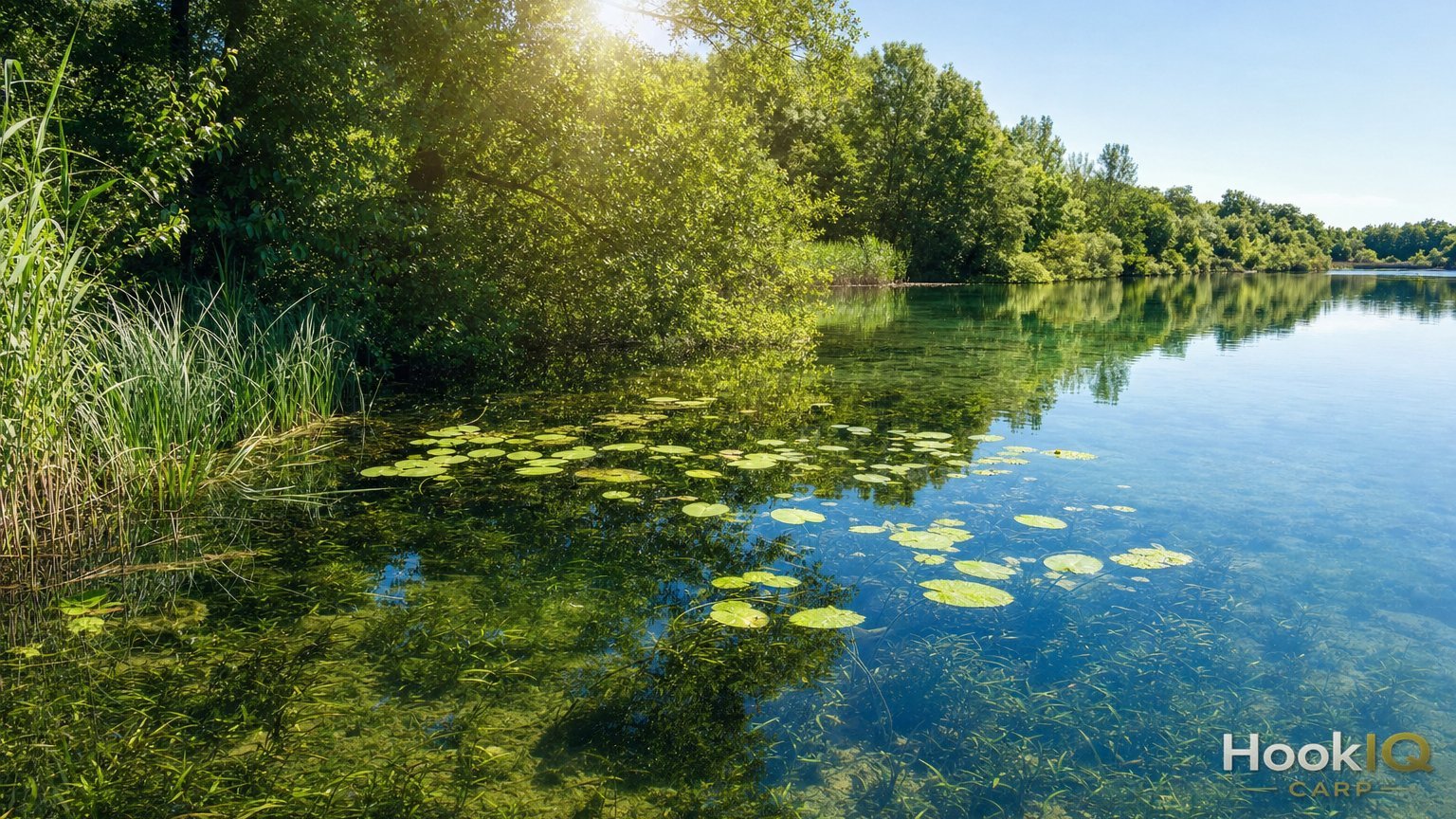
May and June: Shallow margins are your first port of call. Areas with weed growth and a hard bottom — no silt. Grass carp don't root around; they need firm ground beneath them. Look for spots where lily pads or hornwort grow. That's where the table is set for this vegetarian.
July and August: The holding spots shift now. Overhanging trees and bushes become magnets, especially those dropping berries or seeds into the water. At the same time, grass carp love sunbathing. On calm, sunny afternoons, you'll often find them cruising in the upper layers of shallow bays.
Autumn: Shaded spots under trees, inflows with slightly warmer water. Activity drops off once the temperature falls below 16 °C. In late autumn, below 10 °C water temperature, targeting grass carp specifically is rarely worth the effort.
Water Types Compared
Not every water holds grass carp. Your best chances are in club lakes and gravel pits that were deliberately stocked during the 1970s and 1980s. Ask the club whether grass carp were stocked and when. Since grass carp don't reproduce naturally in most European climates, populations only exist where fish were actively introduced.
Rivers with grass carp are rare, but they do exist. Canals and slow-flowing river stretches with warm water can harbour surprisingly good populations. The fish tend to hold in slack bays and behind groynes where weed and plant debris accumulates.
In reservoirs, focus on the shallow foreshore areas where the water heats up quickly in summer. The deep centre is of little interest to grass carp. They need plant growth and warmth — both are found more readily in the margins.
Watch out for these tell-tale signs on the water:
- Weed beds with grazed edges (a sure sign grass carp are active)
- Overhanging vegetation where berries or seeds collect
- Shallow bays with a hard bottom and water temperatures above 20 °C
- Spots where you can see triangular dorsal fins breaking the surface
Pre-Baiting: More Is More — But Not on the Day
The baiting strategy for grass carp is fundamentally different from classic carp fishing. Three to five days before your session, bait the swim heavily. Seven to ten kilograms per day is no exaggeration. The mix consists of 70% soaked hard maize and 30% tiger nuts, supplemented with wheat, corn, or molasses pellets.
On the fishing day itself, cut the quantity by 70%. The logic is simple: you want the fish to arrive at the swim hungry and find your hookbait before they fill up. If you bait just as heavily on the day as you did in the lead-up, the grass carp will stuff themselves on free offerings and ignore your hookbait entirely.
Preparing hard maize properly: two days beforehand, place it in a sealed bucket of water and leave it to soak. The finished maize should be slightly sour and soft enough to thread on a hair rig, but firm enough not to fly off during the cast.
Playing the Fish: Expect the Unexpected
You've got a bite. The bleeps were quiet, almost tentative. Then you strike. And from this point on, different rules apply.
A grass carp on the end of your line is a force of nature. Long, brutal runs that have your clutch screaming. No head-shaking, plodding fight like a common carp. The grass carp runs and runs. And just when you think it's tired and you lower the landing net into the water — it explodes. That final surge right in front of the net is legendary. Many grass carp are lost at exactly this moment.
My tip: take your time. After what you think is the last run, wait another 30 seconds before showing the net. Always use a padded unhooking mat. After the fight, check your hook point for sharpness. The grass carp's hard mouth blunts hooks faster than any other freshwater fish.
5 Practical Tips That Make the Difference
- Hook size 8–10 instead of 4–6. The grass carp's hard mouth needs a smaller hook that finds precise purchase in the scissors. Larger hooks bounce off.
- Lead weight at least 100 g. The bolt effect only works on grass carp with sufficient resistance. With a 60 g lead, the fish ejects the hook before you can strike.
- Keep the hair extremely short. Maximum 1 cm between the hook bend and the bait. Grass carp suck in cautiously and need immediate hook contact.
- Fish between 10 am and 2 pm. In midsummer, grass carp are most active during the warmest hours — exactly when most carp anglers take their lunch break.
- Scan for triangular dorsal fins. Before choosing your swim, watch the water for half an hour. That distinctive fin tells you where the grass carp are patrolling.
Conclusion
Grass carp reward anyone willing to break out of their usual patterns. Smaller hooks, heavier leads, plant-based baits, and the willingness to fish on the surface. If you can spot the right swims in midsummer and bring the patience to outwit one of the wariest freshwater fish out there, you'll be rewarded with fights you won't forget in a hurry. I like to use the HookIQ app for this — it shows me the combination of water temperature, time of day, and conditions at a glance, so I can focus entirely on observation.