
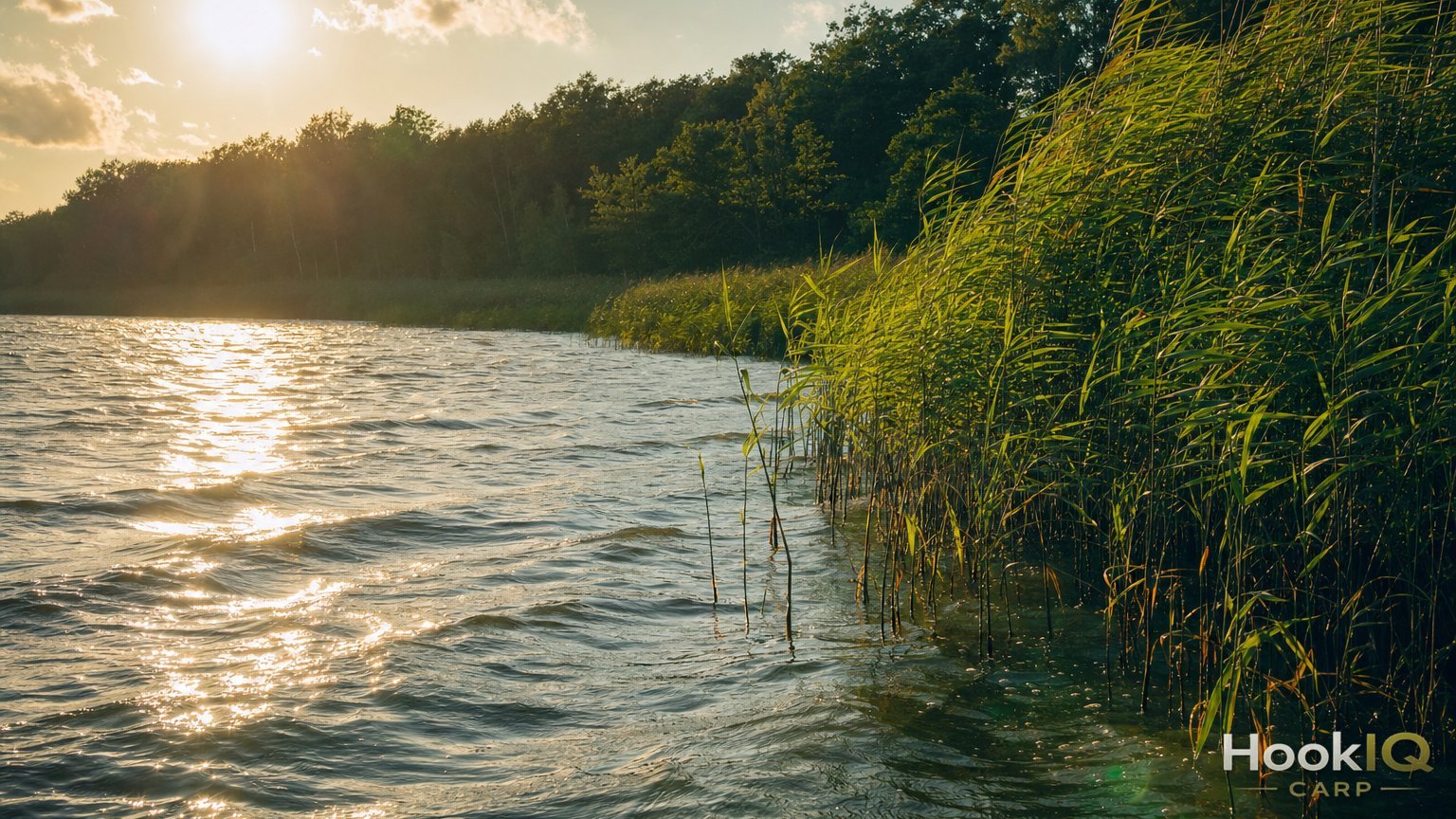
There are those August days when the air is already still by morning and the heat shimmers over the water. The bivvy turns into a sauna, the water feels lukewarm like a bath, and the lake lies mirror-flat and seemingly dead. Plenty of anglers think: high summer, warm water — surely these are dream conditions for carp. And then they sit through an entire scorching afternoon behind silent rods, unable to make sense of the world.
The mistake comes down to a single misunderstanding. Back in January I wrote from this same spot about deep holes and sheltered, wind-protected bays, because that's where the fish look for warmth and calm. In August almost every one of those rules flips on its head. The carp is now hunting for movement, freshness and, above all, oxygen — not the sheltered, stagnant corner. Understand that, and in the height of summer you fish with the carp instead of against it.
In this piece I'll break down two types of spot that produce almost every time in August: the windward bank, where fresh, oxygen-rich water pushes up against the margin, and the cooler thermocline, where the fish hang out in open water when the heat is brutal. Both work — but for completely opposite reasons.
Why Warm Water Suffocates Carp
Let's start with the physics, because it explains almost everything that happens on the bank in August. Cold water can dissolve a lot of oxygen; warm water far less. At 15 °C, a litre still holds around 10 milligrams of oxygen. At 20 °C it's about 9, at 25 °C only just over 8, and when a shallow bay heats up to 28 or 30 °C, barely over 7 milligrams are left. So the supply shrinks at exactly the moment the fish needs it most.
Because here's the second factor. Carp are cold-blooded — their body temperature tracks the water almost one to one. The warmer the water, the higher their metabolism and the more oxygen they burn just sitting still. Warm water offers less oxygen while the fish demands more. That squeeze is the real reason high-summer carp often seem more sluggish than the water temperature would suggest.
On hot, windless days this becomes critical in rich, productive waters. At night there's no photosynthesis, but plants, algae and micro-organisms keep breathing and eating into the reserve. Oxygen levels drop to their daily low in the early hours. If an algal bloom collapses during a long hot spell, the level can crash right down. Below roughly 4 milligrams per litre carp stop feeding; below 3 it gets serious for them. That's exactly what lies behind the summer fish kills you read about during heatwaves.
The Windward Bank: Fresh Oxygen and a Laid Table
The first — and for me the most important — August spot is the windward margin. The moment even a light breeze drifts across the lake, several things happen there at once, all of them in the carp's favour.
The wind pushes the warm, oxygen-poor surface layer against the bank and forces it downward, while cooler water rises up. Above all, though, the ruffled, moving surface constantly tears oxygen out of the air and into the water. On a muggy August day the windward side of a lake can carry one or two milligrams of oxygen per litre more than the calm bank opposite. To a fish gasping for air, that's a magnet.
On top of that comes the laid table. The surface drift carries plankton, washed-in natural food and particles suspended in the water against the windward margin. Where food and oxygen come together, the small stuff gathers — and the carp follow.
What I look for when picking a windward bank:
- An off-shore wind blowing straight into your face. As uncomfortable as it is to fish into the wind, that's precisely the bank I want to be on. The comfortable peg with the wind at your back is almost always the poorer choice in August.
- A weed edge or reed line within casting range. Aquatic plants pump out oxygen during the day and shelter snails, larvae and freshwater shrimp. The seam between weed and open bottom is one of the best addresses of the whole summer.
- Incoming fresh water. An inflow, a stream, even the outflow of a spring brings cooler, oxygen-rich water. In the heat the fish will often sit right in front of it.
A warm, strong summer wind that blows from the same direction for two days is, for me, the most reliable tell there is in August. That's when I pack up and move to the side it's pushing against.
Setup for the Windward Bank
> Spot: Windward margin, 1.5 to 4 m, along a weed or reed edge, ruffled surface > Best time: Early morning and the cooler evening hours; on overcast, windy days it can fish through the day too > Bait: An active, digestible boilie in fish or spice, 15 to 18 mm, with a bright wafter as the hookbait > Feed: Bait steadily — the fish feed well in warm water — alternating small boilies and particle > Rig: A simple combi or blowback rig, hook size 4 to 6, kept short over the weed > Key point: Use PVA so the hookbait sits cleanly on the weed edge and doesn't sink into it
The Thermocline: Why the Carp Hang in Open Water
The second type of spot isn't a place on the bottom at all. It's a layer of water. To understand it, you need to know what happens in a deeper lake at the height of summer.
The sun heats the top few metres hard, and because warm water is lighter, it stays sitting on top. Below it, a remnant of cold, heavy water lingers from spring. Between the two, a narrow transition zone forms where the temperature drops steeply over just a few metres. That's the thermocline. In many gravel pits and reservoirs it sits somewhere between three and six metres deep in August.
For spot selection this is decisive, because here the winter rule reverses completely. In January the deep bottom is the stable warm zone where the fish overwinter. In August that very same deep bottom is often a dead zone. Below the thermocline there's barely any exchange with the surface, photosynthesis is absent in the darkness, and breathing organisms use up the last of the oxygen. In many stratified lakes the deep water is practically oxygen-free by late summer. Not a single carp on earth chooses to sit down there.
Instead the fish holds at the upper edge of the thermocline. There it finds a compromise between a bearable temperature and still-adequate oxygen — and it's precisely in this layer that it often suspends far out in open water, high above the bottom. Fish rigidly on the deck in August and on many waters you'll cast your hookbait clean underneath the fish.
The answer to that is the Zig Rig. A long hooklink with a buoyant foam or pop-up hookbait presents the mouthful at exactly the depth where the fish are holding. The trick is finding the right height. I feel my way in by fishing different hooklink lengths, often between two and four metres below the surface. When a take comes, I know what depth it's happening at and adjust the other rods to match.
The Fish in Warm Water: Active, But With Limits
To read both spots properly, it helps to look at what's going on inside the carp in August. After spawning in early summer the fish are famished and spend the warm months building reserves back up. So August is a feeding phase. Only the heat draws a firm ceiling over it.
The rough thresholds I work to look like this:
| Water temperature | State of the carp | What it means for you |
|---|---|---|
| 16 to 20 °C | very active, feeding constantly | full rations, bait on the bottom produces |
| 20 to 24 °C | optimum, high turnover | feed generously, every method works |
| 24 to 27 °C | active, but oxygen-dependent | look for wind and weed, check open water |
| 27 to 30 °C | sluggish, avoids warm shallows | fish the thermocline, night and morning |
| over 30 °C | heat stress, barely feeding | early morning hours, cool fresh water |
These numbers aren't hard laws — every water ticks differently. But the direction holds. In warm water carp feed far more than in winter, digest faster and actively search for food. That's why in August you can bait up with confidence, quite unlike January. Only when the heat sits for days and oxygen runs short does the activity tip over — and then everything shifts to the cooler margins of the day.
Timing: The Night and the Early Morning Are Yours
In January you wait for the one warm hour in the afternoon. In August it's exactly the other way round: the hot midday and afternoon sun is the hardest time, and the cool hours are the gold.
As the evening draws on the air temperature falls, the shallows slowly cool, and the fish move actively back over the feeding grounds again. All through the night, often well into the early morning, the best bite is on. Dawn is one of the most reliable windows of the whole high summer, because the water is at its coolest then and the fish are still on the move after their night-time patrol. There's one small catch: oxygen in the water hits its daily low at first light, which is why in oppressive heat I'd rather fish the wind-blown, weedy zones than the still, deep corners.
I don't write off the full midday heat entirely, but I switch tactics. Then it's either the Zig rod working the cooler open water, or — in calm, warm weather — I'll put out a surface setup. Floating baits on the top are one of the finest methods of the summer, because on windless afternoons carp love to sit up high and bask. Scatter a few floating pellets and you'll watch the fish come.
To save myself constantly doing the maths on these windows, I let the HookIQ app pull water temperature, wind, air pressure and time of day together for me. Especially in August, when heat, oxygen and wind direction are so tightly linked, it helps me see the promising windows at a glance instead of juggling three weather apps. The fish still gets the final say, of course — but I spend far less time standing in the blazing midday sun on the wrong bank.
Windward Bank or Thermocline? The Direct Comparison
| Criterion | Windward margin | Cool thermocline |
|---|---|---|
| Where | shallow to mid-depth margin | open water, upper edge of the layer |
| Oxygen | high, from wind and weed | moderate, but better than on the bottom |
| Best condition | warm, steady wind | oppressive heat, windless lakes |
| Best time | night, morning, windy days | hot midday and afternoon |
| Method | bottom rig on the weed edge | Zig Rig in mid-water |
| My approach | bait to the fresh edge | find the height, then adjust |
My advice, nice and concrete: if a warm summer wind is blowing across the lake, I pack up and move to the windward side, to the nearest weed edge. But if the lake lies mirror-flat and dead under brutal heat, I go looking for the fish in the cooler open water with the Zig rod. If you can split your rods, put one on the windward bank and send the other into mid-water. That way you cover both patterns of behaviour and work out faster what the fish are on that day.
Conclusion
August asks something different of the carp angler than winter does, but it rewards the same thing: the one who reads their water. In warm water the fish feeds full and active, yet the heat pins it into a narrow window of oxygen and temperature. Hunt it where fresh water pushes against the bank, or in the cooler layer out in open water, and hit the cool hours from evening to morning. Do that, and high summer will hand you the strongest, best-conditioned fish of the whole year.
Drink plenty, grab some shade over the midday, and don't let the heat throw you off your game.