
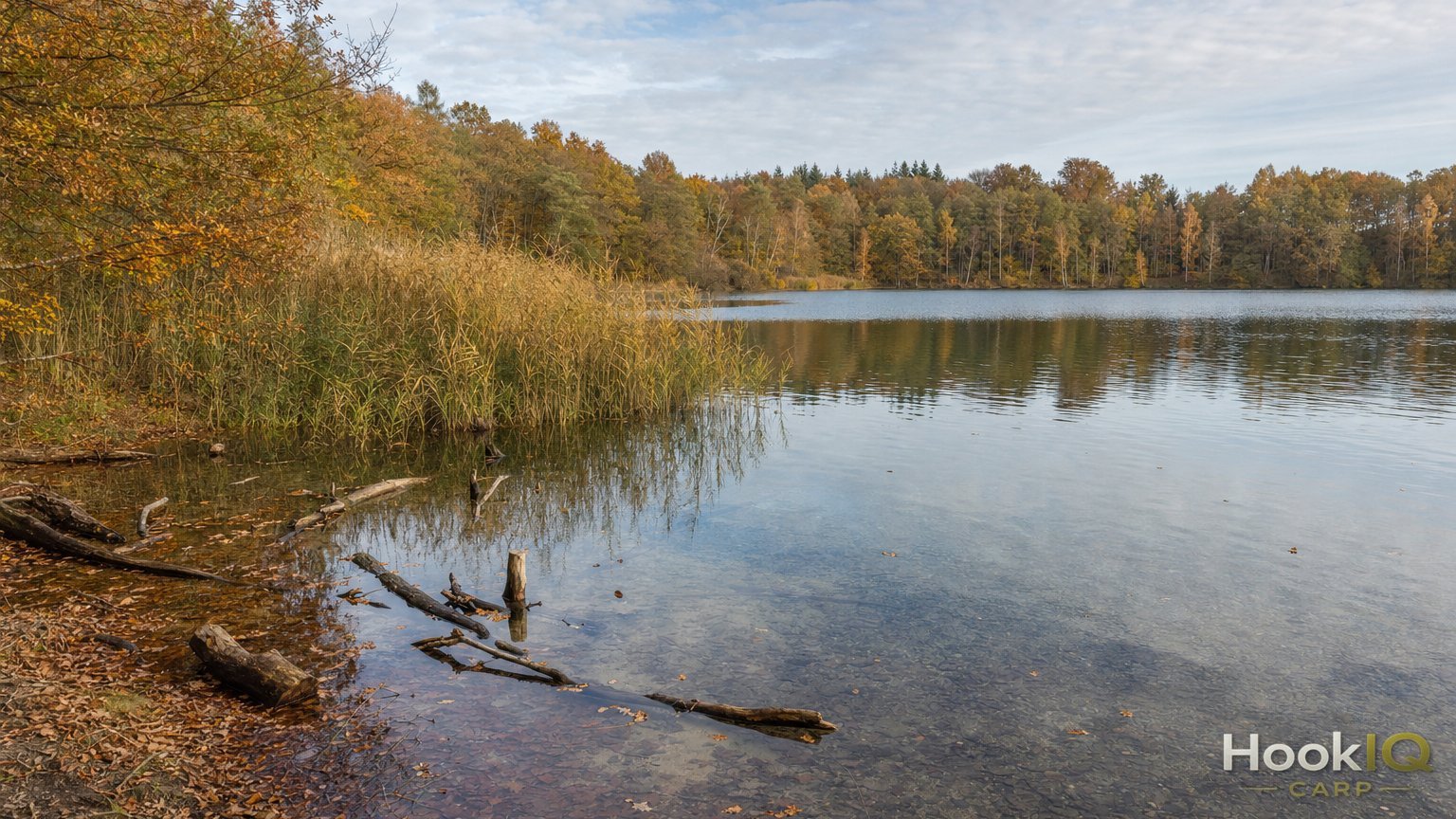
Mid-October, line barely settled after the cast, and the first run comes before your coffee's even gone cold. That's what a swim feels like when it's truly switched on. You probably know the opposite too: two kilos of bait chucked in in a hurry, one session, nothing happens. The difference isn't luck on the day — it's the plan you put in place weeks earlier.
Autumn is the season where that plan pays off the most. Carp are laying down reserves for winter now, the feeding window is wide open, and the fish are willing to commit to a spot over several weeks. But that's exactly what makes autumn the trickiest season to get wrong. Feed too much, too little, or on the wrong rhythm, and you waste the best season of the year. And if you're doing this on club water without talking to the committee first, you're risking more than just an empty swim.
Why Autumn Needs Its Own Timeline
Carp don't feed at a steady rate through autumn. As long as the water sits between 14 and 16°C, you're in the real feeding frenzy — the fish are laying down their biggest reserves for winter. With every degree the temperature drops after that, appetite gets more cautious, and the drop-off happens in clear stages.
| Water Temperature | Feeding Behaviour | Bait Per Session |
|---|---|---|
| 14–16°C (57–61°F) | Feeding frenzy, final big reserve-building phase | 2–4 kg (4.5–9 lb) |
| 10–13°C (50–55°F) | Still active, but pickier | 1.5–2.5 kg (3.5–5.5 lb) |
| 6–9°C (43–48°F) | Noticeably reduced, cautious | 0.5–1 kg (1–2 lb) |
| Below 6°C (43°F) | Almost shut down, only opportunistic | A handful to 0.5 kg (1 lb) |
This table isn't gospel, it's a framework. A shallow gravel pit cools down faster than a deep quarry lake, and a sudden cold snap can shift these stages within days. That's why I check the temperature on every feeding day before I even pick up the throwing stick. Ten minutes of effort that decides whether the swim is still producing in three weeks or already overfed.
The Rhythm: Weeks Before the Actual Session
A swim that's meant to produce in November doesn't get built the weekend before. I plan two to four weeks ahead, depending on how hard the water gets fished and how fast the carp respond to new feeding spots. On heavily-fished club waters it often takes longer for a swim to establish, because the carp have grown more wary from constant disturbance.
The rhythm itself is simpler than most people think. Every two to three days, ideally at the same time of day, the same amount in the same spot. That consistency matters more than the absolute quantity. Carp learn patterns, and a swim that reliably delivers food becomes a go-to spot faster than one that gets fed heavily one day and barely at all the next. One important catch: on most club waters, you're not allowed to just top up a swim in passing — more on that below. That's why, from the start, I plan every baiting trip as a short but genuine fishing session with a rod in the water, even on days I'm not really expecting a take.
After the actual build-up comes the part most anglers skip: the rest period. I fish a freshly-established swim with light tackle and low expectations for the first two weeks, then at most once a week with full gear after that. Every extra intensive session means noise, lead landing in the swim, and movement over the spot — exactly what you want to avoid while the fish are still committing to the area.
Setup Box: Four-Week Roadmap for the Autumn Swim
- Week 1: Pick the swim, feature-find it with the marker rod, run two to three short test sessions with a moderate amount of bait matched to water temperature
- Week 2: Lock in the every-2-to-3-days rhythm, bump the amount up to 2–4 kg depending on water temperature, keep fishing a rod while you feed
- Week 3: Hold the feeding amount steady, fish it lightly, focus on watching the swim (bubblers, showing fish)
- Week 4: Last feed two days before the main session, then start the first serious session with a reduced hookbait presence
The Amount: Scale It, Don't Guess
How much bait belongs on a swim depends far more on the water than on internet rules of thumb. On an average club lake of two to three hectares (5–7 acres), two to four kilos of boilies or particles per feed, spread over roughly a 10x10 metre area, is usually enough in October. On big lakes or rivers, experienced anglers work with far bigger numbers — on Germany's River Elbe, for instance, anglers talk about twenty to forty kilos of sweetcorn on a three-day rhythm. These figures don't transfer directly, they just show how wide the gap between different types of water really is.
The rules for starting a session are different from the rules for the weeks-long build-up. Until I land my first fish, I introduce a maximum of half a kilo per rod, then top up with around a kilo after that. If the temperature drops below 8°C during the session, I go straight back down to the smaller amount. Overfeeding is the most common autumn mistake, because the temptation to pile more in right after the first fish is strong.
Fishmeal boilies are my base in autumn, often with a carbohydrate component added that stays easier to digest as temperatures keep falling. Particles like sweetcorn, hemp, or crushed tiger nuts still work well between 8 and 14°C; below that, the risk rises that uncooked or oily particles cause problems in a carp's gut. Below 8°C I switch to crumb and small, easily digestible baits instead of whole boilies.
Whether you feed a tight square metre or spread it over a full 10x10 metre area is ultimately down to preference and depends on the water. A tight spot holds fish closer together, but you need to cast more precisely, and you risk one big fish hogging the whole swim. Spreading it wider prevents that, but needs more bait overall because the amount gets diluted over a bigger area. On small club waters with several members fishing the same bank, I've come to prefer the wide-spread approach these days, simply because it causes less friction when someone else is sitting nearby at the same time.
Marker Rod Control: What the Rod Actually Tells You
A marker rod is essential for a long-term swim, but not as a tool for checking whether the bait's already been eaten. What it's genuinely good for is showing you depth, bottom composition, and features — that's its real strength. I use it before the first feed to check whether the swim has gravel, silt, or a drop-off, and I mark any features on the sounder or a GPS app.
For working out whether fish are sitting over the swim and whether the last feed has already gone, I use other tools. An underwater camera gives more honest answers than any feeling you get winding in a marker float. Where that's not possible, I watch for bubblers, showing fish on the surface, and how much resistance the lead still meets from leftover bait on the next recast.
If you mark the swim with a marker buoy to find it again, don't leave it sitting directly over the bait. Three to four boat-lengths off, in the direction you'll be casting, is enough to stop a carp picking up the line and towing the buoy off. Otherwise you lose the marked spot, and in the worst case, you injure the fish.
It's also worth using the marker rod to check several possible rod positions at different depths, not just the one main spot. On a lake with a maximum depth of nine metres (about 30 ft), I like fishing three staggered depths in autumn — say, three and a half, six and a half, and seven and a half metres. The reason is air pressure. In high pressure, fish often sit higher in the water column; in low pressure, they drop back down deeper — and if you only fish one depth, some days you'll simply miss the zone the fish are actually holding in.
Clearing It With the Fishery: The Step Most Anglers Skip
This is the most important point in the whole plan, and it has nothing to do with bait or rhythm. On a lot of German club waters, pre-baiting without actively fishing at the same time is explicitly against the rules. Usually only baiting during an active fishing session is allowed — not loading up a swim without a rod in the water. That's exactly why I plan every baiting trip, as described above, as a short but genuine fishing session rather than just driving past with a bait bucket. Some fishery rules also cap the amount at around a litre of dry feed per session, some allow more, some far less. Regulations and club rules vary a lot by fishery and country, so always check your own water's rules before you start.
Before I build an autumn swim over several weeks, I call the bailiff. That five-minute phone call can save you a disciplinary headache, and it clears up the second tricky question straight away: whether other members are already using the same area. A swim you've built up over weeks starts to feel like your personal territory — but it legally isn't. The grey area between an informal claim and the actual club rules is one of the most common sources of friction on shared waters, and sorting it out beforehand means you fish far more relaxed than someone who has to justify themselves after the fact.
In practice that means: clear your choice of swim with the committee, match your feed quantities to the fishery rules, and when in doubt, ask one time too many rather than go over the limit once too often. A club that sees you sticking to the rules gives you more leeway on the next project.
Practical Takeaways
A few numbers that have worked well for me over the last few years:
- Plan at least two weeks ahead, ideally three to four, before your main session
- Feed every two to three days, at the same time of day
- Scale the amount to water temperature: 2–4 kg at 14–16°C, 0.5–1 kg at 6–9°C, just a handful below that
- Two weeks' rest after the build-up, then at most one session a week
- Keep your marker buoy three to four boat-lengths from the actual swim
- Talk to the bailiff or committee before starting, and check the fishery's quantity limits
Conclusion
An autumn swim that actually works needs two to four weeks of patience. A single well-timed session on its own won't do it. Stick to the rhythm, scale the amounts to water temperature, and use the marker rod to read the bottom and the features, and you'll build a spot that keeps producing through the whole of autumn. And if you've talked to your club beforehand, you can fish that swim without the risk of someone suddenly turning up at the water with the fishery rules in hand.
These days I plan these weeks by keeping an eye on water temperature and air-pressure trends alongside the calendar, and for that I've settled into using the HookIQ app without much fuss, because it pulls both together at a glance and shows me which days are most likely to be worth a feed or a session. The rest — the conversations with the bailiff and the patience at the water — I still have to bring myself.