
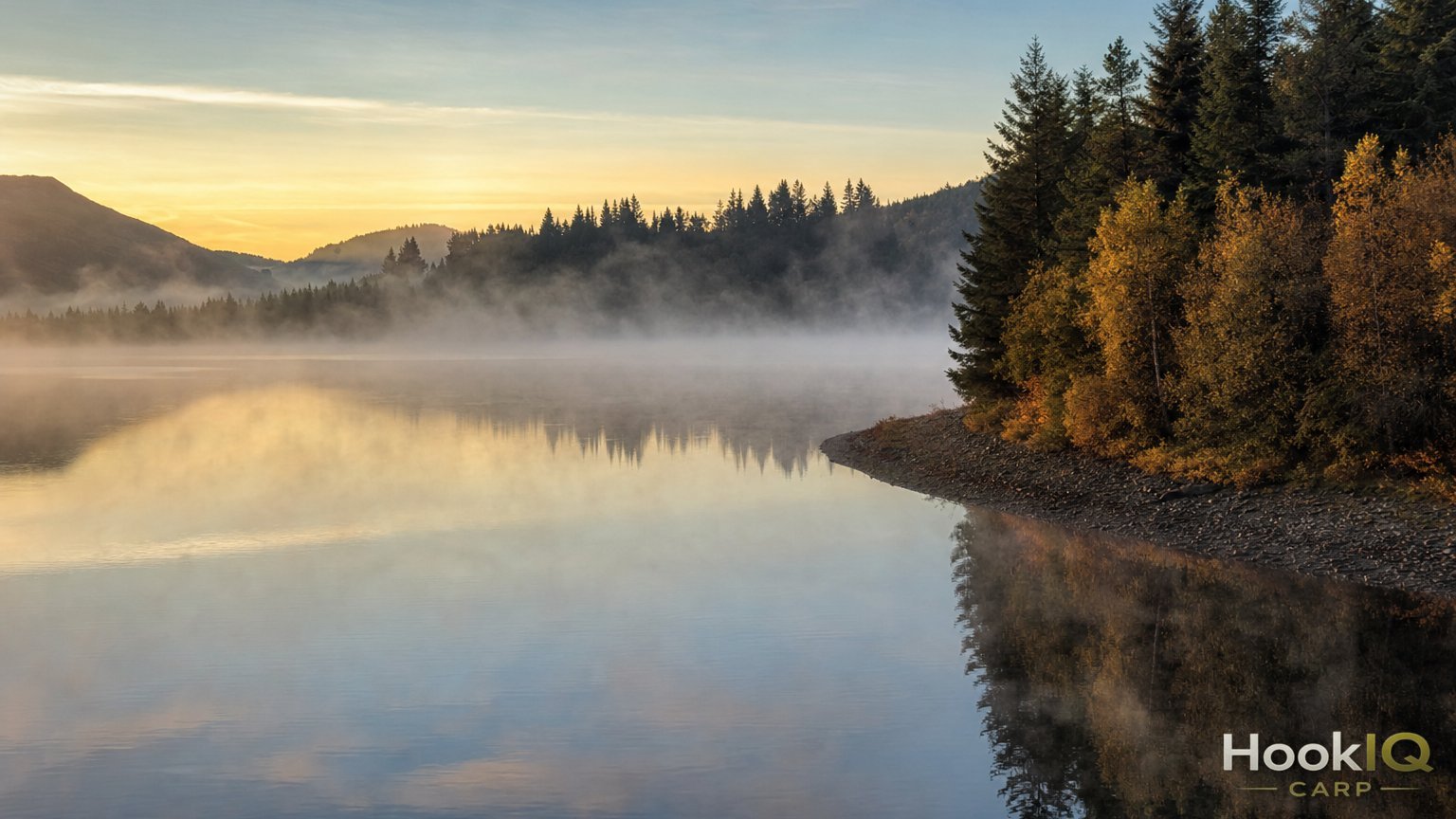
Dreaming of a session in France but can't justify 500 euros a week for a pay-lake? I've got good news. France has a vast network of public waters where a single fishing permit lets you set up legally and affordably. No booking, no waiting list, no swim fee. Just you, your bivvy, and a lake bigger than some English counties.
I've been fishing public water in France regularly for over 20 years. Most of my best sessions happened on lakes that barely anyone talks about, because everyone is fixated on the well-known syndicate waters. In this article, I'll walk you through step by step how to fish legally on French public lakes, which Carte de pêche you need, what the Domaine public actually means, and how to find the right spot once you arrive.
The Carte de pêche: Your Key to French Waters
In France, there's no fishing exam or licence test like in Germany. No course, no paperwork, no government office. What you need is a Carte de pêche. Technically, it's a membership of a local AAPPMA (the French equivalent of an angling club), which doubles as your fishing permit.
You can buy it online at cartedepeche.fr, at a local tackle shop, at a tourist office, or even at a tobacconist.
How Much Does the Carte de pêche Cost in 2026?
| Permit Type | Price | Rods | Validity |
|---|---|---|---|
| Carte Interfédérale | €114 | 4 rods | 1 year, 91 départements |
| Carte Personne Majeure | €87 | 4 rods | 1 year, 1 département + reciprocity |
| Carte Découverte Femme | €42 | 1 rod | 1 year, 91 départements |
| Carte Hebdomadaire | €36.50 | 4 rods | 7 days |
| Carte Journalière | €18 | 4 rods | 1 day |
| Carte Mineure (12–18 yrs) | €27 | 1 rod | 1 year |
| Carte Découverte -12 ans | €8 | 1 rod | 1 year |
For a one-week trip, the Carte Hebdomadaire at €36.50 is the smartest choice. It gives you access to all public waters in the relevant département and allows up to 4 rods. If you visit France several times a year, the Interfédérale at €114 covers 91 of the 95 départements.
For comparison: a week on a pay-lake will easily set you back €250 to €500 — just for the swim. The Carte Hebdomadaire covers waters that together span tens of thousands of hectares.
Domaine Public: Where You Can Fish Without Booking
This is where it gets important. Not every water in France is automatically open access. You need to understand the difference between Domaine public and Domaine privé.
Domaine public fluvial covers all navigable rivers and canals, major reservoirs, and their tributaries. Fishing rights belong to the state, which transfers them to the local AAPPMAs. Your Carte de pêche is all you need — no additional permission required. The Seine, the Saône, the Lot, the Moselle, and hundreds of other rivers fall under this category, along with the large reservoirs.
Domaine privé means the riparian landowner holds fishing rights up to the centre of the waterway. Even here, an AAPPMA may have leased the fishing rights, so your Carte de pêche still gets you in. The key point: the majority of French waters technically fall under Domaine privé, but as long as the AAPPMA holds the lease, you won't notice the difference.
There's also the distinction between Eaux libres (open waters naturally connected to other waterways) and Eaux closes (isolated, enclosed waters). On Eaux libres, the Carte de pêche is always required. Eaux closes — for example, a fenced pond with no inflow or outflow — fall under private law and often require separate permission.
In practical terms for carp anglers: large reservoirs, rivers, and canals are almost always Domaine public or at least fishable with the Carte de pêche through the AAPPMA. And these are exactly the waters where the big fish swim.
The Rules: What You Need to Know
France is more relaxed than many European countries, but there are clear rules. Break them and you risk fines. Here are the key points for carp anglers:
Rods and Hooks
On Category 2 waters (cyprinid waters — i.e. all typical carp lakes), you can fish with up to 4 rods if you hold the Interfédérale or Majeure permit. Each rod may carry a maximum of 2 hooks. All rods must be set up within 20 metres of your fishing position.
Night Fishing
As a general rule, fishing in France is prohibited from 30 minutes after sunset to 30 minutes before sunrise. For carp anglers, there's an important exception: each département can authorise specific stretches for night fishing on carp by prefectural decree. These stretches are reviewed and updated annually.
The restrictions for night anglers:
- Only plant-based baits allowed (boilies, sweetcorn, tiger nuts). Worms and maggots are off limits at night.
- Carp must not be retained in keepnets at night under any circumstances. Catch, photograph, release.
- Your swim must be illuminated at night.
- Night fishing for carp in France always means no-kill. No carp may be taken.
The 60 cm Rule
France has no national minimum size for carp. However, the live transport of carp over 60 cm in length is prohibited. This effectively creates a nationwide no-kill rule for big carp. Every fish over 60 cm must be returned immediately.
Season
Category 2 waters are open year-round, from 1 January to 31 December. So there's no closed season for carp anglers. Night fishing stretches, however, often have their own windows — typically from March or April through to October or November.
Exclusion Zones
Fishing is prohibited within 50 metres upstream and downstream of lock installations. This mainly affects canal and river stretches.
Five Public Lakes That Don't Require Booking
Here are five reservoirs you can fish with a Carte de pêche. No syndicate, no pay-lake, no waiting list.
| Lake | Département | Area | Night Fishing | Highlight |
|---|---|---|---|---|
| Lac de Pareloup | Aveyron | 1,290 ha | Yes | Low pressure, plenty of 50 lb+ fish |
| Lac de Vassivière | Creuse/Haute-Vienne | 1,000 ha | Yes | Lake record 64 lb, varied bank features |
| Lac du Salagou | Hérault | 750 ha | Yes | Records over 66 lb, striking red earth |
| Lac de Montbel | Ariège | 570 ha | Yes (check stretches) | Pyrenean foothills, plenty of 44 lb+ fish |
| Lac de Madine | Meuse | 1,100 ha | Yes (check stretches) | Lorraine region, good mixed stock |
Pareloup: My Personal Favourite
Lac de Pareloup in the Aveyron is, in my opinion, one of the most underrated carp waters in France. At 1,290 hectares, it holds a mixed stock of roughly 60% mirrors and 40% commons, with fish over 25 kg a regular occurrence. What makes it special is the comparatively low angling pressure. While Lac du Der gets packed with anglers, at Pareloup you'll often have hundreds of metres of bank all to yourself.
Two Well-Known Lakes with Important Restrictions
Lac de Saint-Cassien (Var, 450 ha): Cassien is legendary. Record carp over 30 kg, crystal-clear water, Mediterranean climate. But since summer 2012, night fishing has been permanently banned. Bivvys and tents are also not allowed. You can only fish during the day, and the western arm is completely closed from January to June. Only electric motors are permitted. Still worth a day session, but don't plan any overnighters.
Lac du Der-Chantecoq (Marne/Haute-Marne, 4,800 ha): France's largest reservoir offers free daytime access with a Carte de pêche. However, the 35 night fishing swims must be reserved in advance. Registration opens on 1 July by email to the Maison des Pêcheurs. For daytime fishing, no booking is needed.
Finding Your Spot: How to Locate the Right Swim
This is the part that separates a successful session from a frustrating blank. How do you find the right spot on a lake you've never visited before?
Before You Leave: Digital Preparation
Geocarp.fr is the best resource for night fishing stretches. The site lists over 1,300 GPS-validated spots across France, all with linked prefectural decrees. You can instantly see whether and when night fishing is allowed and exactly where each stretch begins and ends.
Fédération de pêche for the relevant département: each of the 95 départements has its own website with water maps, regulations, and lists of night fishing zones. Simply search for "fédération pêche" plus the département name.
Google Maps Satellite: Use it to scout bank access points, car parks, and promising features — bays, islands, points, sunken trees. On large reservoirs, satellite imagery often reveals old river beds that become exposed at low water levels.
On the Bank: Making the Most of Your First Hours
Don't just drive to the nearest bit of bank and cast out. Take the first two to three hours for a recce.
- Drive the banks. Large reservoirs often have multiple access points. Some swims are only reachable via dirt tracks. These spots see less pressure and are often more productive.
- Talk to local anglers. French anglers are usually happy to help if you ask politely. Even a few words of French go a long way. "Bonjour, il y a des carpes ici?" is enough to get the conversation started.
- Look for signs. Rolling carp, bubbles on the surface, clouds of silt near the margins. On large reservoirs in summer, carp tend to congregate in the shallower bays, especially during the early morning and evening.
- Watch the wind. Most anglers set up on the sheltered bank because it's more comfortable. But the windward bank often produces better, because that's where the food gets pushed.
- Use an inflatable boat. On reservoirs over 500 hectares, a dinghy with an electric motor is a massive advantage. You can reach spots that are inaccessible from the bank and map out features and depths with your fish finder. Check the boat regulations for the specific lake beforehand.
Useful Online Resources at a Glance
| Resource | What You'll Find | URL |
|---|---|---|
| Geocarp.fr | 1,300+ night fishing stretches with GPS and decrees | geocarp.fr |
| Cartedepeche.fr | Buy your Carte de pêche online | cartedepeche.fr |
| Fédération de pêche (per dép.) | Water maps, local regulations | Search: "fédération pêche + département" |
| PublicFishingFrance.com | Public waters by département | publicfishingfrance.com |
| Google Maps Satellite | Bank access, features, car parks | maps.google.com |
Checklist: What You Need for Your Trip
Before you set off, make sure you've ticked off the following:
- Carte de pêche purchased online (cartedepeche.fr) or planned to buy on arrival
- Photo ID with you (required alongside the Carte de pêche during checks)
- Night fishing stretches verified at your target water (Geocarp.fr or Fédération de pêche)
- Local special rules checked (boat restrictions, closed bank sections, nature reserves)
- Plant-based baits packed for night fishing (boilies, particles, sweetcorn)
- Unhooking mat and soft mesh landing net ready (mandatory for no-kill)
- Head torch for the overnight lighting requirement
What Does a Week in France Actually Cost?
To wrap up, here's the maths that surprises most people:
| Item | Public Water | Pay-Lake |
|---|---|---|
| Fishing permit for 1 week | €36.50 (weekly permit) | €250 to €500+ |
| Swim fee | €0 (bivvy on the bank) | Often included |
| Toilet/shower facilities | None | Often included |
| Fuel (e.g. from Calais, approx. 800 km) | Approx. €120 | Approx. €120 |
| Food for 1 week | Approx. €80 | Approx. €80 |
| Total cost | Approx. €240 | €450 to €700+ |
For around €240, you get a full week of carp fishing on a lake covering hundreds or thousands of hectares. No time pressure, no one in the next swim, no feeling that you have to catch to justify what you've paid.
Conclusion
France's public waters are the best-kept secret in European carp fishing. For the price of a tank of fuel, you get a weekly permit that opens the door to lakes most anglers can only dream of. Pareloup, Vassivière, Salagou, Montbel. No booking portal, no waiting list. Just a Carte de pêche, a quick look at Geocarp.fr, and the willingness to get in the car and go. The fish are there. You just have to show up.