
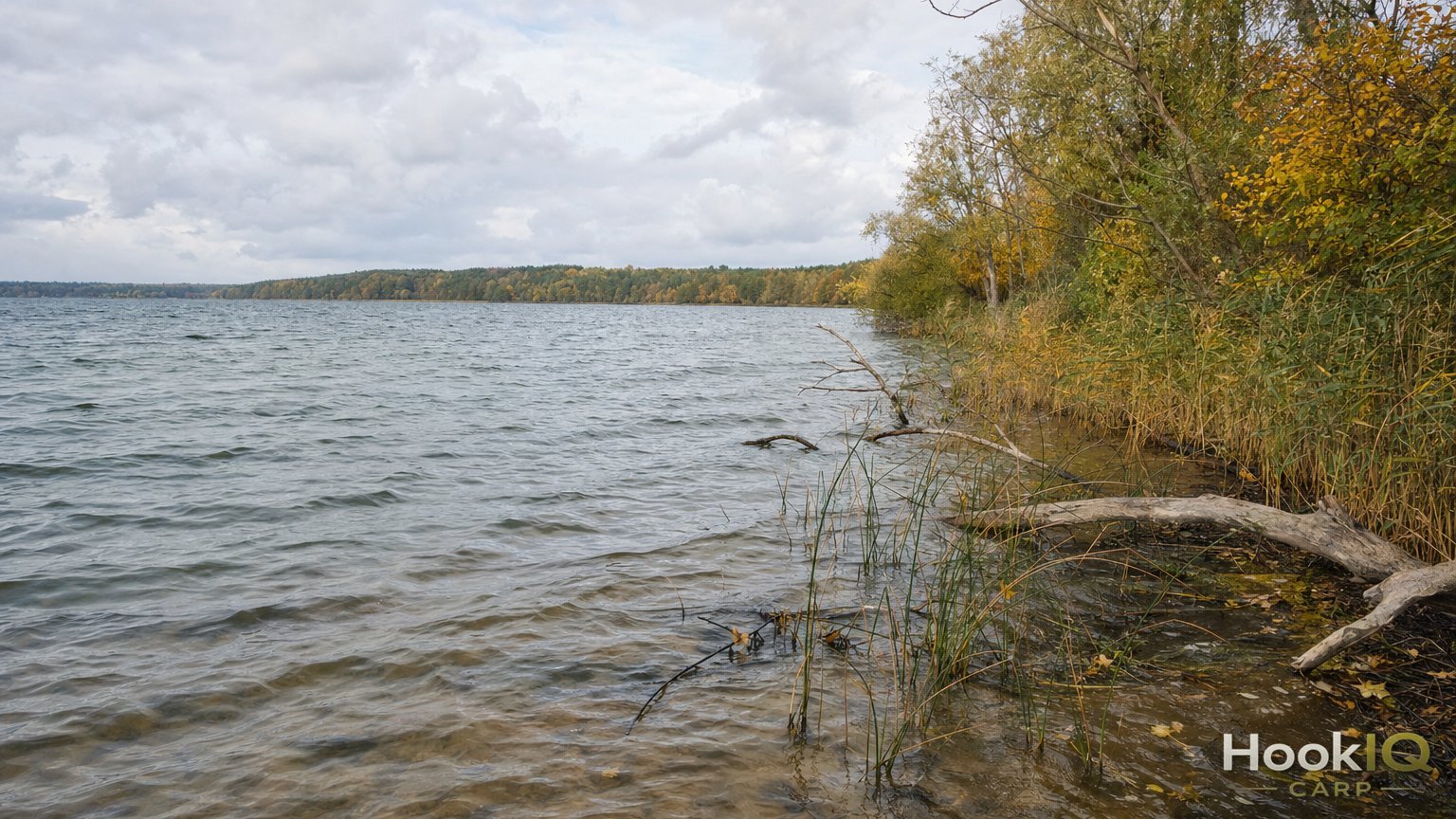
You're standing at the water's edge, the app reads 1023 hPa, a light easterly breeze, blue sky. Everything feels calm, almost inviting. And yet days like this have handed me more blank sessions than any other weather pattern. If you actually want to understand when carp feed, you have to stop staring at the temperature readout and start reading the barometer and the wind vane like a second fish finder.
Most anglers I meet on the bank pack their gear by gut feeling. Sun's out, so they fish. Rain's coming, so they pack up. In doing so they give away exactly the hours when a water is most likely to switch on. In this piece I want to show you how I read air pressure, wind direction and water colour together before I even set up the first rod, and why these three factors belong together the same way a rig, a bait and a baited spot do.
Why air pressure has a say in your catch rate
Unlike perch or zander, carp have what's called a physostomous swim bladder. It's connected to the digestive tract by a duct, which lets the fish take on or release gas relatively quickly. That probably explains why carp do react to pressure changes, but more calmly than a lot of other species. Nobody's fully mapped the exact mechanism yet — the rules of thumb below come from decades of practical experience shared by anglers, not from a scientific study. Carp tend to adjust their depth in the water column gradually rather than scrambling to re-balance in a panic.
Under high, stable pressure, carp tend to sit higher in the water column. That's the phase when zig rigs suddenly start outfishing the bottom bait right next to them. When pressure drops, the fish pull back down toward the bottom, and classic bottom baits take over again. Over the years I've settled on a rough set of benchmarks I run through in my head whenever I open the weather app:
| Pressure range | Reading | Rig consequence |
|---|---|---|
| below 1010 hPa | low, falling, or just passed through | carp sit deep, favour bottom rigs, often active feeding |
| 1000–1020 hPa | stable mid-range | the most reliable zone, fish hold territory, predictable feeding |
| above 1025 hPa | high and stable | fish often sluggish or riding high, expect a tough session |
Here's the key point: the absolute number matters less than the movement. A barometer that drops from around 1020 to 1005 hPa within twelve hours announces a feeding window far more reliably than a day that sits flat at 1008 hPa. The transition itself is the real trigger, not low pressure on its own. So whenever I have the choice, I deliberately book my session for the window while the barometer is dropping, not the day after, once everything has already settled.
Spotting the feeding window before it slams shut
A feeding window comes together from several factors lining up at once, a pretty tangible mix of physics and feeding behaviour. Falling pressure is the main trigger, but wind and coloured water are often what really amplify the effect.
Over three decades on the bank, one pattern keeps repeating: when a front pushes through in the afternoon, with a noticeable pressure drop and a freshening wind from a mild direction, the bite often comes in the two to three hours beforehand and during the front itself. Afterward, once the rain has cleared and the sky opens up, things typically go quiet again. If you only wait for the rain itself, you miss the actual window.
I have to be honest about one exception here, because it's caught me cold more than once: in autumn, a low-pressure system can do the exact opposite. If cold air sweeps in with the low and abruptly chills a warm surface layer, carp respond with stress rather than appetite. Not every low is automatically a feeding window. Especially now in September, it pays to keep an eye on water temperature rather than trusting the barometer blindly.
My tip
> Don't just look at the current pressure reading — look at the trend over the last twelve hours. A drop of at least 5 to 10 hPa in that span is, for me, the most reliable signal to reposition the rods and plan around a feeding window.
A session that burned this into me
I remember an early-autumn trip to a mid-sized club lake where I fished two full days at a steady 1026 hPa with dead calm conditions and had exactly one liner. On the third day, a front rolled through around noon — the barometer dropped to 1011 hPa within a few hours, the wind swung southwest and picked up noticeably. I didn't reel in; instead, I moved two rods toward the windward bank. Between 2 and 5 pm, right during the pressure drop, I had four runs, three of them on bottom rigs in the shallows, where a visible brownish colour line had formed. The next day, with pressure back to a steady 1013 hPa and calm weather again, it went dead quiet. That pattern — quiet lead-up days, a short intense window during the actual pressure drop, then dead again — repeats itself so reliably year after year that I now plan entire short sessions around it.
Offshore wind, coloured water and the two-stage food chain
This part trips up a lot of anglers because it feels wrong on instinct. If the wind is at your back — an offshore wind blowing from your own bank out across the water — it feels like poor conditions. Calm water in front of you, no chop, everything looks dead. In reality, the food usually piles up on the opposite bank in this setup.
The physics behind it is simple. Wind moving across the surface pushes the top, warmer layer of water in its direction. When that current hits the far bank, it kicks up chop, which stirs up sediment and releases natural food: mussels, small snails, freshwater shrimp, bloodworm larvae that would otherwise sit safely in the bottom silt. Carp follow that coloured zone because, within hours, more natural food becomes available there than anywhere else in the water. There's an interesting two-stage effect here that I underestimated for a long time: the stirred-up mussels and snails feed on the fine particles first, and those molluscs then become the carp's preferred prey in turn. So coloured water hands the fish two advantages at once — cover, and a freshly kicked-off little food chain.
In practical terms, that means: wind in your face — an onshore wind hitting your own bank — is, in most cases, the better starting position. The coloured, oxygen-rich water with freshly released food sits right in front of your rods.
There's a seasonal twist to this, though, one that took me years to fully understand:
| Season | Where the approach pays off | Why |
|---|---|---|
| early summer through high summer | the bank the wind is blowing onto (onshore/windward) | water is thermally layered, warm surface water and food collect on the windward bank |
| autumn and winter | the sheltered, leeward bank instead | turnover and circulation push warmer deep water up exactly where the wind isn't pressing directly |
The old angler's saying, "into the wind in summer, out of the wind in winter," captures this pretty precisely. Compass direction matters too: from my own experience and plenty of reports from other anglers, southwest to west generally counts as a mild, reliable direction with a steadier pressure trend, while an east wind — especially in early spring — notoriously brings tough days.
Underwater visibility shifts noticeably with this colour change too, and that has a direct effect on your rig. In clear water, carp on a lot of waters get noticeably more cautious around lead, leader and terminal tackle near the bank. Once the wind has built up a colour line, that caution drops off fast. On days like that, I like to shorten the leader a bit and fish closer to the actual baited spot, because the reduced visibility lets fish get closer to the lead than they would in gin-clear water.
Setup adjustments by condition
| Condition | Rig recommendation | Bait presentation |
|---|---|---|
| High, stable pressure, clear water | Zig rig or mid-water pop-up | small amounts, fish sit high and cautious |
| Falling pressure, onshore wind, coloured water | Bottom rig, short to medium leader | feed more generously, fish feed actively and with little caution |
| Stable mid-pressure, little wind | Balanced bottom bait or wafter | moderate feed amounts, focus on spot accuracy |
What this means for you on the bank
Air pressure, wind and water colour rarely act in isolation. Their combination decides whether a day turns into a real session or just dead time in the bivvy. Before I cast out these days, I run through a short mental checklist almost automatically:
- Check the pressure trend over the last 12 hours. A clear drop points to bottom rigs and an upcoming feeding window; stable high pressure points to zigs or mid-water presentations.
- Read the wind direction on your own bank. If it's blowing into your face, the food is probably in front of you. If it's at your back, a spot on the opposite bank or a long cast downwind is often worth it.
- Watch the water colour along the bank. A brownish line trailing off the windward bank usually marks the most active zone for the next few hours.
- Factor in the season. In summer I follow the wind; from autumn on I also check whether turnover is underway and switch to the lee bank if needed.
- Question cold-air snaps in autumn. If pressure drops alongside a noticeable temperature crash, expect a feeding lull rather than a window, and plan the session more defensively.
Quick facts
- Carp have a physostomous swim bladder, which makes them react more moderately to pressure swings than perch or zander
- A pressure drop of 5 to 10 hPa within 12 hours is a more reliable signal than a single low reading
- Readings above 1025 hPa often mean sluggish fish riding high in the water
- An onshore wind on your bank usually means the food and colour are with you, not on the opposite bank
- In autumn, a cold-air low can shut down feeding completely, even with pressure dropping
Bottom line
Being able to read the weather isn't a substitute for picking the right spot or the right rig, but it often decides whether your bait ever lands in an active window at all. Always track the pressure trend over the last few hours, not just the current number. And when you read wind direction, think about the opposite bank as much as your own. Honestly, I stopped keeping track of all this on notepads at the water a long time ago — these days I use the HookIQ app, which pulls together pressure trend, wind direction and water temperature and shows me exactly when a window is opening. Saves me the constant mental math between bites.