
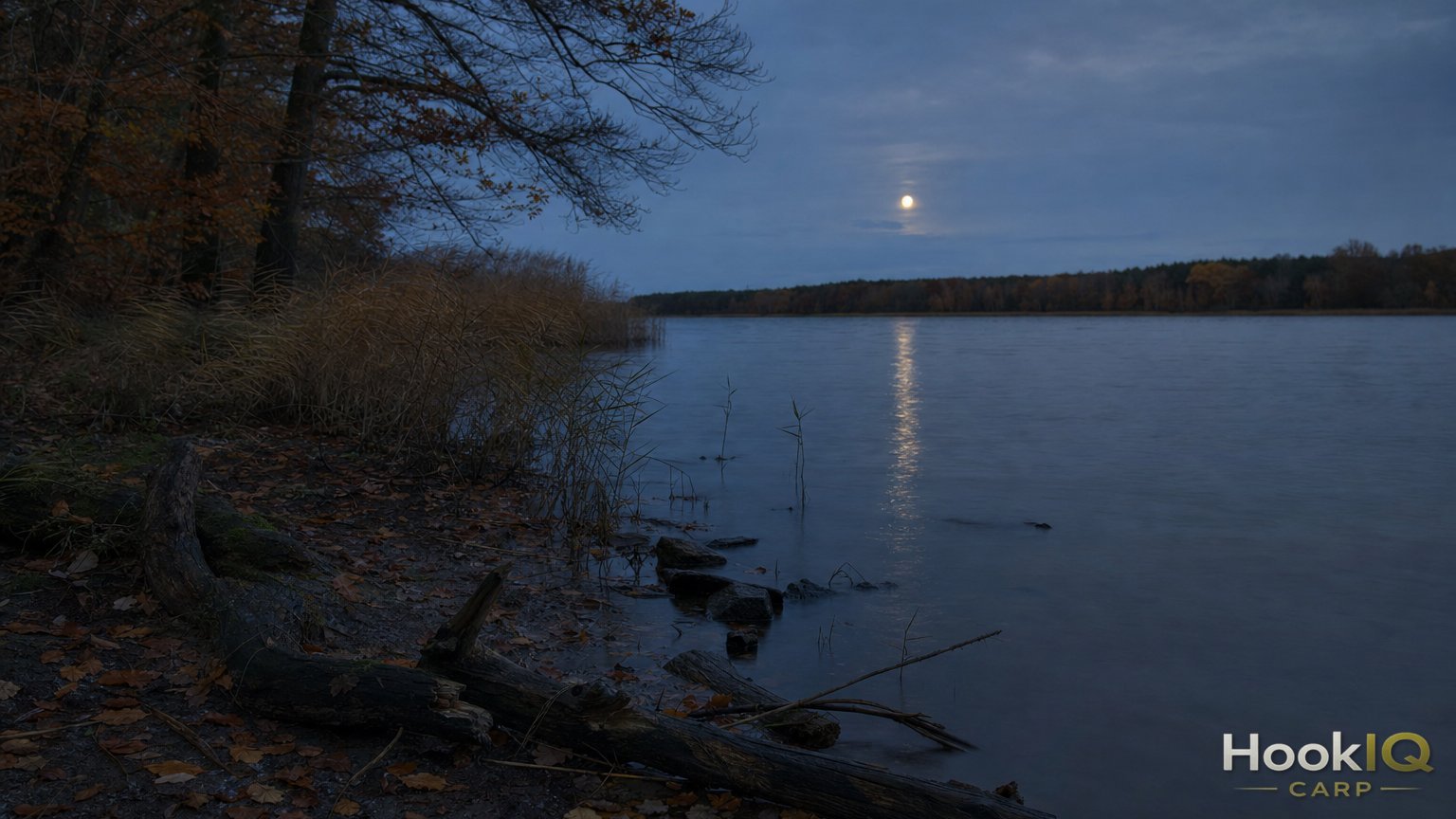
5:40pm, you've just clocked off, you're stood by the car, and the sun's already dropping behind the treeline. Three months ago you'd still have had three or four hours of daylight left. Now you've got barely half an hour before you're setting up the rod pod by head-torch light. This is exactly the point in the year where plenty of anglers pack the rods away and wait for the weekend. Yet autumn is when carp feed hardest. Plan your session smartly, and you don't have to give any of that up.
Where the Daylight Really Goes
Daylight shrinks faster in October than most people realise. In London, the sun sets around 6:55pm BST on 1 October, giving just under twelve hours of daylight. By 31 October — after the clocks go back — sunset has dropped to roughly 4:00pm GMT, with barely nine hours of light. That's over a two-hour swing within a single month, made sharper by the clock change itself. It's a similar story further north: in Manchester, sunset slides from around 6:58pm to roughly 4:05pm, and in Edinburgh — further north again — from about 6:52pm all the way down to 3:42pm. By mid-November, sunset across much of the UK is already before 4pm.
For you as an after-work angler, that means: if you're not out of the office until 5 or 6pm, you simply won't get a daylight session from late October onwards. Setup happens in the dark whether you like it or not. That's no reason to stay home — it's a reason to plan the session differently than you would in summer.
| Period | Sunset (London) | Daylight after work (5:30pm) |
|---|---|---|
| 1 October | 6:55pm | approx. 85 minutes |
| 15 October | 6:25pm | approx. 55 minutes |
| 31 October | 4:00pm (post clock change) | 0 minutes, already dark |
| Mid-November | approx. 3:55pm | 0 minutes, already dark |
Making the Most of Autumn Feeding Windows, Instead of Missing Them
Here's the good news: the exact twilight periods getting in your way are the most productive times of the year. Dawn and dusk are widely considered the most active feeding windows in autumn, with several practical sources putting the bite odds around 15% higher than in broad daylight. The window you could afford to ignore in summer — because carp fed round the clock anyway — is your most valuable window in autumn.
Water temperature is the deciding factor. Carp still feed reliably between 10 and 16°C, with some sources narrowing the sweet spot to 12–18°C. Below 8°C, feeding activity drops off almost completely — that's the threshold where autumn tactics slide into winter tactics. So as long as your water's still in double figures, every after-work hour on the bank is worth it.
Three things I always check before an autumn session:
- Water temperature over the last three days, not just the current reading. A sharp drop of 3–4°C within 48 hours noticeably slows the fish down.
- Wind direction. In autumn, carp often follow an onshore wind into shallower, wind-churned areas that carry more oxygen and stirred-up food.
- Air temperature at dusk. A mild evening after a sunny day often triggers one last feeding spell before the night properly cools things down.
Setting Up in the Dark, Without Stress and Without Spooking Fish
Setting up in the dark isn't a problem if you flip the order round: anything that needs daylight gets done beforehand, and anything that's pure routine gets done by lamp light.
I check the swim during the day whenever I can — on my lunch break or the weekend before. I make a mental note of any landmarks on the bank so I'm not hunting for them in the dark. Rigs get tied at home and slotted straight into the rig board, and bait gets portioned into PVA bags in advance. By the time I'm actually at the water, all that's left is: pod up, rods out, cast.
There's one simple rule for working the bank: point the lamp down and towards yourself, never across the water's surface. Any beam that sweeps over the water can spook fish out of your baited area — especially in the shallow margins where carp often sit in autumn. Your eyes also need 20 to 30 minutes to adjust to the dark. A harsh white beam resets that every time you glance at the lamp.
That's exactly why a head torch with a genuine red or green light mode is worth having. Red light preserves night vision best; green is the colour the human eye picks up most sensitively in low light. These extra modes are surprisingly rare on the market, which makes it worth seeking out a model that actually has them.
| Model | Lumens | Weight | Standout feature |
|---|---|---|---|
| RidgeMonkey VRH300X | 50–200 | 135 g | Red and green mode, 90h runtime, emergency light up to 360h |
| Petzl Aria 2 RGB | 450 | 106 g | Red, green and blue, very lightweight |
| Nitecore NU25 UL | 400 | 45 g | Lightest model, red light, USB-C |
| Silva Explore 5 | 700 | 116 g | Up to 50h on low mode |
| Led Lenser HF8R Core RGB | 1,600 | 194 g | Adaptive beam, strongest output |
For close-range work around the pod, 150–200 lumens is plenty. The 1,600-lumen beasts like the Led Lenser HF8R Core RGB are better suited to the walk back to the car or scouting a swim, not the moment you're checking a rig at the water's edge.
Compact Gear for the Short Session
A three-hour after-work session doesn't call for your full weekend arsenal. I deliberately cut down for short sessions — less kit in the dark means fewer things to go wrong, and that's what matters when time is tight.
A brolly system goes up in under two minutes and is more than enough for an after-work session; the big two-man bivvy stays in the shed for weekend trips. Rod pods have moved on too — there are now lightweight, quick-extend models that collapse down to under a metre and a half. Some fold from 60cm up to 112cm and weigh under 2kg. A 2-in-1 rod with two interchangeable tips — say a 2.75lb and a 3.5lb tip on the same butt section — saves you carrying a whole second rod in the boot, and packs down to under two metres.
| Setup | Weekend session | After-work session |
|---|---|---|
| Shelter | 2-man bivvy | Brolly, under 2 minutes to pitch |
| Rod pod | Sturdy standard pod | Folding pod, under 2kg, packs to approx. 60cm |
| Rods | 2–3 separate setups | 2-in-1 rod with interchangeable tip |
| Rigs | Tied at the water | Pre-tied at home in the rig board |
| Transport | Barrow, several bags | One rucksack, approx. 45 litres |
A pre-packed tackle box with a ready-made rig board holding several complete rigs saves you exactly the fiddly work that takes longest and costs the most patience in the dark. For a short session, if it fits in one rucksack, that's all that comes — everything else stays in the car.
How Much Bait Does a Short Session Really Need?
For a long-term baited swim that I build up over weeks, I'm looking at 2–4kg of bait per feed in autumn at 10–16°C water temperature, spread across several days at two- to three-day intervals. That doesn't apply to a single after-work session. A PVA stick with 150–200g per rod is plenty, topped up with a small handful of loose boilies right by the hookbait. A short session is about fishing an already-established, pre-baited swim briefly — not overloading it with extra feed. If you've already been baiting a spot for weeks, treat the after-work session as a quick visit where the real bait work is already done.
That also saves you time at the bank and weight in the rucksack. A small bait tub with pre-weighed portions is plenty for two or three rods — I leave the big 5kg bucket at home for short sessions.
My Timeline for a 3-Hour Session
Here's how my after-work session plays out in practice, arriving at the water at 6pm and leaving the bank by 9pm, leaving enough time for the drive home:
- 0–5 minutes: pitch the pod, open the rucksack, switch the lamp to red light.
- 5–15 minutes: rig both rods with pre-tied rigs, attach a PVA stick with 150–200g of bait per rod.
- 15–20 minutes: cast to the marks noted earlier in the day, set up the bite alarms.
- 20 minutes to the end: wait, watch, react instantly to a take — no extra feeding in such a short window.
- Last 10 minutes: reel in, check the rigs, pack the pod and rucksack away in the same order they were set up.
This fixed routine is a matter of practice. After three or four sessions, the setup runs almost on autopilot, even without constantly checking the lamp.
At a Glance
| Aspect | Recommendation |
|---|---|
| Window from late October | Plan for a dark setup — daylight barely stretches far enough |
| Best bite time | Dusk, with water temperature between 10 and 16°C |
| Lower limit | Below 8°C, feeding activity drops sharply |
| Lamp tech | Red or green light, 150–200 lumens for close-range work |
| Gear | Brolly instead of bivvy, folding pod, 2-in-1 rod, one rucksack |
Autumn hands you the best feeding windows of the year — just in a smaller time slot than summer. If you already know the swim, your rigs are sat ready in the rig board, and your lamp isn't spooking the fish, three hours after work is plenty for a good carp. These days I like using the HookIQ app to decide which evenings are actually worth the effort — it pulls water temperature, air pressure and twilight windows together in one glance, instead of me cross-checking five different weather services against my own notes. That leaves more time for what actually matters: getting the rod out before it's properly dark.