
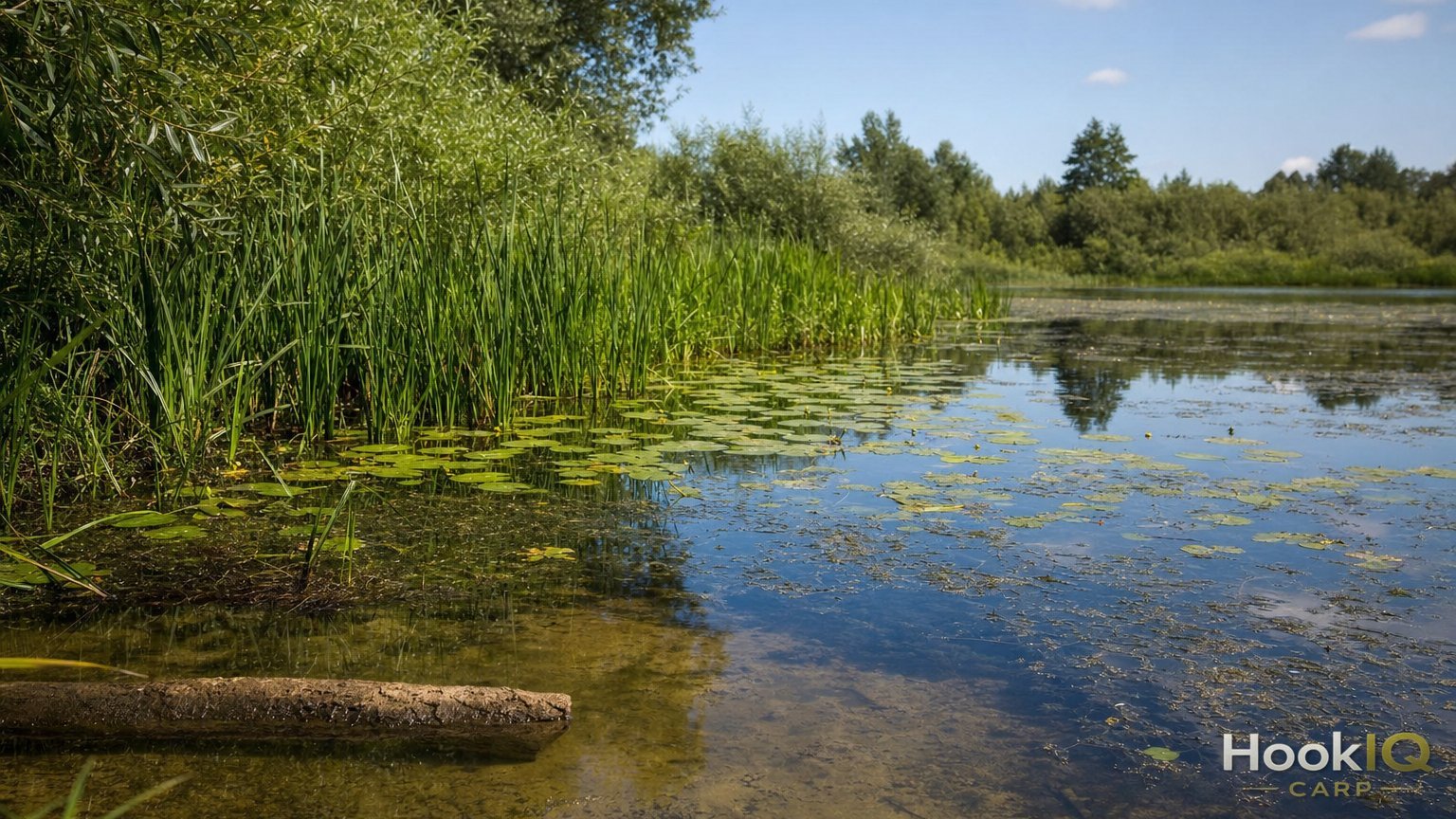
Picture this: you're creeping along the bank, crouched low. Through your polarised lenses you spot three dark shapes drifting less than two metres from the edge, weaving between the lily pads. Your heart is hammering. You've got a short rod in one hand, a single hookbait on the hair, and nothing else. No bite alarms, no bivvy, no bait boat. Just you and the fish. That's stalking in its purest form. And in summer, there's no more effective way to catch carp.
Why Stalking Works So Well in Summer
Something fundamental changes in summer: carp leave the deeper water and move into the margins. Once water temperatures climb above 15 °C, their activity ramps up noticeably. Between 20 and 25 °C, carp hit peak feeding activity — and that's exactly where most lakes sit during the height of summer. In this phase, they're practically solar-powered. They seek out shallow, sun-drenched areas, patrol reed edges, root around under lily pad beds, and hold in the shade of overhanging trees. Exactly where you can see them and reach them with a well-placed cast.
The beauty of stalking is that you don't need a fixed swim, heavy tackle, or an overnighter. An hour can be enough. Two hours in the evening, crouched on the bank with your eyes open and a bait on the hook. That's all it takes.
Polarised Glasses: Your Most Important Tool
Before you even think about picking up a rod, you need a decent pair of polarised glasses. Without them, you're blind — literally. The water's surface reflects sunlight and makes it impossible to spot fish below. With good polaroids, that glare vanishes and suddenly you can see everything: the dark backs of cruising carp, clouds of disturbed silt, nervous tail flicks.
| Lens Tint | Best For | Advantage | |---|---|---| | Amber / Copper | All-round, daylight to dusk | Best underwater contrast, versatile | | Grey | Full sun, midday light | Neutral colours, comfortable in bright conditions | | Yellow | Overcast skies, morning / evening | Brightening effect, good in diffused light | | Green | Clear water, light-coloured lake beds | Reduces glare on sand and gravel bottoms |
My tip: amber or copper tint is the right choice for 90% of stalking situations. It boosts the contrast between the dark body of a carp and the lakebed without distorting colours. Invest a bit more in a pair with proper optical quality. Cheap polaroids distort the image and give you a headache after an hour.
One more thing: polarised glasses don't just reveal where fish are holding. They also show you polished, lighter patches on the bottom — spots where carp have been feeding regularly and worn away the silt. These areas are pure gold, even when you can't see a fish right now.
The Art of the Approach
Carp in the margins are extremely alert. They register every vibration, every shadow, every sudden movement. Over the years, I've learned that most anglers don't fail because of their bait or rig — they fail because they spook the fish before they've even started fishing.
Here's the routine that's served me well over hundreds of sessions:
1. Watch first, walk later. When you arrive at the water, stay put. Observe for 20 to 30 minutes from a distance before you approach any spot — ideally from at least 30 to 50 metres back. Too many anglers march straight to the water's edge and then wonder why nothing's biting. The fish that were there have long since bolted into deeper water.
2. Move slowly. Advance in 5 to 10 metre increments. Knees slightly bent, place your feet toe-first. Sound over the top? Try it. The difference is enormous. Carp pick up footfall vibrations through the ground and water, because sound travels four times faster in water than in air.
3. Control your shadow. Make sure your shadow never falls on the water. Position yourself so the sun is in your face or coming from the side. Your own shadow sweeping across the swim is the surest way to send every carp in the area packing.
4. Dress the part. Dark, muted colours. Olive, brown, dark green. No bright t-shirts, no white caps. You want to blend into the bank, not stand out from it.
5. Eliminate noise. Close car doors quietly. Don't dump tackle on the ground where it clatters on gravel. Keep your voice down. These sound like small things, but on a quiet summer's day at the water, these details make the difference between a fish on the mat and an empty net.
> A seasoned angler from the community once put it like this: "From the moment I arrive at the lake, the only thing on my mind is being quiet. Closing doors softly, wearing dark clothing, avoiding gravelly paths, staying low when I walk. The fish should never know I'm there."
The Right Gear: Less Is More
Stalking kit needs to be one thing above all: mobile. You're walking the bank, switching spots, reacting to what you see. There's no room for three rods, a rod pod, and a barrow.
Rod
One rod is all you need. Ideal length is 9 to 10 feet with a test curve of 2.75 to 3.00 lb. In weedy or snag-heavy areas, 3.25 lb is fine. If you stalk regularly, consider a semi-telescopic stalking rod with a transport length of around 110 to 125 cm. It fits in any rucksack and is ready to go in seconds.
Shorter rods of 6 to 8 feet have their place when you're working under low-hanging branches or casting from a kneeling position. But as an all-round stalking rod, 9 feet is the minimum to give you enough cushion during the fight.
Reel and Line
A compact reel in the 3000 to 5000 size range. Light, but with a reliable drag. Spool it with monofilament, not braid. Here's why: at short range — and when stalking you're rarely casting beyond 15 metres — braid lacks shock absorption. A savage take at two metres won't pull the hook from the scissors with mono; it absorbs the impact. That's the difference between a landed fish and a lost one. 0.30 mm mono with a breaking strain of 15 to 22 lb is a solid benchmark.
Landing Net
Keep your landing net assembled and within arm's reach at all times. Stalking fights are short and intense — 30 to 60 seconds, then the fish should ideally be in the net. If you're still putting your net together while the carp is powering into the lilies, you've already lost.
| Gear | Recommendation | |---|---| | Rod | 9–10 ft, 2.75–3.00 lb TC, semi-telescopic | | Reel | Size 3000–5000, compact, reliable drag | | Line | Mono, 0.30 mm, 15–22 lb | | Hooklink | Fluorocarbon, 15–20 cm, 18–22 lb | | Landing net | Always assembled, within reach | | Polarised glasses | Amber / copper tint | | Clothing | Olive, brown, dark green | | Unhooking mat | Compact, always with you |
Margin Hotspots: Where Do the Carp Sit?
Not every metre of bank is equally productive. Carp have clear preferences in summer, and knowing them saves you hours of searching.
Lily pads. The classic. Carp love lilies because they provide shade and harbour plenty of natural food: worms, snails, invertebrates. Place your bait on the edge of the pad bed, not in the middle. Fish patrol the transition between open water and vegetation and pick up a single bait much faster there.
Overhanging trees. In the height of summer, when the sun beats down, carp actively seek out shaded areas. Overhanging branches also drop a constant supply of insects, caterpillars, and larvae onto the surface. The transition between shade and sunlight is the most productive zone. That's exactly where your bait should go.
Reed edges. Reed beds hold an almost magnetic attraction for carp. Fish use the edges as patrol routes and find a constant food supply there. Look for spots where the reeds recede slightly, forming a natural clearing.
Weed edges. Watch for two types: the marginal edge where clear bottom meets a weedbed, and the deeper edge where the weed stops because light no longer reaches the bottom. Both are prime feeding spots.
Bottlenecks and channels. If your water has islands, peninsulas, or bay entrances, the narrows between them are obligatory routes for patrolling carp. You can place your bait pre-emptively and wait for a fish to pass through.
Single Hookbait Tactics: Why Less Catches More
When stalking, a simple rule applies: one bait, one hook, one fish. You're not looking to lay a bed of bait or create a feeding carpet. You want to present a single hookbait so that the carp finds it and takes it.
There are three reasons for this:
1. Less noise. Every bait that hits the water creates a plop. In shallow water, a single cast can make all the difference. The fewer times you cast, the less you disturb.
2. No satiation. A carp that finds three free boilies will eat them and move on. If all that's there is your hookbait, it has no choice.
3. Faster reaction. You spot the fish, you lower the bait in, the fish picks it up. The gap between sighting and bite can sometimes be just minutes.
Which Baits Work?
Anything that can be introduced with minimal disturbance. My top three for summer stalking:
- A halved or trimmed boilie (10–12 mm). Cut boilies look more natural than perfectly round ones. Pressured carp accept irregularly shaped baits with far more confidence. A proven trick is to gently squash 10 mm boilies flat to reduce the splash when they hit the surface. - Two or three grains of sweetcorn on the hair. Corn is inconspicuous, looks natural, and on many waters is associated with far less danger than boilies. On some days, corn on the hook is all you need. - A piece of bread on the surface. When you spot carp sitting just below the surface or even gulping air, a piece of bread on top is the fastest method going. Size 6 to 8 hook, directly hooked, freelined with no lead at all.
The Key Technique: Freelining
Freelining is the ultimate stalking discipline. No lead, no swivel — just the hook on the mainline (or a short fluorocarbon hooklink). The bait sinks slowly and naturally. The advantage: absolutely minimal entry noise. The downside: you need a bit of practice casting, because there's no weight to pull the line.
If the bait needs a touch of weight to hold position — a light current, a bit of wind — 5 to 10 grams of split shot on the line is all it takes. Nothing more.
Rig Options for Close Range
If freelining isn't practical — because you need a bit more casting distance or you're presenting over uneven ground — there are two proven alternatives:
Chod Rig. Ideal on irregular lakebeds. The pop-up always sits cleanly above the bottom, no matter what's underneath. Fished on a short lead (30 to 50 g), it lands neatly in small clear patches between weed or debris.
Snowman / critically balanced bait. A bottom bait topped with a small pop-up. The hookbait hovers just above the lakebed and stands out immediately. This option works superbly with a fluorocarbon hooklink and a blob of tungsten putty as an anchor point.
In both cases: hook size 6 to 8. No smaller. When stalking at close range, you've got no distance margin for error. The hook needs to find a secure hold on first contact.
Playing the Fish: Short, Hard, Decisive
Stalking fights are completely different from playing fish during a normal session. You're fishing at close range — the fish has limited escape route but plenty of snags all around: lilies, weed, branches, reeds.
Three rules:
1. Set the drag looser than for session fishing. At two metres, a savage take can snap the line instantly if the clutch is too tight.
2. Side strain, not lifting. Hold the rod to the side and steer the fish away from snags. Don't pump upwards — the fish will jump and throw the hook.
3. Net quickly. 30 to 60 seconds — that's your window. The longer the fight drags on, the more likely the carp will kite into the lilies or weed. That's why your landing net is assembled beside you. Always.
Checklist: Stalking on a Summer's Day
- [ ] Put on polarised glasses before approaching the water - [ ] Observe for 20 to 30 minutes from a distance - [ ] Approach the spot crouched and quiet - [ ] Control your shadow — sun in your face - [ ] Rod fully set up in hand, landing net assembled - [ ] Place a single hookbait precisely with an underarm flick - [ ] Loosen the drag slightly, keep the rod in hand - [ ] After landing a fish: move to a new spot, don't fish the same swim again
Conclusion
For me, stalking is the most honest and exciting way to catch carp. No other approach brings you this close to the fish. No other approach demands this much patience, observation, and self-discipline. In summer, when carp are patrolling the margins, you don't need high-end gear and you don't need an overnighter. You need a pair of polaroids, a short rod, a good bait, and the willingness to move slowly and quietly. Once you've experienced it — once you've watched a mirror carp pick up your hookbait right before your eyes — you'll be hooked for life.