
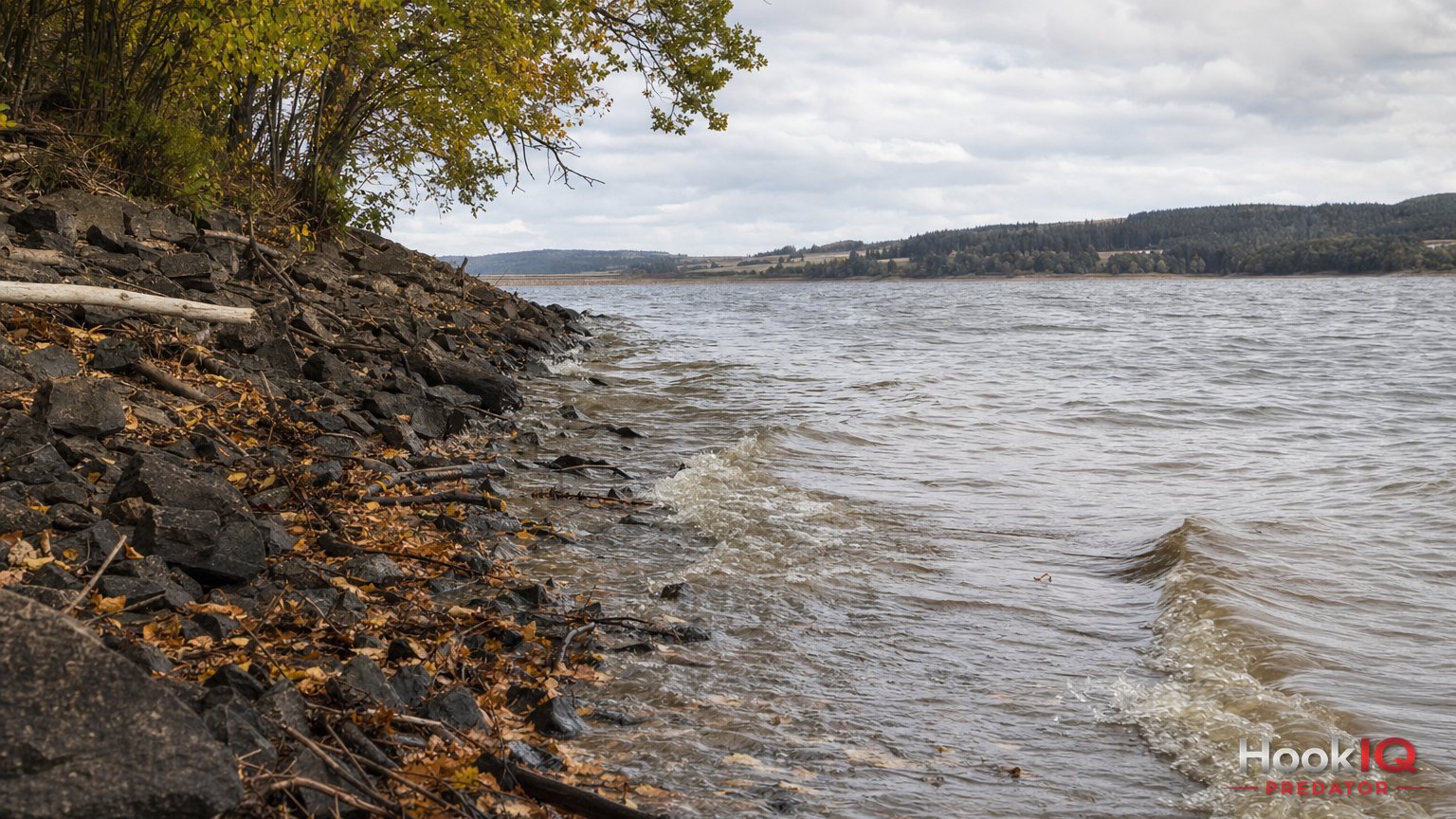
Most anglers pack up when an autumn storm sweeps across the lake. That's exactly when I unpack properly. While car doors fight against the wind in the parking lot and barely anyone can keep a hold of their hat, I pull my hood over my ears and head straight for the spot that hurts today: the windward shore. Where the waves have been pounding relentlessly into the shallows for hours and everything looks brown and churned up. For most people, that's a reason to turn around. For me, it's the reason to get started.
Why Wind Rewrites the Rules on the Lake
A lake is basically a large, sluggish system. Days of calm and stable high pressure often let predatory fish settle into a comfortable routine — holding on familiar edges, at familiar depths, with predictable behavior. A real autumn storm shakes that system up and forces everything swimming in the lake to react in new ways.
The wind pushes the near-surface layers of water in one direction for hours. On the lee shore, this creates a current that flows back along the bottom, while on the windward shore, the warm, oxygen-rich surface water gets driven straight in. At the same time, the surf churns up the bottom, especially over shallow gravel bars, sandy bays, and along rock riprap. The water turns murky, often within one to two hours after the storm starts, and that murkiness is the key to everything that follows.
Baitfish like roach, bleak, and small bream get swept straight into the windward shallows by the current and poor visibility. They lose their bearings, bunch up tightly, and become a ready-made buffet for predators. Pike and zander know this. Both species move onto these edges during and shortly after strong wind, because the prey is concentrated there and the murk makes their own camouflage almost perfect.
Reading the Windward Shore Correctly
Not every windward shore is equally good. I specifically look for transitions — spots where shallow water drops relatively abruptly into an edge two to four meters deep. That's exactly where the predators wait, because from there they can control the churned-up shallows with just a few meters of hunting range, without having to sit in the full force of the surf themselves.
Rock riprap, harbor jetties, and old groyne remains on the windward shore are among my favorite spots on days like this. They break the waves slightly but still give direct access to the murky, baitfish-rich shallows behind them. I remember one October afternoon on a reservoir in Germany's Eifel region, wind force six out of the northwest, water temperature just under 13°C (55°F). The lee shore lay flat and dead calm — not a single bite in an hour. On the windward shore, though, right along an old rock embankment, I landed three zander between 48 and 61 cm (19–24 in) and a pike around 85 cm (33 in) within forty minutes. Same lake, same day, completely different result. The only difference was which side the wind was hitting.
Lure Choice When Visibility Drops to Zero
In heavy murk, no predator fish relies on its eyes alone anymore. Pike and zander now lean heavily on their lateral line, which picks up the smallest pressure waves in the water. That's why on days like this I switch consistently to lures that push a lot of water. For zander, I reach for a 12 to 14 cm (5–5.5 in) soft plastic shad with a wide paddle tail, rigged on a 14 to 18 gram (1/2 to 5/8 oz) jig head, because the weight gets the lure back down to bottom contact quickly in the current along the edge, letting it be worked properly instead of just drifting. Color-wise, in murky water I go consistently bold and high-contrast — chartreuse, fire orange, or a deep black-and-blue — because these colors still throw a recognizable silhouette even in brown water.
For pike, this is prime time for chatterbaits and big spinnerbaits. Both lures create exactly the kind of vibration a pike can pick up from several meters away in murky water, long before it sees anything. In this situation I deliberately fish the chatterbait slower than usual, with short pauses right in front of the edge, because the sudden stop in vibration often triggers exactly the reflex that gets the bite. A 20-gram (3/4 oz) model with a 12 cm (5 in) trailer is my standard on days like this — big enough to still be felt even past two meters of depth.
Timing: Right During the Storm or Afterward?
Many anglers ask me whether they should cast right during the storm or wait until it passes. My experience is clear: the best window is usually the first six to ten hours after the wind has peaked and starts to ease off, while the water is still murky and churned up. During the absolute peak of the storm, casting is often barely controllable, and the fish themselves need a short window to settle onto the new edge. The weather shift afterward — when pressure starts to rise slightly and the first sun breaks through the clouds — is traditionally the most productive phase of the entire autumn for me.
One detail I never underestimate: if a stable high-pressure system follows the storm and temperatures drop several degrees within a day, that window can shrink considerably. These days, I'm already on the water beforehand instead of reacting once it's too late. I'll admit I no longer piece together wind, murk, and pressure trends myself from separate weather services. I use the HookIQ app for that, which shows me exactly this combination for my lake and tells me when the window is really open. In the end, you don't have to remember everything yourself when the technology does the legwork for you.
My Takeaway
For me, an autumn storm is never a reason to leave the rod in the car — it's the trigger for what might be the most productive session of the entire month. Seek out the windward shore on purpose, watch for edges two to four meters deep right in the murky shallows, and switch to lures that deliver pressure instead of flash. The first few hours after the storm peaks are your window. Pull your jacket on and head out when everyone else turns back.