
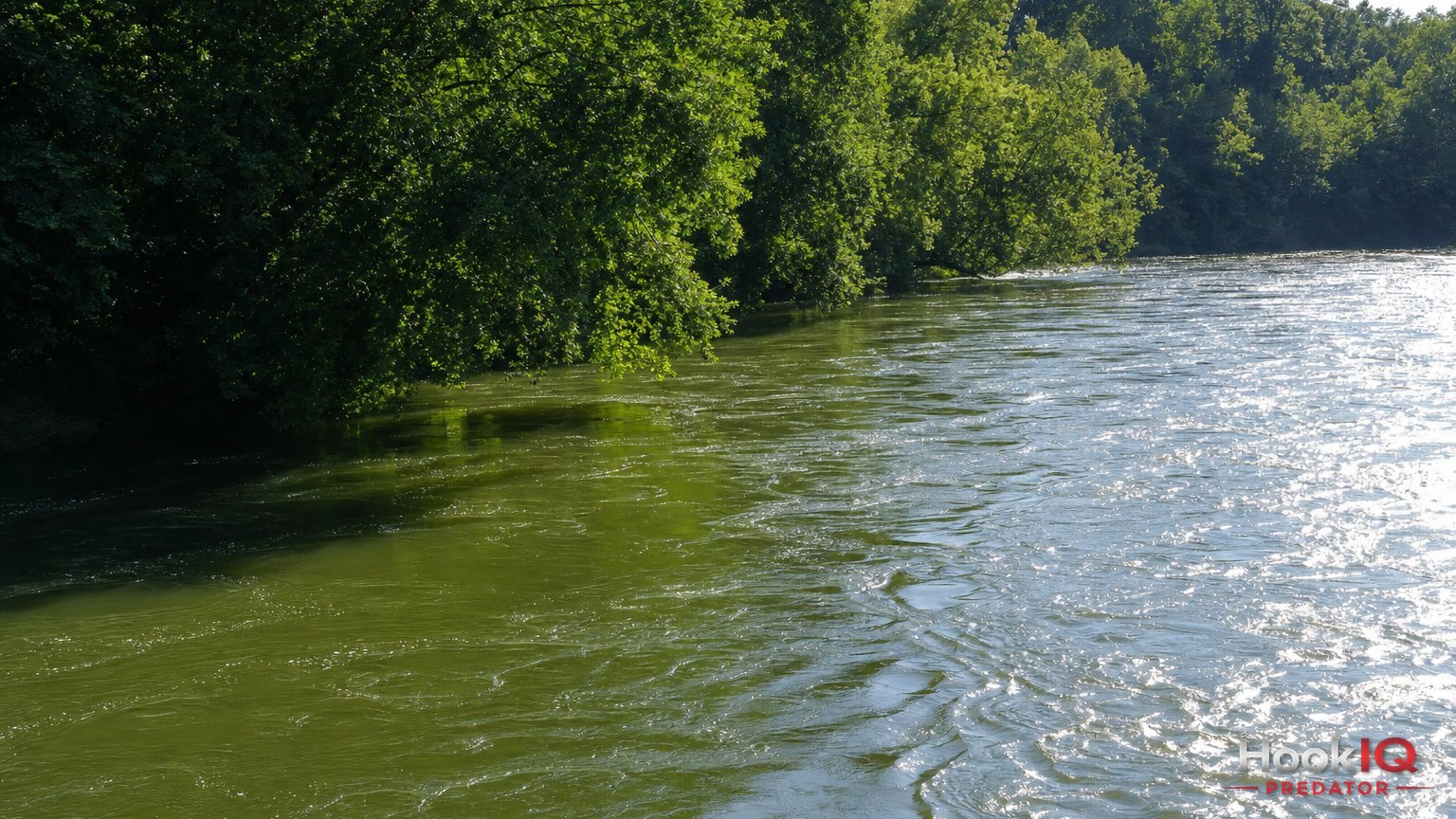
Three in the afternoon, 28 degrees, the sun hammering down on the river. Every sensible catfish angler is at home right now, waiting for dusk. I'm standing at the edge of a deep channel, heavy spinning rod in hand, casting a 23 cm paddle tail shad on a 60 g jighead upstream into the depths. Two drops, three bottom contacts, then the line goes tight. The wels catfish on the other end didn't wait for nightfall. It was hungry. Right now.
Why Deep Holes Change Everything
Most anglers associate catfishing with night sessions, livebait under a float, and hours spent waiting in the dark. That's a proven method, no question. But it only tells half the story. Wels catfish aren't strictly nocturnal predators. They're opportunists, and when conditions are right, they feed around the clock. The key is location.
A deep hole in the river is to a wels catfish what a five-star restaurant is to us. This is where current meets depth. The water carves into the riverbed, creating depressions of four, six, sometimes ten metres, while the surrounding riverbed sits at just one and a half to two metres. At that depth, a big catfish feels safe even in broad daylight. It lies on the bottom, sheltered from current and light, waiting for food to drift past its nose. That's exactly what we simulate with the soft plastic.
I've been targeting these deep spots on mid-sized rivers for years — the Neckar, the Danube, the Main. What keeps surprising me: the bites don't only come at dusk. Some of my best fish have been caught between 2 and 5 pm, in the middle of the day, under full sunshine. Depth makes it possible.
Reading the Current Seam
Not every deep hole fishes equally well. The critical feature is the current seam — the transition between the main flow and the calmer water inside the depression. This seam is the catfish's feeding lane. Everything the river carries along — baitfish, crayfish, dead fish — gets slowed down at the current seam and sinks. The catfish just needs to park itself on the edge and eat whatever drifts past.
You can often spot the current seam on the surface as a visible line where faster and slower water meet. Sometimes small eddies form there, or the surface texture changes. If you have sonar on your boat, it becomes even clearer: the depression shows up as a sharp drop-off, and the fish hold right on the transition edge.
From the bank, I watch the drift of debris. Where branches or foam circle and collect, that's usually the edge of the deep channel. That's exactly where I want to present my shad. Not in the deepest point, but on the edge, where the current still pushes the lure slowly across the bottom.
The Right Gear for Heavy Jigs
If you want to fish soft plastics for big wels catfish in deep holes, you need heavy-duty tackle. This isn't about overkill — it's about physics. In a deep channel with decent current, you need jigheads between 40 and 80 g just to get the shad down to the bottom in a controlled way. A 14 g jig that works for zander fishing will end up a hundred metres downstream before it touches the riverbed.
I fish a 2.70 m rod rated 40 to 120 g. That sounds like a broomstick, but modern catfish rods in this range are surprisingly sensitive. You feel every bottom contact, every ledge, and most importantly, you feel the moment something takes the lure. The reel should be a sturdy 5000 or 6000 size, spooled with 0.19 to 0.23 mm braid. For the leader, I use 1.0 mm mono or heavy 0.80 mm fluorocarbon, about 80 cm long. A wels catfish doesn't have sharp teeth that'll cut your line. But its tooth pads are like sandpaper, and during the fight the line gets abraded against the mouth. That's why the heavy leader matters.
For soft plastics, I go with models between 20 and 25 cm. That sounds big, but for a catfish it's a snack. Colour matters less at depth. I've caught equally well on white, chartreuse, and black. What matters far more is the lure's action: it needs to produce a solid tail kick even on the slowest retrieve. Big paddle tail shads with soft material work best here because they generate displacement and vibration even on the drop.
The Technique: Heavy, Slow, Bottom-Hugging
The retrieve at a deep hole is different from classic jigging for zander. Forget the rhythmic lift-and-drop. Here, I fish the shad with a kind of bottom-dragging technique. I cast upstream or at an angle upstream into the depression, let the jig sink until it hits bottom, and then pull it across the riverbed in slow, short drags. Between drags, I let the lure sit — sometimes three seconds, sometimes five. That's when it happens.
A wels catfish bite on a soft plastic rarely feels like a sharp hit. It's more like someone suddenly hung a sandbag on your rod. The line goes tight, the rod tip loads up, and for a second you think you're snagged on the bottom. Then the bottom moves. That's the moment your heart rate goes to 180.
I set the hook hard, using the full length of the rod. The jighead needs to punch through the catfish's hard mouth pad. A half-hearted hook set means a half-hearted result — and with a 60 g jighead, you've got plenty of weight to drive the hook home.
Finding Spots and Working Them Systematically
The best deep holes sit where the river changes direction naturally. Outside bends, bridge pilings, tributary confluences, weirs. Anywhere the current gets concentrated and digs into the riverbed, deep spots form. In river towns, you'll often find these depressions right at the bridges, because the pilings deflect the current and create scour holes behind them.
I always work a deep hole systematically. First, I fish the current seam on the upstream side, where the lure naturally gets carried into the depression. Then I work my way into the depths. Fan-casting, throw by throw, like a clock face from twelve to three to six. This way I cover the entire area without skipping a zone. If catfish are holding there, you'll usually get a contact within the first ten casts. If nothing happens, I move on to the next spot. Daytime catfish spinning demands mobility. This isn't sit-and-wait fishing with artificial lures.
The Best Time in Summer
Right now in the height of summer, when water temperatures climb above 20 degrees, wels catfish are extremely active. Their metabolism runs at full throttle, and they need enormous amounts of food every day. That means they simply can't afford to feed only at night. A big catfish over 1.50 metres needs so much energy that it'll strike during the day when the opportunity presents itself.
The most productive hours, in my experience, fall between late morning and early afternoon. That contradicts everything you read in the books. But my theory is simple: by that time, the shallow water has heated up so much that baitfish move into the deeper zones — into the holes and channels. Right in front of the catfish's nose. And when a catfish is already sitting among the baitfish, it'll take the soft plastic too.
Respect for the Fish
One more thing, because it matters to me. If you're deliberately targeting catfish in the height of summer, you need to know that some fish are still recovering from the tail end of the spawning season. By early July, most wels catfish are done spawning, but some late spawners are still at it. If you catch a fish that has clearly just spawned and looks exhausted, treat it with respect. A quick photo, a brief measurement, and then it goes back. Especially with big catfish that take decades to reach that size — we carry a responsibility.
And one more thing: fighting a giant wels catfish during the day, in full visibility, watching this colossus circle beneath you — that's an experience no night session can replace. Give it a try. Find the nearest deep hole, pack the heavy spinning rod, and send a fat shad into the depths. There might already be one waiting for you.