
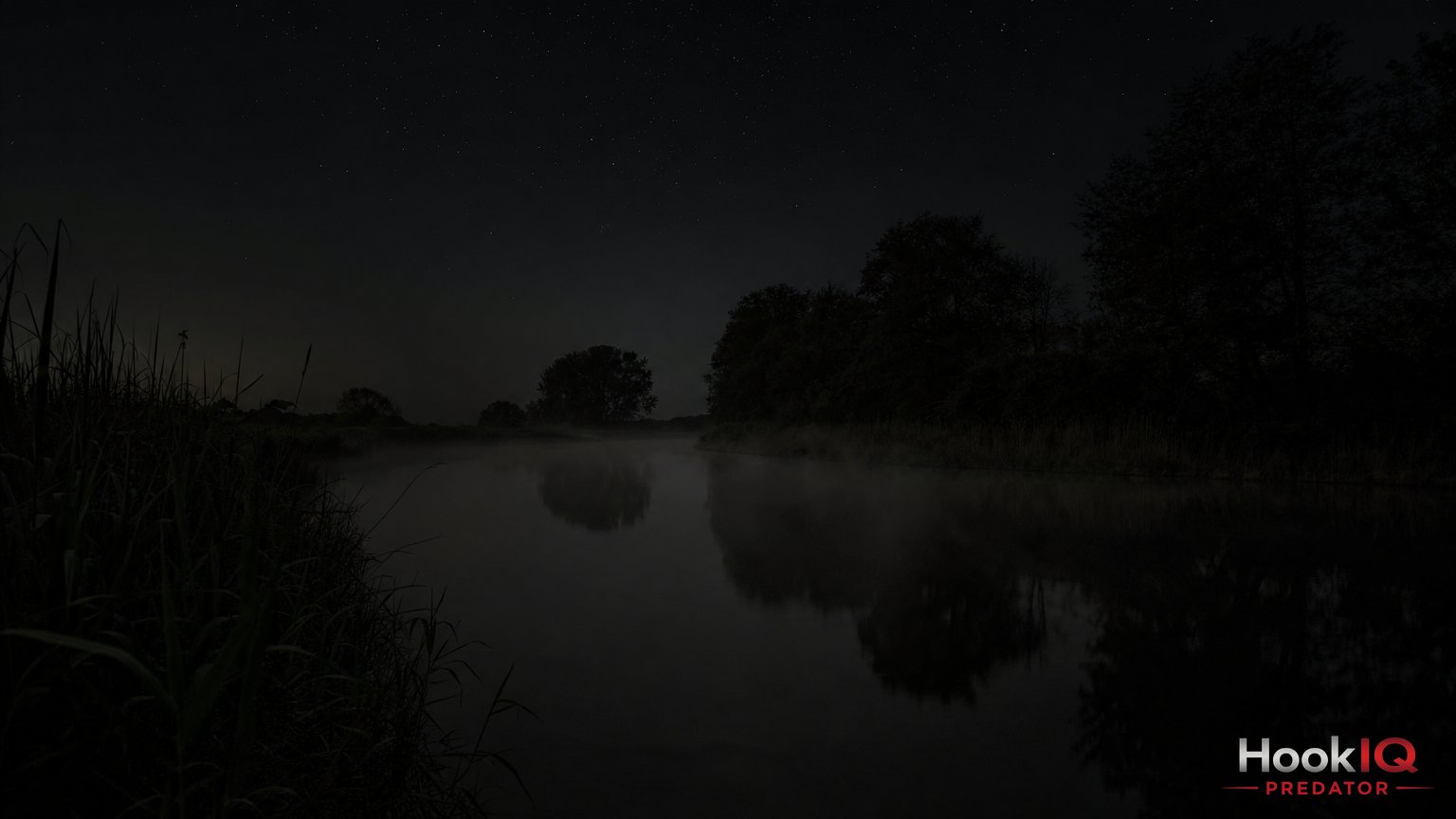
Just past midnight, the air is perfectly still, and that heavy summer smell of warm water and damp reeds hangs over the river. The rod tips sit motionless in the glow of the isotopes. Then, without warning, the left rod jolts forward, the line tightens, and the baitrunner starts screaming. Moments like these are why you're out here instead of in bed.
Why the Span Rig?
If you want to target catfish from the bank, you face a fundamental problem: the best spots — deep channels and holes with undercut edges — are often right in the middle of the river. With a standard bottom rig, you either can't reach them at all, or the current sweeps your baitfish off to some random spot where no catfish is holding. This is exactly where the span rig comes into its own. You anchor your line to a fixed point on the far bank or to a structure in the water, and you can position your baitfish with pinpoint precision directly over the deep hole. Not somewhere nearby — exactly where you want it.
I've been fishing this method for a good fifteen years on various rivers, from the Rhine to the Elbe to the Danube. What keeps impressing me: the span rig doesn't just catch fish — it catches the right fish. Because you're presenting your bait where the catfish actually hold, not wherever the current happens to dump it.
The Rig in Detail
The principle is simple, but the execution demands care. You need a strong mainline — I use braided line with at least 0.40 mm diameter and a breaking strain of 40 kg. On the mainline sits a running lead of 100 to 200 g, depending on the current. Below that, a swivel with a snap link, and from there the leader. For the leader I use Kevlar or heavy mono in 1.0 to 1.2 mm, about 80 to 100 cm long. At the end sits a single hook in size 6/0 to 8/0, depending on baitfish size.
The crucial part is the span itself. You run your mainline across the river and fix it to a tree, a stake, or another solid anchor point on the opposite bank. The line is tensioned so it hangs in a gentle arc above the water. Your baitfish then hangs freely at the desired spot, at the depth you control through the length of your leader and the position of the lead.
If you don't have access to the far bank, the method also works with a heavy rock or an anchor lead that you cast across or deploy by boat. The line is fixed to the rock, and the rest stays the same.
Finding the Right Hole
Not every deep area in a river automatically makes a good catfish spot. What you're looking for are deep holes with structure: scoured channels behind bridge pillars, deep holes at groyne heads, confluences with backwaters, or areas where the current hits an obstruction and creates a slack-water zone behind it. Baitfish gather in these spots, and where baitfish gather, catfish aren't far behind.
In summer, when water temperatures climb above 20°C, catfish are extremely active at night. During the day they often sit on the bottom of the deepest holes, barely moving. As soon as darkness falls, they move out and patrol their routes. A baitfish suspended directly above one of these daytime lairs is often taken within the first two hours after nightfall.
I prefer to scout my spots during the day, ideally with a fish finder from a boat. If you don't have a boat, you can map the depth structure by systematically plumbing with a heavy lead. Any hole that drops more than three metres below the surrounding riverbed is worth a try.
Choosing the Right Baitfish
When catfishing with live bait, there's a simple rule: bigger is better. A catfish of one and a half metres will happily swallow a baitfish of 300 to 500 g. My preferred baitfish are bream and chub in the 20 to 30 cm range. They're tough, they last a long time on the rig, and their swimming movements send out strong pressure waves that catfish detect through their lateral line.
Gudgeon and roach work too, but they're often too small and too fragile for heavy current. If you're allowed to use eels as bait, they're an outstanding choice — incredibly hardy and they stay lively for hours. But make sure you check local regulations, as using eels as bait is banned on many waters.
Hook the baitfish through the back, just behind the dorsal fin, so it can move freely but stays secure on the hook. Hooked too far forward, it spins in circles. Too far back, and it can't swim properly. The hook point should protrude a good centimetre through the back. It sounds brutal, but it's the only way to get the hook-up reliability you need when a catfish takes.
Planning the Night
A catfish session isn't a casual Sunday outing. You need preparation, patience, and the willingness to spend an entire night on the bank. I always set up camp while it's still light — position the rods, deploy the span rigs, and bait up. That way, once darkness falls, there's nothing left to do but wait.
The prime window for catfish on the span rig starts about an hour after sunset and runs until roughly three in the morning. On really hot July nights, when water temperature doesn't drop below 22°C even after dark, the bites can come much later. I've caught some of my best fish right at dawn, when the first birds start singing and the sky is just beginning to lighten.
Bring warm clothing, even in summer. Down by the water it gets properly cold around three or four in the morning, and when you're freezing, you make mistakes. A flask of coffee, a decent chair, and a headtorch with a red-light mode are also essential kit. Red light, because white light ruins your night vision and attracts insects — which on a July night by the river will drive you absolutely mad.
Bite Indication: More Than Just a Glow Stick
Bite indication on a catfish session is something I see a surprising number of anglers being sloppy about. A glow stick on the rod tip is enough to see a bite, but not enough to hear one. And that's the critical point when you're fishing two or three rods and closing your eyes now and then.
I use a combination of electronic bite alarms and baitrunner reels. The bite alarm sits on the rod and registers every bit of line movement. The baitrunner is set so that a taking catfish can pull line without dragging the rod in. This is especially important on the span rig, because the line is under tension and a catfish picking up the bait initially works against the resistance of the taut line.
Many catfish don't take the baitfish with an explosive hit — it's more of a slow, deliberate take. The line gets a light tap first, then peels off steadily. This can take seconds, sometimes half a minute. A good bite alarm signals this line take immediately, giving you time to walk to the rod, close the bail arm, and set the hook.
As an extra safeguard, I clip a small lead weight of about 20 g onto the line between the reel and the first rod ring. When the catfish takes line, this weight drops and the clack on the bite alarm is impossible to miss, even if you're half asleep. Over three rods and a long night, details like these are the difference between a converted bite and one that sorts itself out.
The Strike and the Fight
When the bite alarm kicks off and line is being taken steadily, let the catfish run for a few metres first. It needs to fully engulf the baitfish before you strike. Striking too early usually means the hook is still buried in the bait and the catfish is gone. I generally count slowly to ten, close the bail arm, and set the hook with a firm sweep.
Fighting a big catfish is in a league of its own. These fish battle with raw power and stamina, not with jumps or sprints like a pike. It feels like you've got a wet sandbag on the other end, pulling slowly but relentlessly into the depths. Give line when it pulls, and gain metres back when it pauses. With a proper rod — 200 to 300 g casting weight — and a solid fixed-spool reel in the 5000 or 6000 class, you've got the tools to land a fish well over the metre mark.
A landing net with at least a metre-wide frame, or better still, an unhooking mat right on the bank, is mandatory kit. Catfish are more delicate than many people think. Careful handling — wet hands, never on dry ground — and a quick return to the water go without saying.
My Verdict
The span rig is, for me, the most effective method for targeting catfish from the bank. It takes more preparation than a simple bottom rig, but it rewards the effort with a precision that's otherwise only possible from a boat. Find a deep hole with structure, suspend a hefty baitfish at the right depth, trust your bite indication, and be patient. The night belongs to the catfish — and if everything comes together, the catfish belongs to you.