
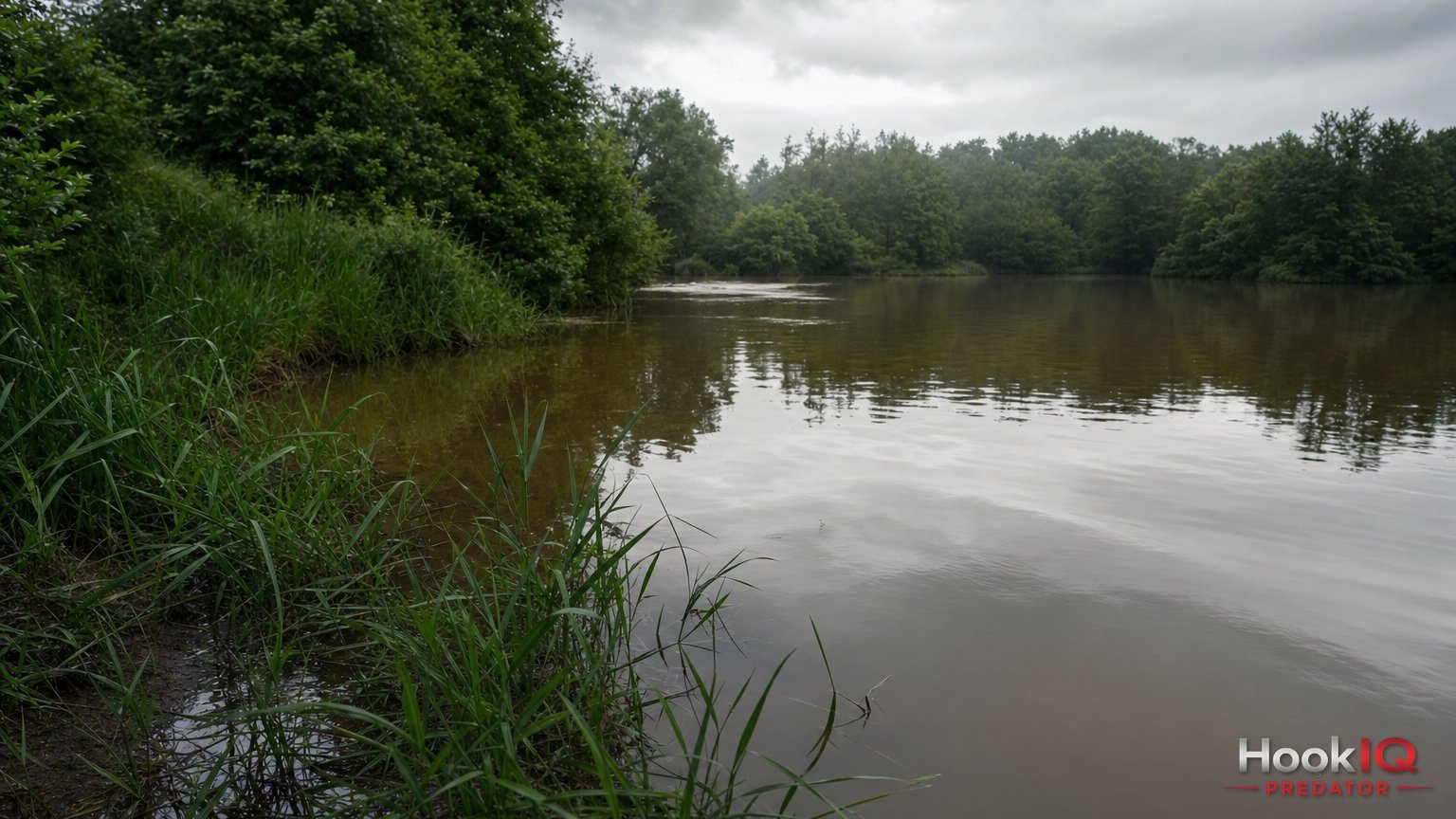
It tipped it down for half the night. When I get to the lake in the morning, the water is brown like cold cocoa, a crown of foam is drifting where the feeder stream comes in, and visibility doesn't reach two hands deep. Two anglers who were already there are packing up. Too murky, one of them says, nothing's happening today. I don't say anything, tie on a chatterbait, and just think to myself: perfect.
Why a Pike Still Feeds in Brown Water
The biggest mistake people make in murky water is assuming a pike can't hunt if it can't see. Sure, the pike is a sight predator — on a gin-clear gravel pit it will pick you apart with its eyes. But it isn't half-blind in the other sense; it has a second, hugely sensitive sensory system: the lateral line. Through this row of fine pressure receptors along its flanks, it picks up water movement and vibration long before it could ever see anything. A fleeing roach leaves a pressure-wave fingerprint, and that's exactly what the pike is tuned to read.
After heavy rain, the whole game flips for a sight predator. Suspended particles rob it of long-range vision, and suddenly the lateral line isn't a backup — it's the primary weapon. The pike moves in tighter to structure, its attacks get shorter and snappier, and it lashes out at anything in its close zone that makes the right kind of racket. A lure that only looks pretty vanishes in that soup. A lure that thumps and rattles hard becomes a lighthouse. And this is exactly where the chatterbait plays its strengths like almost no other lure.
The Chatterbait Is a Vibration Machine
Crank a chatterbait for the first time and you feel instantly what it's about. The little hexagonal metal blade in front of the jig head slams hard from side to side on the retrieve, transmits an aggressive, irregular shudder all the way up the rod blank, and throws off a wall of pressure waves that a pike reads through the murk from several metres away. A regular soft plastic kicks and wobbles — that's subtle, and in brown water often too quiet. The chatterbait, on the other hand, shouts. It's basically a vibration transmitter with a hook.
For summer pike I reach for models between 15 and 25 grams, dressed with a beefy shad trailer of 10 to 13 centimetres. The trailer isn't a decoration; it lengthens the silhouette, adds extra lift, and gives a second, softer vibration tone. What matters to me is a chatterbait with a solid wire arm and a clean-running blade, because cheap models love to tangle or roll onto their side on a fast retrieve. And with pike, there's no getting around wire: I always fish a 25 to 30 centimetre titanium leader or a hard 7x7 steel leader in front. A chatterbait working right in the close zone in front of the jaws gets inhaled mercilessly, and without a leader the lure is gone after the first decent fish.
The Weed Edge Is Your Address
In high summer, and especially after a downpour like that, pike in a lake rarely sit out in open water. They hang on the edges, where the weed stops and the open water begins. That weed-to-water boundary is a highway for prey fish and an ambush point for the pike. After rain it gets even better, because fresh water runs over the shallows, washes in food, and pushes the baitfish onto the edges.
The chatterbait is made for this terrain because it runs relatively weedless. The leading blade shoulders single strands aside instead of snagging straight away, and when I feel it picking up weed, I give a short, hard snap with the rod. Most of the time the lure rips free, and that exact moment — that sudden release and re-start — triggers the take surprisingly often. I cast as parallel to the edge as I can and keep the lure in the boundary zone for as long as possible, rather than dragging it out across the open water. Where the weed stands in clumps, I deliberately let the chatterbait run into a frond, rip it free, and let it drop for a second. That rhythm of contact, break-out, and short pause is often the whole trick in murky water.
For speed I mostly go slow to medium. The lure has to be retrieved so the blade beats cleanly and you can feel it thumping through, but not so fast that it blows straight past the close zone of a sluggish summer pike. When the fish are hesitant, I build in stops. Crank briefly, let it drop, crank on. On the drop the trailer kicks and the blade winds down, and a lot of takes come in exactly that second of stillness.
Colour Choice in Brown Water: Contrast Beats Realism
Now to colour, because a lot of nonsense gets talked about murky water. Intuition tells many anglers: dirty water, so go natural, muted colours to keep it realistic. That's exactly backwards. If the pike can barely see anyway, a realistically painted perch pattern does nothing for it. What counts is contrast. The lure has to stand out as a clear, dark or gaudy silhouette against the diffuse background.
Two directions work reliably for me. The first is loud and bright: chartreuse, fire orange, firetiger, ideally with a gold blade that flashes back the last rays of light. These colours produce maximum visibility at the short distance where the pike can still make anything out at all. The second direction is the exact opposite and is criminally underrated: deep black. A black lure throws the hardest, most defined silhouette when little light gets into the water, because it stands as a compact dark shadow against the murky residual light. On hazy, dark rainy days and at dusk, black is often my first choice. When I don't know any better, I start with black-and-gold and switch to chartreuse if nothing happens. In the end the fish decides the exact colour anyway, but the vibration brings it in, and the contrast makes it snap. In that order.
How a Typical Murky-Water Session Plays Out
Back to that brown lake from earlier. I work my way along the first weed edge — black-and-gold chatterbait with a white trailer, slow retrieve with short stops. On the fifth or sixth cast, right after the lure breaks free from a weed frond, the rod slams over. No timid tap, but that hard, dull thump only a pike delivers, one that shoots out of the murk from close range. The fish goes straight into the weed, I hold hard against it, and after a short, furious fight a solid summer pike of a good 80 centimetres slides into the net. No monster, but a fish those two packers-up left lying there this morning because the water was supposedly too murky.
The interplay of fresh murk, the weed edges, and the right light matters more here than any single lure size. I don't have to work that interplay out for myself anymore: when a window opens after rain, and how murk, wind and daylight happen to line up right now — I let HookIQ pull the factors together for me and simply watch for when the app gives the green light. That way I save myself the head-scratching and stand at the right edge at the right time.
My Takeaway
Murky water after rain isn't a reason to pack up — it's one of the best invitations to go pike fishing that summer has to offer. Don't trust the fish's eyes, trust its lateral line, and give it a vibration signal with the chatterbait that it can't ignore. Find the weed edges, keep the lure in the boundary zone, work with short break-outs and stops, and back contrast over realism — black or gaudy, not subtle. When the next storm rolls through and everyone else stays home, now you know where you need to be.