
Last October I was sitting in my boat over a break at roughly forty-five feet, eyes locked on the sonar screen, and for a second I completely forgot I was holding the throttle. Below me hung a cloud of baitfish so thick it nearly blacked out the display. And right in the middle of it, sitting slightly off to the side and noticeably bigger than everything around it, was a single, unmistakable mark. That's exactly the kind of screen that gets me out of bed early every autumn.
The Day the Sonar Screen Left Me Speechless
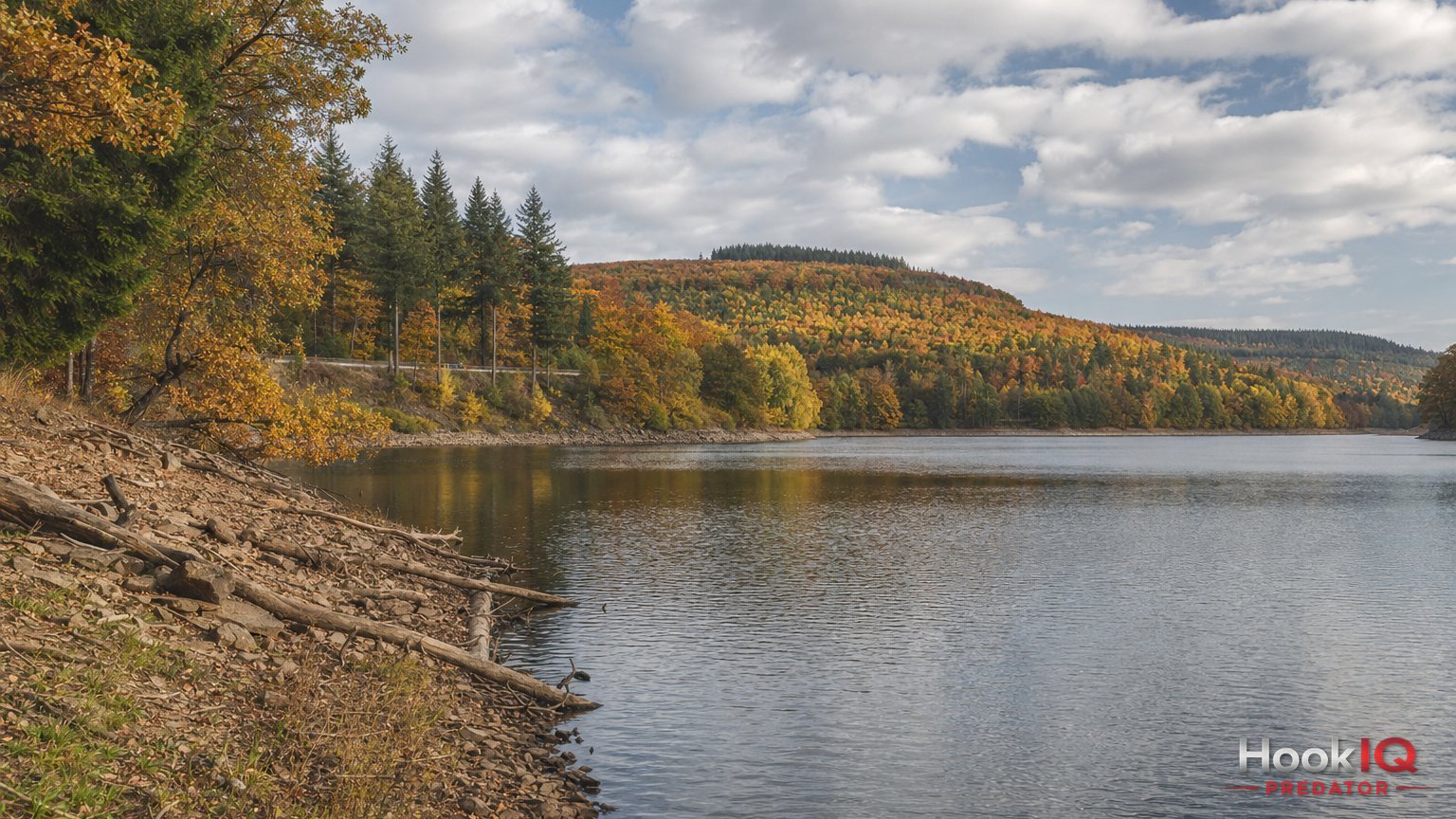
I've fished this reservoir for years, but every autumn it shows me a different face. In the days before this trip, the water temperature had dropped from about sixty degrees to fifty-two, and that slide kicks off the same chain reaction on almost every deep lake or reservoir. The warm surface layer cools down, the thermocline breaks apart, and suddenly roach, whitefish and young perch can spread through the entire water column again instead of being pinned to the top few feet. To most anglers that sounds like a dry limnology footnote, but to me it's the single most important signal of the whole year. The baitfish pull off the shallows and stack up over the old river channels, on plateaus and breaklines in thirty to sixty feet of water. And wherever that much biomass concentrates, the big pike aren't camping far away.
That morning I started out fishing my usual autumn program — weed edges in the shallows, mid-sized jerkbaits, the same setup that had put fish in the boat reliably all September. I did catch a few, but they were the usual suspects in the twenty-four to thirty-one inch range. Nice fish, no question, but not the caliber I'm actually chasing once autumn sets in.
Why My Go-To Lures Suddenly Looked Too Small
The moment I had to rethink everything came when I ran back over that same break and the sonar screen basically lit up with fish marks. It clicked that I'd been fishing right past the real action all morning. The small pike sitting in the weeds are hunting two- to three-inch fry and juvenile perch. The truly big pike — fish over forty-four inches — are long past bothering with that. A fish that size has to put on enough weight to survive the winter, and at that point only large-caliber prey is worth the energy. An eight-inch bream or a fat whitefish delivers more calories per strike than ten small roach combined. That's exactly why the biggest fish pull out to wherever the big forage is stacked in autumn — and that's no longer the weed line, it's the depths.
So I put the five-inch jerkbait away and switched to my heavy gear. That single change is what turned the whole session around.
The Turning Point: Going Big and Being Patient on the Drop
What's tied on now is a swimbait somewhere between nine and eleven inches — usually a glide bait with an internal weight-transfer system, or a soft paddle tail rigged on a serious jighead between three and four ounces. To a lot of walleye guys that probably sounds like overkill, but at forty-five feet a lure simply needs mass to reach bottom in a reasonable amount of time and actually stay down there. I fish these baits on a rod rated for at least three-and-a-half ounces, thirty- to forty-pound braid, and a sixteen-inch titanium leader, because a stiff wire leader visibly kills the action on a bait this size.
The real skill is in the retrieve. I let the bait sink all the way to bottom or down to the level of the school first, which at the weights I'm throwing can easily take fifteen to twenty seconds. That waiting period feels wrong to a lot of anglers because it feels like you're doing nothing. But that's exactly when most of my bites happen — while the bait is wobbling and gliding down through the school. After that I give it two or three long, slow cranks, pause again for several seconds, and repeat that all along the break. No frantic twitching, no aggressive jerking. In my experience, big pike in cold, deep autumn water want exactly this slow, almost clumsy presentation that mimics a dying or disoriented baitfish.
The other key piece is that I'm not blind-casting around the lake — I'm running the boat deliberately along the breaks and plateaus where the sonar shows baitfish stacked up. And I'm not targeting the thickest part of the ball, I'm targeting the edge. Big pike almost never sit in the middle of the school; they hold slightly off to the side, often one to three meters deeper or offset laterally, in position to pick off individual fish peeling away from the formation.
The Bite That Proved the Theory
That morning it happened on the fourth cast along that same break. The swimbait hadn't even made it through three cranks after the drop when the line suddenly came tight like someone had stomped on the brakes. No soft tap — a hard, unmistakable pull that loaded the rod all the way down to the handle. The fight ran close to ten minutes because the fish kept diving back down and using the depth to strip line off the reel. When it finally came up to the surface, I knew right away the switch in lure size had paid off. A pike right at forty-six inches, thick through the shoulders, with the classic blocky head of a fish that's been feeding on big forage for weeks.
If there's one thing I took away from that day, it's this: in autumn, lure size often decides fish size more than location does. Keep throwing baits sized for the small and mid-size pike in the weeds, and small and mid-size pike are exactly what you'll keep catching. Be willing to go deep, tie on a genuine heavyweight, and bring the patience for long drops — and you get access to an entirely different class of fish.
My Takeaway
For me, autumn is the time of year I pull out the heaviest leaders in the box and size my lures up across the board. The moment the water temperature drops below the low fifties and the thermocline breaks down, the action shifts away from the bank and onto the breaks, plateaus and channels where the baitfish schools stack up. A nine- to ten-inch swimbait, worked with long pauses along those structures, has put more forty-plus-inch pike in my boat over the last few seasons than any other method. I keep a close eye on water temperature because it tells me exactly when that window opens, and honestly, I don't have to piece that together myself anymore. The HookIQ app shows me the temperature curve and the best days at a glance, so I can plan my limited free mornings for exactly when the odds of a real trophy pike are highest. Pull on some warm gloves, strap on the heavy gear, and go deep. That's exactly where this year's fish of a lifetime is waiting right now.