
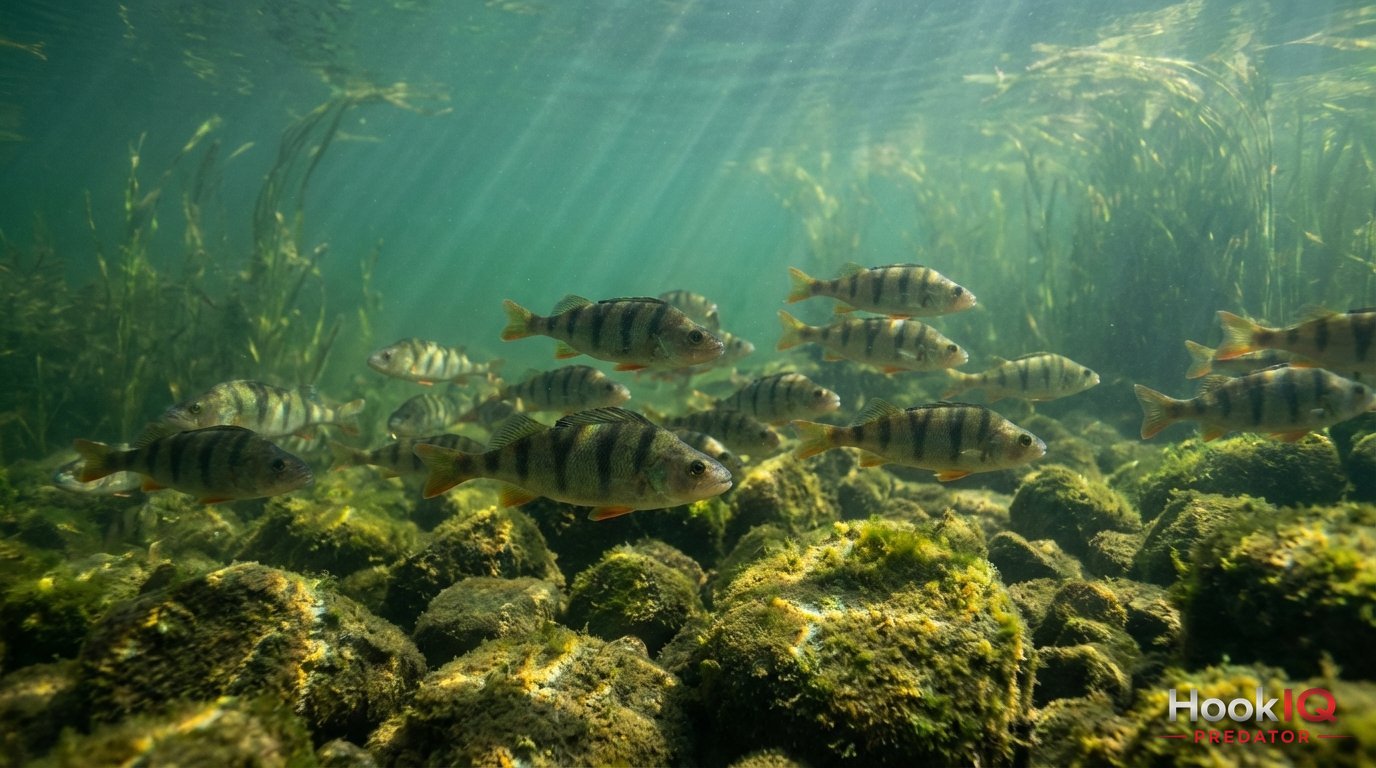
Three casts along the riprap, nothing. Switch to a jig, five casts, still nothing. Then I pulled out the drop shot rig, nose-hooked a small worm, and let the weight sink to the bottom. Ten seconds of doing absolutely nothing. Just watching the rod tip. And then that faint tremor, barely perceptible, more intuition than sensation. Hook set. A perch built like a rugby ball hanging on the fine hook, pinned perfectly in the front of the mouth. That's how drop shot works. Once you've figured it out, you'll never want to fish without it.
Why Drop Shot Works So Damn Well for Perch
There are days on the water when everything clicks. The perch are fired up, chasing jigs and smashing shads like there's no tomorrow. On days like that, you don't need a drop shot. But those days are rare. Far more often you're standing at the water's edge, watching fish on your sonar, and nothing's happening. The perch are sitting there, grouped up at six to eight metres deep, right above the bottom, ignoring everything that swims past them. That's exactly when the drop shot rig comes into play.
The crucial difference from every other finesse technique comes down to one simple principle. The lure suspends freely above the bottom, completely independent of the weight. It hangs there in the water column and moves with the slightest current, the gentlest twitch of your rod tip. It doesn't imitate fleeing prey. It imitates an unsuspecting, easy meal. And that's exactly what passive perch want. Not a frantic escape, but a convenient snack they can inhale without effort.
I've been fishing for predators for over thirty years, and if I'm honest, no technique has fundamentally changed my perch fishing the way drop shot has. It's the method that still produces fish on the toughest days.
The Rig in Detail
The drop shot rig is simple, but the details make the difference between catching the odd fish and consistent success. Everyone knows the basic principle: hook on the leader, weight at the bottom. But how you choose and tie each component decides everything.
Let's start with the hook. Many anglers make the mistake of going too big. For perch on a drop shot, a size 6 to 8 hook is plenty. Small hooks have a massive advantage. Perch take a lure more cautiously than pike — they inhale it. With a small hook, the lure slides into the mouth without resistance, and when you set the hook, it almost always pins perfectly in the front of the lip. Bigger hooks create resistance during the inhale, causing the perch to spit the lure straight back out.
For the knot, I use a simple Palomar knot that keeps the hook standing cleanly away from the leader. Thread the fluorocarbon through the hook eye, form a loop, and pass the hook through the loop three times. Moisten the knot and cinch it down carefully. The hook should stand at a right angle to the leader — that's exactly what you want. The lure suspends freely and can move unhindered on the hook shank.
I choose weight based on a simple rule: as heavy as necessary, as light as possible. On a calm lake at three metres depth, 5 grams is enough. On a canal with light current, I go for 10 to 12 grams. At deeper spots or in stronger wind, 14 grams is fair game. You always want bottom contact, but the weight shouldn't stick to the bottom like an anchor. Clip-on weights are particularly handy — you simply pinch them onto the line. They let you adjust the distance between lure and bottom in seconds without retying. That's worth its weight in gold when you realise the perch aren't sitting right on the bottom today but half a metre above it.
Speaking of distance: the leader length — the gap between hook and weight — is one of the most underrated factors in drop shotting. My starting point is 40 centimetres. If the fish are glued to the bottom, I drop it to 20 to 25 centimetres. If they're sitting higher in the water column, I extend it to 50 to 60 centimetres. This adjustment alone can make the difference between a blank and twenty fish.
For leader material, I use 0.20 to 0.25 mm fluorocarbon. There are several reasons. Fluorocarbon is virtually invisible underwater, which is a real advantage in the often crystal-clear waters where perch live. It also has slight stretch, which helps enormously when playing fish. Especially with small hooks and light rods, you lose fewer fish because the fluorocarbon absorbs shocks and prevents the hook from tearing free.
The Right Lures: Less Action, More Seduction
When drop shotting for perch, there's a rule of thumb that rubs many anglers the wrong way at first: the less built-in action a lure has, the better. It sounds counterintuitive, but it makes perfect sense once you understand how the rig works. The lure hangs freely on the hook and responds to the tiniest impulses. Every current, every twitch of the rod, even surface chop creates micro-movements that make a subtly vibrating lure look far more enticing than a wildly paddling grub.
That's why my first choice is always no-action shads or stick baits. Models like the Shaky Lui, Pin Tail or Dream Shot have a slim body with a small tail that quivers and shakes at the slightest pressure. Underwater, these lures look like a small fish hovering motionless in the water column, barely moving. Exactly the image that triggers a passive perch into striking.
For rigging, I use two approaches. The standard is a nose hook, where you push the hook once through the nose of the soft plastic. The lure hangs freely on the hook shank and moves naturally. In weedy waters with filamentous algae, I switch to an offset hook. The hook point is buried in the body of the lure, which means you pick up far less weed. The trade-off: your hook-up rate drops slightly because you have to punch through the plastic on the hook set.
Over the years I've developed a simple colour strategy. Green pumpkin or chartreuse as a starting point — you can't go wrong with those on nine out of ten waters. In sunny conditions with green-tinted water, I switch to orange or motor oil. And when nothing's working, I try very light, almost translucent colours.
Lure size for perch typically runs between 5 and 8 centimetres. I start at 7 centimetres and downsize when I'm getting too many missed bites. Here's a tip I picked up years ago from an experienced tournament angler, and it's proven true hundreds of times: when perch keep pecking at the lure but won't commit, they're not being too cautious. The lure is simply too big for them.
One more detail on plastic compound. In shallow water where you're often sight-fishing, I use softer plastics. They respond to the slightest impulse and look incredibly lifelike. Once you go deeper, past about six metres, I switch to firmer compounds. They create more pressure waves underwater because they offer more resistance and transmit stronger impulses. That matters in deeper water, where perch often feel a lure before they see it.
Lure Presentation: The Art of Doing Nothing
Lure presentation with a drop shot is the biggest adjustment for any angler coming from jigging or other active techniques. Because the best thing you can do is often: nothing. Or almost nothing.
My go-to technique is the stationary twitch. Cast out, let the weight sink to the bottom, then work with just the rod tip. Tiny twitches, barely more than a tremor at the tip. The lure dances above the bottom, moving a few centimetres side to side, but essentially stays in one spot. No other rig can do this. With a jig, you always have to move. With a Carolina rig, you drag across the bottom. Only the drop shot lets you present a lure at the exact same spot for minutes on end while keeping it looking alive.
The second approach is passive holding. You simply let the lure work in the current or wave action. Sounds mad, but on many days it's all you need. Especially when perch are extremely passive — in cold water or after a weather front — sometimes the best presentation is no presentation at all. The lure sits in the water column, vibrating ever so slightly. Eventually, even the laziest perch can't resist, and it inhales the thing.
Then there's the lift and drop, which feels a bit more like classic jigging. You slowly raise the rod, let the lure rise, then lower it again. The lure glides back down, and it's precisely during this falling phase that most bites come. I use this retrieve when I'm searching a larger area or when the perch are a bit more active.
One small detail I underestimated early on: the choice of weight shape affects the presentation more than you'd think. A pencil weight slowly tips over when stationary, creating a tiny impulse through the line that transfers to the lure. It sounds trivial, but I'm convinced that exactly these micro-movements make the difference on difficult days.
The Right Tackle
Drop shotting for perch is all about sensitivity, and that starts with your tackle. You don't need an arsenal of specialist rods, but a well-thought-out combo makes your fishing more efficient and the experience more intense.
My standard drop shot rod is 2.10 to 2.20 metres long with a casting weight of 3 to 14 grams. From a boat, the shorter option works fine. When I'm fishing from the bank, I reach for the 2.40 metre rod because the extra length gives me more casting distance and helps me guide the lure more precisely over obstacles. The rod tip is crucial. A soft tip — ideally a solid tip — is worth its weight in gold for drop shotting. It shows you bites you'd never feel with a stiff rod. Perch often inhale the lure so gently that all you see is a slight loading of the tip — no tap, no thump. With a solid tip you detect it. With a stiff jig rod, you don't.
Pair that with a 2500-size reel spooled with fine 8-strand braid, ideally 0.06 to 0.08 mm diameter. The thin braid provides maximum sensitivity and minimal resistance in the water. In wind and current, a thicker line makes your rig uncontrollable because it acts like a sail, dragging the weight off the spot.
When and Where Drop Shot for Perch Works Best
Drop shot is a year-round technique, but there are phases when it clearly outperforms other methods. In autumn, when water temperatures drop and perch school up at deeper spots, drop shot is my absolute number one. The fish often stack up along ledges, over rock fields or along sheet piling, but they're not actively hunting. They're waiting. And that's exactly the situation drop shot was made for.
In winter, with water temperatures below 8 degrees, it gets even better. Perch are in maximum energy-saving mode. Every unnecessary movement costs calories they don't want to spend. A jig crashing through the water at twelve grams is more likely to spook them than trigger bites. A drop shot lure sitting motionless in the current, barely vibrating, is exactly the right offer.
But drop shot also earns its place in summer, especially on waters with heavy weed growth. While a Carolina rig constantly picks up filamentous algae and a jig has to plough through the greenery, a drop shot lure hovers elegantly above it all. The weight collects some weed too, but the hook stays clean. On some lakes with dense growth, drop shot is the only method in summer that can present a lure cleanly at all.
As for hotspots: anywhere perch gather and hold, drop shot is a banker. Riprap along canals, groyne fields on rivers, sheet piling in harbours, drop-offs at gravel pits. What these spots have in common: clear structure where perch hold, and enough depth to deploy the rig effectively. From two metres of water depth, drop shot works brilliantly. Under one metre it gets impractical — other techniques are better suited there.
Drop Shot vs Jig vs Carolina Rig: When Do I Reach for What?
I'm often asked why I don't just fish a jig all the time. The answer is simple: every technique has its sweet spot.
The jig is my first choice when I'm searching a water and need to find fish first. With a jig I cover large areas quickly, fish actively, and trigger reaction strikes from fish that are in the mood. As soon as I've located the perch and notice they're not biting aggressively, I switch to drop shot. Then it's no longer about finding the fish, but about persuading them to bite.
The Carolina rig sits somewhere in between. It's more finesse than the jig, but it works along the bottom. On clean, hard substrates, it's a fantastic method. But as soon as filamentous algae, leaf litter or fine silt come into play, you've got a problem. Your lure drags weed constantly, and the presentation falls apart. The drop shot hovers above it all and stays clean.
The biggest advantage of the drop shot over both other techniques is the ability to fish stationary. You can hold your lure at the exact same spot for minutes and keep it looking alive. Neither a jig nor a Carolina rig can do that. And that's the key when perch are sitting passively on a spot and aren't willing to chase a moving lure.
Practical Tips That Make the Difference
To wrap up, here are a few things I've learned over the years that will save you missed bites and lost fish.
Perch are masters at stealing lures. Smaller fish especially will pull the soft plastic off the hook without you ever feeling a bite. A small bait holder — a spiral you screw into the lure and thread the hook through — solves the problem almost entirely. The lure sits rock-solid, and no perch in the world gets it off without getting hooked in the process.
When it comes to the hook set, I'd advise patience. Drop shot isn't jig fishing where you hammer home the hook immediately. When you feel a bite, drop the rod tip briefly to give the fish a bit of slack, then set the hook with a controlled lift. No heave, no overhead strike. Just sweep through and build contact. The small hooks practically set themselves.
Missed bites are part of drop shot fishing, more so than with other methods. If you notice the fish keep pecking at the lure but won't stick, downsize. From seven to five centimetres — that's often enough. And if that still doesn't help, switch from a stick bait to a slimmer worm. Sometimes perch simply want it even more minimalist.
Pay attention to water temperature. Above 14 degrees, perch still behave in a summery, aggressive manner, and you can present more actively. Between 8 and 14 degrees it gets interesting — the fish are there, but picky. Below 8 degrees you're into proper winter fishing, and patience becomes your most important skill. On those days, I'll happily let the lure sit in one spot for 30 seconds or longer before I do anything at all. It feels wrong, but it works.
Drop shot is a technique that makes you grow as an angler. It forces you to slow down, look more closely, fish more delicately. And it rewards you with fish on days when everyone else has packed up and gone home. Tie a rig tonight, pack a few small stick baits, and give it a go. You won't be disappointed.