
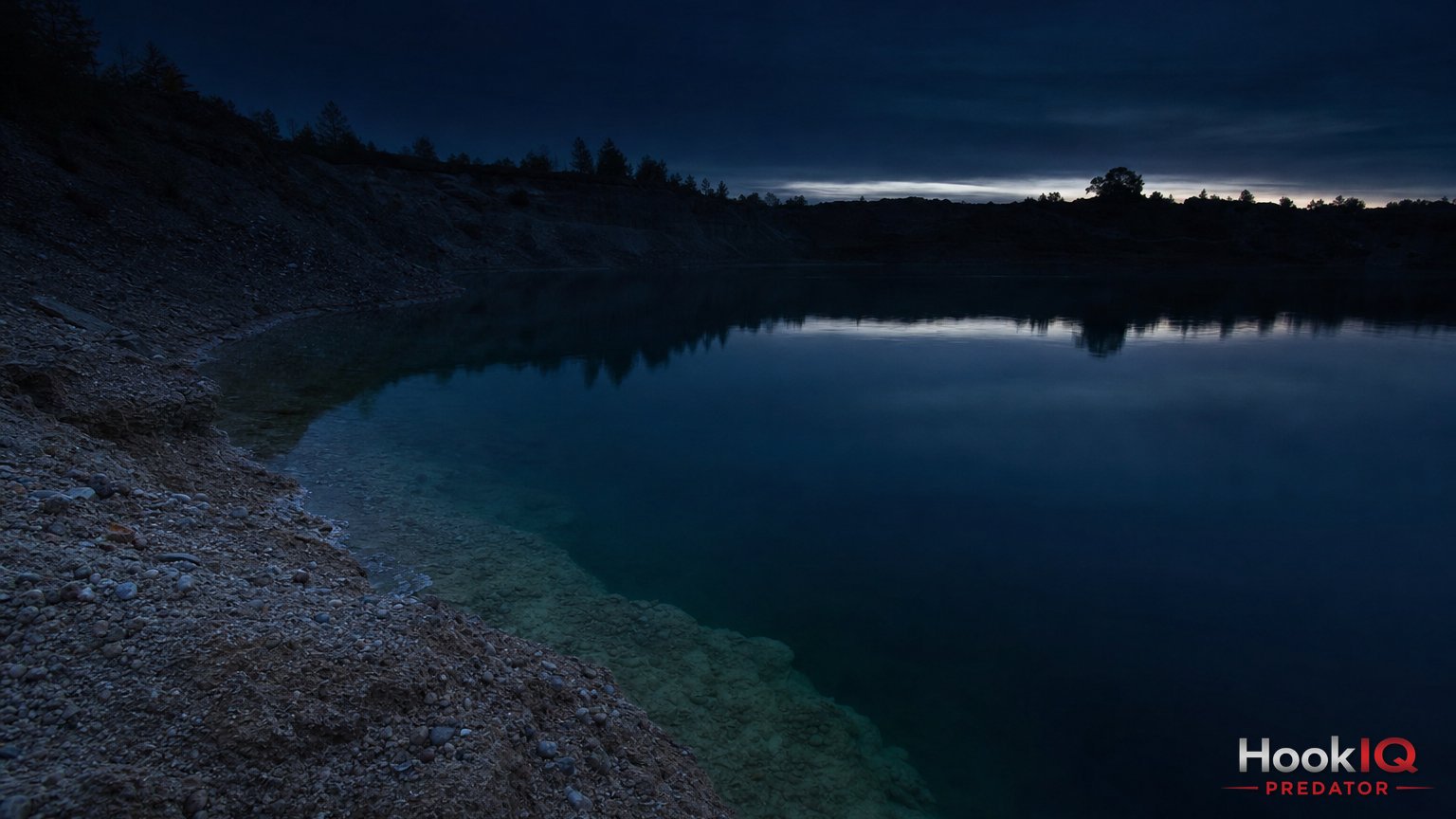
Twenty metres of visibility, no current, no weed — just gravel and silence. The gravel pit lake is the venue where most zander anglers fail, because they turn up with the same tactics that work on canals and rivers. Let me tell you straight: forget everything you know about jigging on flowing water. Gravel pits play by different rules.
Why Gravel Pit Lakes Are a Different Game
Most gravel pit lakes across Europe are former quarries, and that's exactly what makes them so unique. The water is gin-clear, often with visibility of ten metres or more. The bottom is gravel and sand, with the odd slab of rock or remnants of old excavation equipment. There's virtually no current, no turbidity, and the zander have all the time in the world to inspect a lure before committing. Or deciding to pass.
What many anglers underestimate: in these clear waters, zander hold significantly deeper than in murky canals. In midsummer, when surface temperatures climb to 24°C, you'll often find them between eight and fifteen metres deep. It's cooler down there, oxygen levels are right, and the light is subdued enough for a zander to feel comfortable. The key word is thermocline. Below this temperature layer, the water drops noticeably colder — and that's exactly where the fish sit.
The Plateau Edge: Your Number One Hotspot
Every gravel pit has underwater topography worth studying. The most productive features are the plateau edges — areas where a shallow shelf drops steeply into deeper water. Picture a ledge falling from six to twelve metres. Zander patrol these edges because they offer cover and allow the fish to move between deep and shallow water in seconds. Baitfish often hold on the plateau itself, with the zander lurking right on the drop-off.
It took me years to understand that casting randomly into a gravel pit is a waste of time. A fish finder — or at the very least a decent contour map — is essential. Without knowing the topography, you're fishing blind. And fishing blind in a venue that's ninety percent featureless, deep water is pointless.
Once you've found the edge, look for additional detail. Is there submerged timber? A small hump, a depression, a patch of coarser gravel? Even the slightest irregularity can be a holding spot. Zander in gravel pits are territorial. Find a good spot once, and it'll keep producing for months.
Dropshot: The Go-To Rig for Clear Water
Why dropshot? Because this rig does three things that matter on gravel pit lakes. First: the lure hovers in place, just above the bottom, without moving. In a venue where zander scrutinise every lure, this ability to stay perfectly still is worth its weight in gold. Second: you can bring the lure to life with the smallest movements. A subtle shake of the rod tip is enough to make the soft plastic twitch without displacing it. Third: you maintain bottom contact through the weight while the lure suspends above it. This gives you an incredibly precise feel for the substrate — and for every bite.
The Setup: Why Your Leader Needs to Be Long
This is where things get technical, and where most anglers go wrong. The standard dropshot rig with a twenty-centimetre gap between hook and weight works fine on canals or in harbours. In a gravel pit, you need far more separation, because in this clear water the fish can see the weight and it spooks them. I fish with leader lengths of fifty to eighty centimetres between hook and weight. Sounds like a lot, but it makes a massive difference.
The logic is simple: the longer the leader, the more naturally the lure moves. It has more freedom to swing and sway, and the weight sits far enough away to avoid putting the fish on edge. In exceptionally clear water — visibility beyond ten metres — I'll go up to a full metre of separation. That requires an adjusted casting technique because the overall rig gets considerably longer, but trust me, it's worth the effort.
For leader material, I use fluorocarbon exclusively, in 0.22 to 0.25 mm. Fluorocarbon has virtually the same refractive index as water, making it practically invisible underwater. In clear gravel pit water, that's not a luxury — it's a necessity. Mono or wire have no place here. The mainline is a thin braid, 0.08 to 0.10 mm, connected to the fluorocarbon leader via a small swivel.
Lures: Think Small, Stay Natural
In gravel pits, less is more. Forget the 12 cm shads that are standard on canals. Here, I fish with soft plastics between five and eight centimetres. Slim pin-tail models or small creature baits work best because they imitate the natural prey in these waters — small baitfish, juvenile perch, gobies. That's the forage zander are keyed in on.
For colours, I stick to natural tones. Translucent lures in green, brown or smoke are my first choice. On low-light days or in the early morning hours, a subtle glitter in the body can make the difference, but bright shock colours are usually counterproductive in clear water. There's one exception: when zander become active at dusk and move into shallower water, a dark lure in black or motor oil can work surprisingly well. It stands out as a silhouette against the still-bright sky above.
I prefer nose-hooking the lure. The soft plastic hangs from just the nose, free to react to the slightest impulse in the still water. An offset hook in size 2 to 4 provides enough gap for a solid hookset without restricting the small lure's movement.
Lure Presentation: Patience Is Not a Weakness
Dropshotting a gravel pit is, above all, an exercise in patience. You cast the rig to the plateau edge, let the weight sink to the bottom, and wait. Sounds boring — it isn't. Once the weight touches down, keep the line taut and let the lure just hover. Ten seconds, twenty seconds, sometimes thirty. Then give a subtle impulse through the rod tip. No jerk, no snap — just a gentle quiver, barely more than a slight vibration of your hand. The lure twitches, wobbles briefly, and goes still again.
My typical sequence on gravel pits: fifteen seconds of dead time, two gentle twitches, dead time again. After a minute, I lift the weight and reposition it a metre further along the edge. This way, I work the drop-off systematically, metre by metre. It's not fishing for the impatient — but it's devastatingly effective.
One mistake I see many anglers make: they move the lure too much. In clear water, a zander has plenty of time to study the bait. If it's darting around erratically, it looks unnatural. A real baitfish hovering above the bottom barely moves. It flicks a tail fin, turns slightly, then holds still again. That's exactly what you need to replicate.
The Bite: Focus in the Silence
The bite usually comes during the pause. The lure is still, you're holding tension, and suddenly there's a subtle weight loading into the rod. No sharp tap like you'd get jigging on a canal — more of a soft, progressive pull, as if something has gently attached itself to the lure. That's the moment you need to be switched on. Lift the rod, take up the slack, and set the hook with a controlled sweep. Not too hard — with a fine fluorocarbon leader, an aggressive strike risks a snap-off.
Especially in midsummer, when water temperatures are high, zander in gravel pits bite with extreme caution. They pick up the lure, hold it briefly, and drop it again if anything feels wrong. A leader that's too heavy, a hook that's too large, a lure that behaves unnaturally on the take — any of these can cause the fish to eject the bait before you even register the bite.
The Right Rod and Reel
This style of fishing demands sensitive tackle. A dropshot rod between 2.10 and 2.40 metres with a fast-action tip and a casting weight of no more than 15 grams gives you the sensitivity you need. The tip must be soft enough to transmit delicate bites, but the backbone in the mid-section needs to be strong enough to drive the hook home at range. I prefer rods with a solid tip for this application — it lets me feel every contact, even during the dead phases.
For the reel, a 2500-size spinning reel with a smooth, finely adjustable drag is all you need. I set the drag on the lighter side, because when a good zander shakes its head during the fight, the fine fluorocarbon leader is the weak link. Better to give line than to risk the fish snapping the leader on the first run.
The Best Times on Gravel Pit Lakes
In midsummer, the early morning hours and the evening twilight are the most productive windows. When the sun sits low, zander move closer to the plateau edge and become more active. During the midday heat, when the sun beats straight down into the water, they often sit motionless in the depths and are nearly impossible to tempt.
One tactic that has consistently produced good fish for me over the past few summers: I start around eight in the evening on the plateau edge and work it systematically until dark. The last half hour before full darkness is usually when it all happens. The zander push up the edge, sometimes to just five or six metres deep, and become noticeably more aggressive. That's the moment when the cautious nibbles stop and proper strikes begin.
What Hundreds of Sessions Have Taught Me
Zander fishing on gravel pits has taught me that sometimes, fishing means doing almost nothing. On venues with current, turbidity and structure, you can compensate with an active retrieve. Not on gravel pits. Here, you need to serve the lure to the fish as if it were a real, unsuspecting baitfish. And then you need to wait.
Dropshotting with a long leader on the plateau edge isn't a spectacular method. There are no rod-wrenching takes, no surface explosions, no adrenaline rush on the retrieve. But when the rod tip comes alive after twenty minutes of silence and you're pumping a solid zander up from ten metres of depth, you know exactly why you're doing this. Because you outsmarted that fish. In its element, on its terms, with a method that demands patience and precision.
Give it a go. Find a gravel pit with decent depth, locate the edge, tie a long dropshot rig, and take your time. The zander are there. You just need to show them you mean business.