
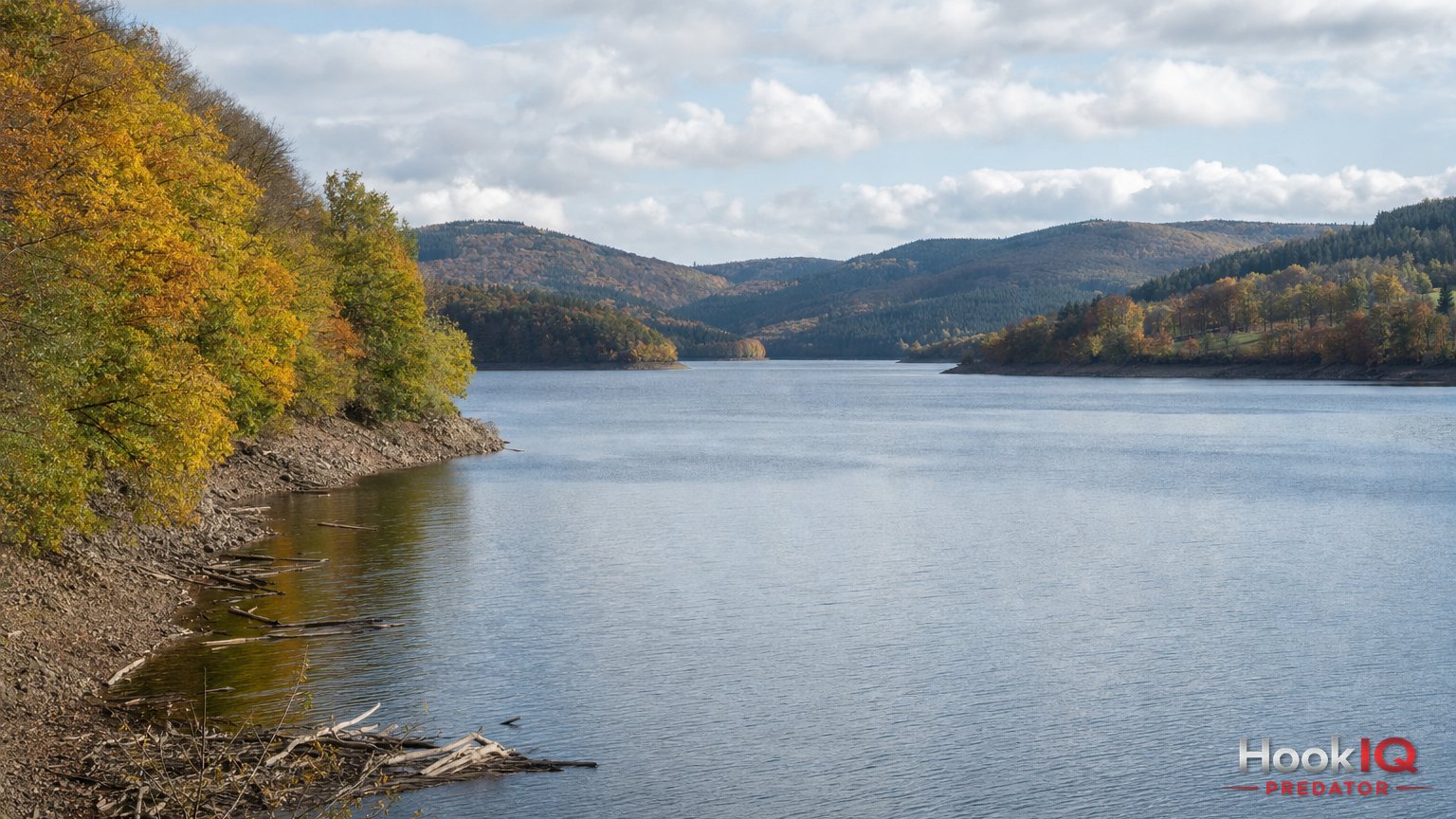
I'm sitting in the boat, transducer hanging two meters below the surface, and the screen is finally showing exactly what I've been waiting days for. No more sharp line at nine meters that marked the border between warm and cold water all summer. Instead, one smooth gradient running from the surface clear down to twenty meters. The thermocline is gone. And that single fact is about to change everything I thought I knew about this reservoir.
When the Thermocline Collapses
All summer long, the water in the reservoir organized itself into layers. Warm and oxygen-rich on top, a sharp temperature break — the thermocline — below that, and underneath it a cool, often oxygen-poor dead zone where predators rarely linger. That layering was my most reliable compass through July and August. The zander held almost exclusively just above or right on that break, because that's where the baitfish were and the conditions still worked.
By October the surface cools faster than the depths, the water becomes roughly the same density top to bottom, and at some point the whole system flips. The layers collapse, the lake mixes from top to bottom — anglers call it fall turnover. For me on the water, it means one thing above all: oxygen spreads back down to the deepest holes. Zander can suddenly use water that's been off-limits to them since May. Anyone still stubbornly fishing the old thermocline depth is often casting into empty water while the fish have already dropped ten meters deeper or scattered into open water altogether.
Your Sonar Is Your Eyes Down There
On a reservoir with twenty, thirty, or more meters of water, sonar isn't a nice-to-have for me — it's half the game. Without a transducer I'd be fishing blind most days, and on water this big, that's a straight-up waste of time.
I start by running Side Imaging along the known edges — the old creek channels and riverbeds that ran above ground before the dam went in, and the breaks where flats drop into steep banks. Once I've marked structure, I switch to traditional Down Imaging and study the water column right under the boat. What matters most is how the baitfish are stacked. Tight, dense balls sitting at fifteen to eighteen meters with a few bigger arches right underneath or mixed in — that's my cue to stop and start jigging immediately. Loosely scattered, thin clouds of baitfish with no predators showing are my cue to keep moving.
What a lot of anglers underestimate is how fast these pictures change in the fall. Because turnover keeps zander on the move, a spot loaded with fish yesterday can be dead today. On a good day I'll run through three or four different areas of the reservoir before committing to one, and that constant cross-checking on the sonar is the difference between boating one fish and boating five by the end of the day.
Jig Heads for Deep Water
Once I've found a baitfish concentration at fifteen meters or deeper, my lure choice changes completely too. The 10 to 12 gram jig heads that work fine on a canal or river don't get me to bottom fast enough out here — not even close. On the reservoir in fall, I default to weights between 28 and 40 grams, depending on how much the wind is pushing current and how thin my braid is.
The shape of the jig head matters more than most people think. Classic round-head jigs tend to spin slightly on the drop at this depth, which twists your line and wrecks bite detection. That's why, at these depths, I almost exclusively fish football or darter heads — they fall straighter and don't tip over when they touch down. An 8 to 10 cm shad on a 32 gram football head sinks for me at roughly three seconds per meter, and I use that entire drop to watch the rod tip and treat any hiccup in the fall as a potential bite.
Line choice is inseparable from all of this. A thin, low-diameter 0.13 to 0.15mm braid cuts water resistance and lets the jig head track straight down instead of bowing out the way thicker line does, which hides bottom contact from you. With the wind that's almost always blowing on open reservoirs, that difference is exactly what separates a clean bite registering at the jig head from a hookset into nothing.
Targeting Deep Edges
Deep edges on a reservoir are my first stop in the fall because they offer exactly what the fish are looking for after turnover. Steep or vertical breaks running from ten down to twenty meters work like an elevator between depths, and zander use them to swing shallow to feed or drop back into the safety of deep water, depending on time of day and light.
I usually position the boat parallel to the edge, drop the jig head right on the break line, and work it along the slope with short, controlled hops instead of casting across the edge. That keeps the bait in the strike zone longer instead of letting it blow through in two or three seconds. The real money spots for me are where a break meets a small shelf or ledge halfway down the slope — mini-plateaus on the face of the drop. Zander will park there for hours, waiting on baitfish sinking down from above.
Open Water: The Underrated Spot
What a lot of anglers completely miss on a reservoir is open water with no bottom structure at all. After turnover, zander increasingly follow the baitfish schools, and in the fall those schools often sit in the middle of the lake over twenty or twenty-five meters of water with zero relation to any edge or plateau.
So I run routinely straight across the big open-water flats and watch the screen the whole time. The moment I see a dense, compact baitfish cloud with a few deeper hits mixed in, I stop the boat right on top of it and drop the jig head straight down to just above the baitfish. Open-water jigging like this feels strange at first because you've got no bottom and no structure to key off of. But that's exactly what makes it worth doing. Once you learn to recognize the bite as nothing more than a short pause in the line on the drop, you know you just fooled a zander that was completely invisible a minute ago.
This kind of hunting — where water temperature, mixing, and baitfish behavior rearrange themselves constantly — is also why I check the HookIQ app before every session now. It pulls together the factors that actually matter on a day like this and tells me whether a trip to the reservoir is even worth the drive before I commit to the long haul out.
Bottom Line
Fall turnover on the reservoir is the moment every year when I have to rethink my whole approach to zander fishing. The thermocline stops being a reliable reference point, but in exchange the entire depth range opens up to the fish. Anyone who keeps grinding it out with sonar, switches to 28 to 40 gram jig heads in a stable football shape, and works both the deep edges and the seemingly empty open water will boat some of the best zander of the year over the next few weeks. Grab a warm jacket, charge up the sonar battery, and get out there.