
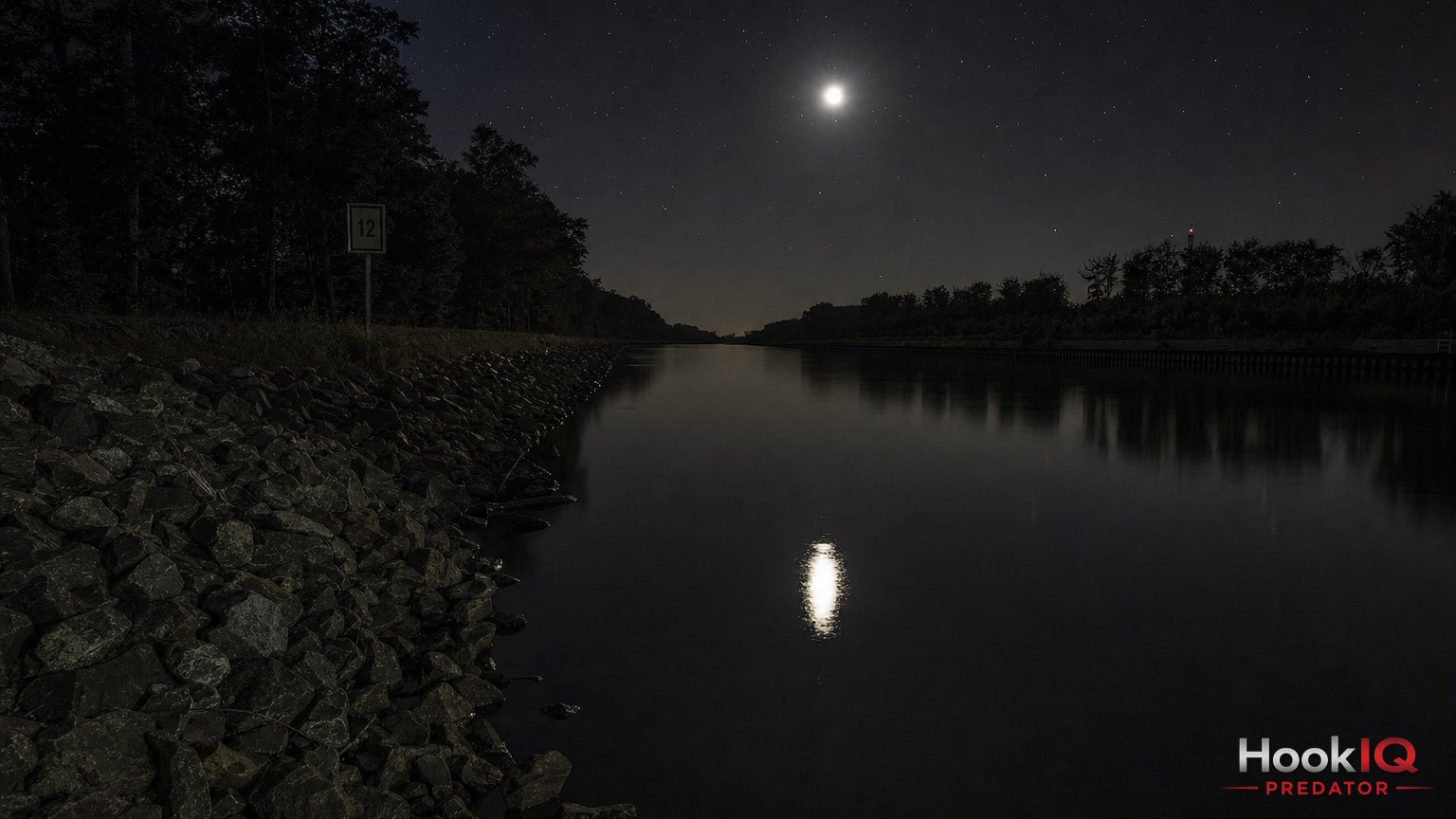
Friday evening, half past nine, the air hanging like a wall over the canal. No wind, not a cloud, the water like glass. I've been standing here for four hours without a single contact. Then, as I jig my soft plastic along the riprap for maybe the fiftieth time, it happens — three zander in a twenty-minute window, one of them just over seventy centimetres. After that, it's over. Like someone flicked a switch. If you've experienced evenings like this, the question is inevitable: what triggers these short, violent bursts of activity?
The Four Key Factors
There's an entire industry promising anglers it can predict the perfect bite time. Solunar tables, barometer apps, moon calendars. Over thirty-plus years, I've tried most of them, dismissed some as nonsense, and revised my opinion on others. What I know today: there are four factors that measurably influence the feeding behaviour of predator fish. None of them works in isolation, and none of them is a guarantee. But if you understand how they interact, you'll find yourself on the water at the right time far more often.
Barometric Pressure: The Underrated Trigger
Few topics spark more debate among anglers than barometric pressure. Some swear that falling pressure flips the feeding switch. Others call the whole thing superstition. My experience after thousands of days on the water is clear: barometric pressure does influence predator activity — just not the way most people think.
It's less about the absolute reading. Whether the barometer sits at 1010 or 1025 hectopascals barely matters on its own. What counts is the change. Stable pressure over two or three days means stable conditions, and stable conditions mean predictable fish. A sudden drop of 10 hectopascals or more within a few hours — typical ahead of a low-pressure system — triggers a short but intense feeding response in many predators.
Why? The swim bladder reacts to pressure changes. A rapid drop creates discomfort that pushes fish into moving actively — and feeding as they go. That's why the hours right before a weather change are often so productive. I've seen it dozens of times, especially with zander: two hours before a thunderstorm, the clouds stacking up, the air turning heavy, and suddenly the jig gets slammed. The window is short — sometimes just thirty minutes — but the bites are aggressive.
Conversely, the hours after a cold front passes, when pressure rises sharply, are often the toughest. Fish need time to adjust to the new conditions. A pike that was lurking in a weedbed under stable high pressure won't start feeding again immediately after a 15-hectopascal spike overnight. That can take a day or two.
My practical tip: don't watch the barometric pressure itself — watch its trend over the last 24 hours. My best feeding windows come during slightly falling to stable pressure. Rapidly rising pressure after a spell of bad weather? That's when I stay home and organise my tackle.
Moon Phases: Between Mysticism and Data
The moon phase is the topic that splits the angling world into two camps. On one side, the solunar believers who won't make a cast without consulting the moon calendar. On the other, the sceptics who dismiss the whole thing as esoteric nonsense. I sit somewhere in between, for one simple reason: my own catch data over many years shows patterns I can't ignore.
The basic idea behind solunar theory is simple. The moon drives the tides, and the tides influence fish activity. For saltwater fish, that's beyond dispute. In freshwater, there's no tidal effect, but the moon still has an influence — through light.
Full moon nights are significantly brighter than new moon nights. That sounds obvious, but it has real consequences. A zander that can fully exploit its lateral line and superb low-light vision on a pitch-black new moon night suddenly loses its optical advantage over prey under a full moon. That changes its hunting behaviour. My experience: in clear water, zander bite noticeably better at night during the new moon than the full moon. In turbid water, where moonlight barely reaches the bottom, the difference is marginal.
Pike are a different story. Pike are sight hunters that perform better with more light. Some of my best pike sessions have come on bright full moon nights, especially in autumn and early winter when water temperatures are dropping and pike are fuelling up during extended feeding spells. A full moon over a clear gravel pit in November, a 20 cm jerkbait worked through the shallows — that can make for magical nights.
As for lunar position — the moon's location relative to the horizon — I'm more cautious. Solunar theory claims that moon transit (moon at its zenith) and moonrise/moonset create so-called major and minor periods. I've never been able to confirm that systematically. What I can confirm: the phase of the moon — full or new — has a noticeable effect that can be explained through light conditions. Anything beyond that, I consider wishful thinking.
Water Temperature: The Metabolic Engine
Of all four factors, water temperature is the only one with a direct, physiological impact on predator feeding behaviour. The reason is straightforward: predator fish are ectothermic. Their body temperature — and therefore their metabolism — is directly tied to water temperature.
Every predator species has a temperature optimum where its metabolism is most active and it needs to feed the most. For pike, that sweet spot is between 15 and 20 degrees. For zander, it's 16 to 22 degrees. For perch, 18 to 24 degrees. And for wels catfish, above 20 degrees. That's why midsummer is so productive for zander and catfish, while pike become sluggish in the heat and retreat to deeper, cooler layers.
But it's not just about absolute temperatures. Just like barometric pressure, it's the changes that trigger activity. A temperature rise of three degrees within a few days — say after a warm spell in early summer — can set off a full-blown feeding frenzy. I remember a June on the Rhine when water temperature climbed from 16 to 21 degrees in a single week. The zander went berserk. We caught double figures three evenings in a row, every single bite coming in the last hour before sunset.
Conversely, a sudden temperature drop can shut fish down for days. After heavy rain or snowmelt, when cold water floods in, there's often radio silence for days. Fish need to adjust their metabolism to the new conditions.
Right now in midsummer, with water temperatures around 22 degrees, conditions are optimal for zander and perch. Metabolism is running at full throttle, and the fish need to feed regularly. But be warned: above 24 degrees, the situation flips. Dissolved oxygen drops, and fish become lethargic. In those phases, the coolest hours of the day — early morning between four and seven — are often the only productive window.
Light: The Daily Rhythm Setter
Light is the factor anglers understand most intuitively because we feel it most directly. Every experienced predator angler knows: dusk and dawn are prime time. But why exactly?
The answer lies in evolutionary biology. Predator fish evolved as crepuscular hunters because twilight gives them a decisive advantage over their prey. The eyes of many predators — especially the zander with its tapetum lucidum — are optimised for low light. At dusk, they see better than their prey, and they exploit it.
The link is clearest with zander. In clear water, bite windows are almost exclusively limited to the twilight phases and nighttime. Fishing for zander in broad daylight on clear water is, in most cases, a losing game. In turbid rivers like the Rhine or the Elbe, it's a different story — zander can be active during the day because the murky water filters the light, creating permanent twilight conditions below the surface.
Pike are more flexible. They hunt in both bright light and twilight but still show activity peaks during the transition periods. What many don't realise: pike have a pronounced midday bite, especially in winter. When the low-angle sun hits the shallows and warms them by a couple of degrees, pike switch on. In midsummer, activity shifts to the early morning and late evening hours instead.
Perch are the most light-dependent predator. They're dedicated sight hunters that need good light to hunt effectively. That's why perch are often more active during the day than at twilight, especially in clear lakes. On overcast autumn days with drizzle, when the light is diffused and soft — no harsh shadows, no glare — I've had my best perch sessions.
Cloud cover also plays a major role in light intensity. An overcast sky can extend feeding windows by softening the harsh midday light. On cloudy summer days, zander sometimes bite right through the afternoon, while on bright sunny days they don't switch on until eight in the evening. That's one of the reasons why bad weather days are often the better fishing days.
When Everything Aligns
The most exciting moments on the water happen when multiple factors line up at once. Picture this scenario: early July, water temperature sitting at a stable 21 degrees, barometric pressure falling slowly but steadily since the afternoon, clouds sliding in front of the sun creating soft, diffused light, and it's a new moon. Those are the evenings when you should be on the water every single minute, because the odds of an explosive zander and perch feeding window are sky high.
Conversely, there are combinations where I don't even bother going. Bright sunshine, rising pressure after a cold front, water temperature three degrees colder than the day before, plus a full moon. The venue can be as good as it gets — the fish are glued to the bottom and nothing is moving.
Over the years, I've learned to plan my fishing calendar less around my diary and more around the conditions. That's a luxury not everyone has, of course. But even if you can only get to the water at weekends, choosing the right hours makes an enormous difference. Standing on a canal with a zander rod at 2 p.m. on a scorching July day is a waste of time. But the same canal at 10 p.m., 21-degree water, slightly falling pressure — that's an entirely different game.
What I Want You to Take Away
There's no app and no table that can tell you exactly when the next bite is coming. Predator fish aren't machines, and nature doesn't fit into algorithms. But there are patterns, and if you learn to read them, you'll catch more fish. Watch the barometric pressure — especially how it's changed over the last few hours. Factor in the moon phase when planning your night sessions. Know the temperature sweet spots for your target species and fish at the times of day that match the current light and season. And when everything lines up — drop whatever you're doing and get to the water.