
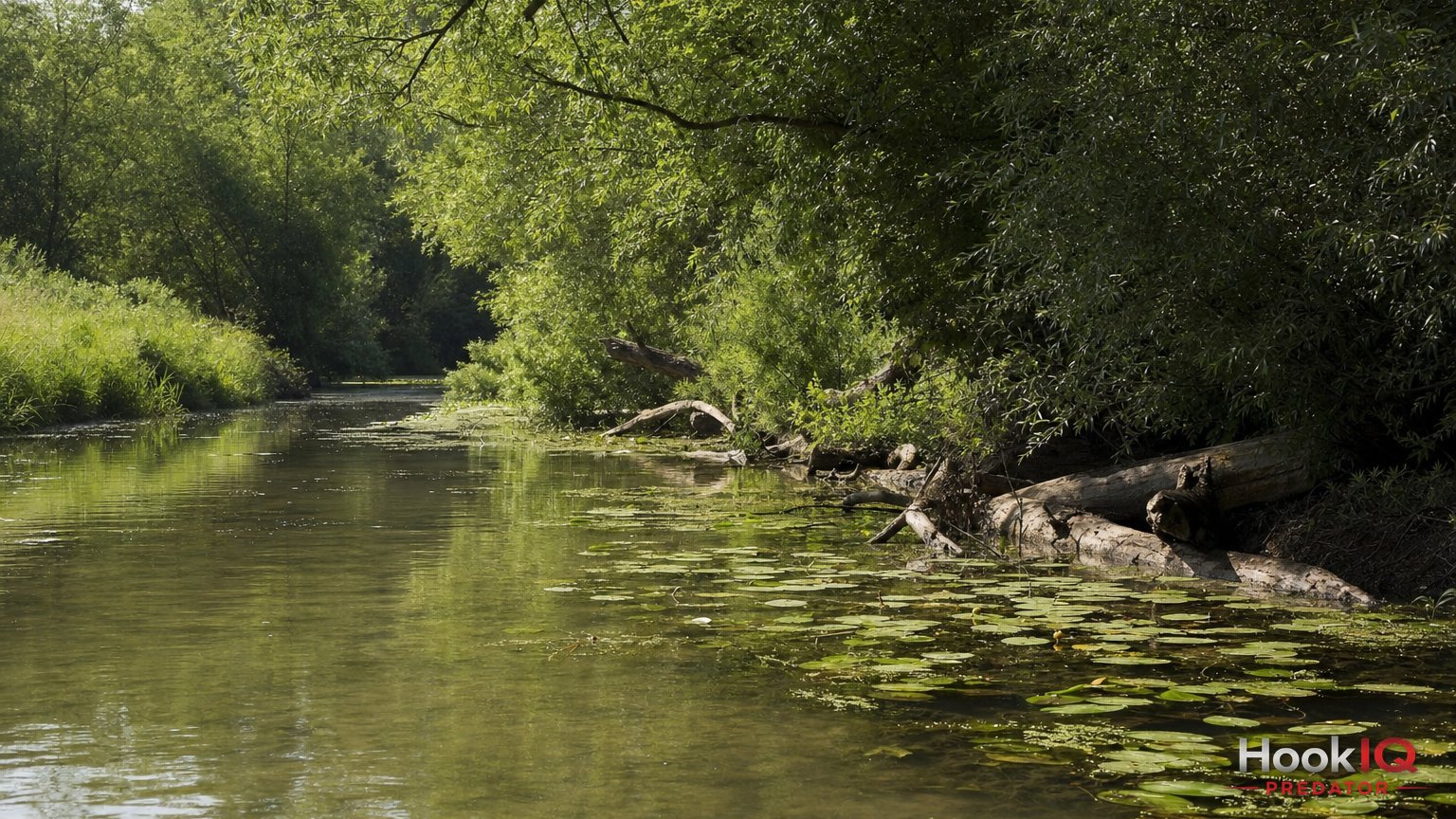
Suddenly the surface explodes thirty metres ahead of you. Dozens of tiny splashes, frantic sprays, and between the waves you catch flashes of green-striped flanks. Your heart pounds, you grab the rod, you cast. And then everything goes still. Too late? Not if you know how to read these feeding frenzies.
The Phenomenon: When the School Comes Up
In midsummer, something fascinating happens on lakes, reservoirs, and larger rivers. Perch schools drive shoals of bleak, small roach, or smelt to the surface and feed in a full-blown frenzy. What you see is pure chaos: baitfish leaping in panic, the surface boiling, gulls circling and diving. The spectacle can last thirty seconds or ten minutes. It can reappear a hundred metres away or vanish completely for an hour.
I have been watching this phenomenon for over twenty years, and it has taught me that summer perch are a completely different animal from the cautious winter fish hugging the bottom. When a school of fifty or a hundred perch hunts together, individual fish practically switch off their survival instinct. Competition within the school makes them greedy, aggressive, almost reckless. That is your window.
When and Where Feeding Frenzies Happen
The classic perch surface blitz needs a few prerequisites. Water temperature should be above 18 °C, ideally above 20. Baitfish must be packed in tight schools, and the perch need structure nearby to launch their attack from. A plateau at four to six metres depth, a submerged gravel bar, the edge of a weed bed, or the tip of a point are typical staging areas.
The best times are early morning between sunrise and about nine o'clock, then again in the late afternoon from five onwards. It happens less often in the midday heat, but on overcast days with a light breeze the hunt can kick off at noon too. I have made it a habit to scan the open water first on every midsummer session before I start casting anywhere. Just stand still, put on your polarised sunglasses, and watch the surface. Sometimes you can spot the schools moving underwater as dark shadows before they ever break the surface.
One sign many anglers overlook: gulls. When black-headed gulls suddenly circle lower and home in on a specific spot, something is happening below. I have spent entire sessions simply following the gulls, and it has paid off every single time.
The Right Lures: Small, Loud, Fast
When you are targeting surface-feeding perch schools, you do not need big lures. Quite the opposite — the smaller, the better. The perch are chasing prey in the 3 to 5 cm range, and your lure should match that profile. My absolute favourite for this situation is a small popper in the 4 to 5 cm range. Hard, compact, with a satisfying pop on every twitch. The popper imitates a panicking baitfish on the surface, which is exactly the trigger hunting perch respond to.
As a second option I always carry a small stickbait, also 4 to 5 cm. I work it walk-the-dog style — short rod twitches sending it darting left and right across the surface. This works particularly well once the perch have become a bit more cautious and the popper is no longer getting hit immediately.
I keep colours simple. On clear days I fish translucent lures with a touch of silver or green — anything that looks like a bleak or a small roach. Under overcast skies or in slightly stained water I switch to chartreuse or a bold perch pattern. At this stage the perch are not fussy about colour, but the size has to be right.
Tackle: Light and Long-Casting
For this style of fishing I use a 2.10 m ultralight rod rated 2 to 10 g. Paired with a 2500-size reel spooled with 0.06 to 0.08 mm braid. The thin braid is important because it lets you cast significantly further and actually get those small lures out to distance.
For the leader I tie on about 80 cm of 0.20 mm fluorocarbon. No wire trace — we are targeting perch here, and fluorocarbon gives the small lures the freedom of movement they need. On some days I skip the leader entirely and tie straight to the braid when the perch are extremely surface-oriented and every extra metre of casting distance counts.
The Art of the Quick Re-Cast
This is the part that decides success or failure: timing. A perch feeding frenzy erupts, you see the splashes, hear the commotion. You have maybe ten, at most twenty seconds before the school dives again. In that time you do not cast into the middle of the school — you cast to the edge. The centre is too chaotic; the fish there are so locked into hunt mode that they barely register your lure. On the fringes you find the stragglers, the greedy individuals breaking away from the main group. They strike immediately.
Once you hook your first perch, fight it quickly, hold it briefly, unhook, and cast again straight away. No photos, no tape measure, no rod swaps. Every second counts. I have had sessions where I caught fifteen perch in twenty minutes because I just cast, hooked, and released like a machine.
When the school goes down, stay put. It often comes back up within one to three minutes, sometimes only twenty metres away. Watch the surface for isolated rings, small splashes, nervous baitfish. Those are the precursors to the next explosion. If you are already in position with your lure in the air, you can cast the instant it kicks off again.
The Route: Following the School
Perch schools in midsummer are on the move. They follow the baitfish, and the baitfish move with the wind and the light. On a typical summer morning I start on the eastern shore because the rising sun pushes baitfish into the shallows there. As the morning progresses, the schools often shift towards deeper water, and I follow them by float tube or on foot from the bank.
A fish finder is worth its weight in gold in this situation, but not in the way you might think. I am not looking for individual fish on the screen — I am looking for large baitfish clouds in the upper water column, between zero and three metres depth. Where the prey is, the perch are not far behind. Sometimes you can see a second, denser cloud below the baitfish school: those are the perch pushing up from below. When you spot that formation on the sonar, motor over, keep your rod ready, and wait. It will happen.
When the School Will Not Come Up
There are days when the conditions look right but the perch simply refuse to surface. Too much sun, too little wind, the water as flat as glass. On days like that I switch strategy and fish a small lipless crankbait in the 4 to 5 cm range just below the surface. I reel it in briskly with occasional pauses, imitating a panicking baitfish fleeing just beneath the surface film. This often provokes strikes from below without the school ever showing on top.
Another option is a small inline spinner, size 1 or 2, retrieved quickly through the upper water column. The spinner creates vibrations and light flashes that attract perch from a greater distance. It is not as precise as the popper, but it covers more water — and sometimes that is exactly the key.
Five Mistakes I Have Made Myself
The first and most common mistake: lures too big. For years I fished 7 to 9 cm crankbaits for surface perch and wondered why I only caught the bigger loners but never cracked the school. When I downsized to 4 to 5 cm, everything changed.
The second mistake: reacting too slowly. If you see the school and still need to put your rod together, find a lure, and set the drag, it is over. Everything must be ready before you reach the water. Rod assembled, lure on the snap, drag set, bail open. Ready for the moment.
The third mistake: chasing the school. Perch are faster than you. When the frenzy disappears and pops up again two hundred metres away, do not run after it. Observe the pattern, try to predict the route, and position yourself ahead of the school — not behind it.
The fourth mistake: setting the hook too hard. With small topwater lures, a short, crisp wrist flick is enough. If you strike with full force the way you would for pike, you will rip the single hook out of the perch's soft mouth. I lost eight fish on a single session before I figured that out.
The fifth mistake: giving up when the school dives. The perch have not gone — they are just taking a break. Sometimes all it takes is standing still for three minutes and waiting. The school comes back up, and then you are ready.
My Verdict
Hunting surface-feeding perch schools in midsummer is one of the most exciting experiences you can have as a predator angler. It is fast, it is frantic, it is pure adrenaline. All you need is a small popper, a light rod, and the patience to find and read the school. Next time you are standing at the lake and the surface erupts in front of you, you know what to do. Do not cast into the middle — cast to the edge. And then cast again. And again.