
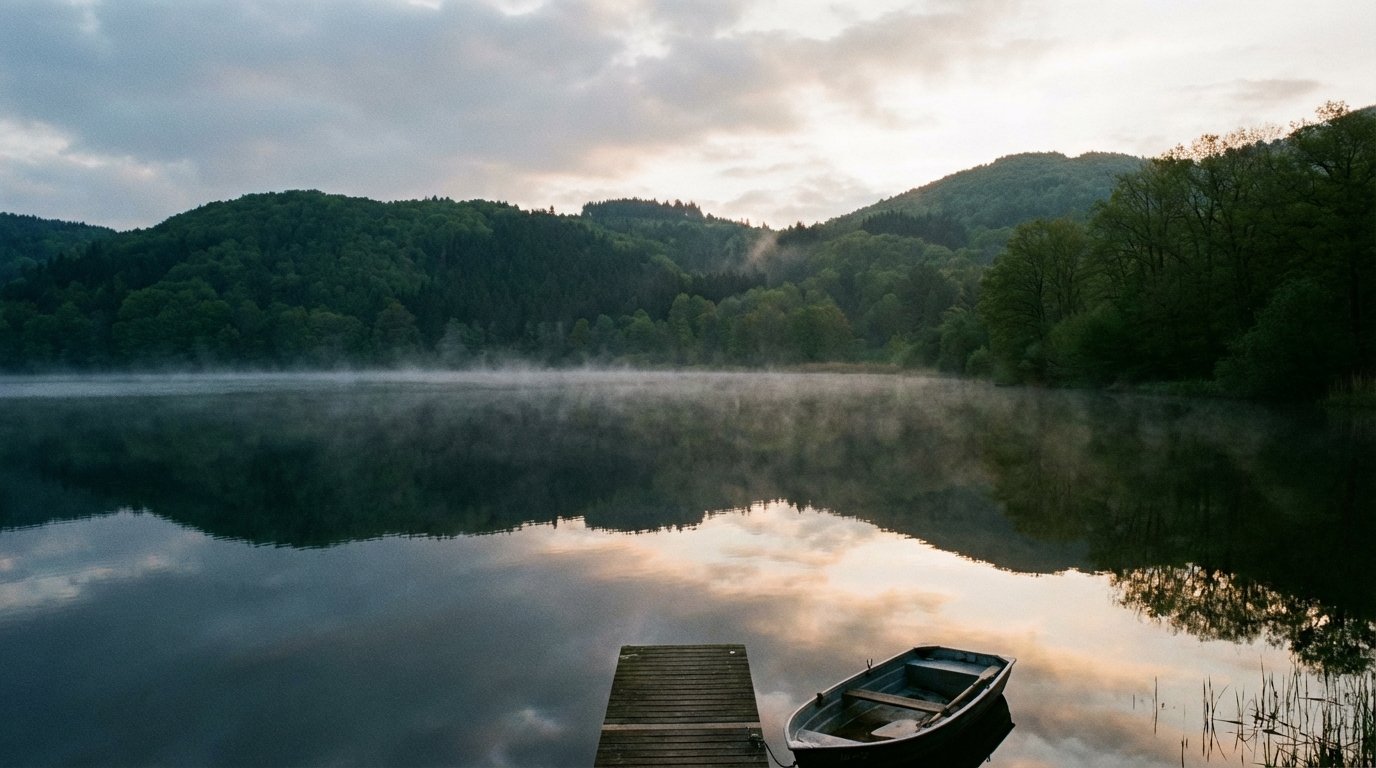
Tomorrow is the day. The closed season ends, my jerkbaits have been lined up in the box for weeks, and I can't think about anything except this one lake. Laacher See. A quiet, deep volcanic crater in the heart of Germany's Eifel region that looks like something from another world — and holds pike that mean business.
A Lake Like No Other
Anyone who sees Laacher See for the first time immediately understands why this place is special. An almost perfectly circular body of water, cradled by the wooded slopes of an extinct volcano. No inflow, no outflow. The water is clear — visibility exceeds ten metres in places — and at certain spots, small bubbles rise silently from the bottom where volcanic gases escape. It sounds surreal, but it's real. Geologically, Laacher See is a maar, formed by a massive eruption roughly 13,000 years ago. Today, at around 3.3 square kilometres and depths of up to 53 metres, it's one of the most fascinating lakes in Rhineland-Palatinate.
For pike anglers, that translates into a venue with extreme depth structure, steep drop-offs, and shallow bays that warm up first in spring. Right there, in those bays with two to four metres of water, the pike are sitting now. They've finished spawning, they're hungry, and they're aggressive. This is the exact moment when a jerkbait comes into its own.
Why Jerkbait on a Volcanic Lake?
I already hear the question: Why not a soft plastic? Why not a spinner? The answer is simple. On Laacher See, with its clear water and shallow margins in spring, you need a lure that commands attention without moving too fast. A jerkbait glides, stops, turns slightly to one side, and then hangs motionless in the water for a beat. For a post-spawn pike that doesn't want to chase more than necessary, that's irresistible.
Over the past few years, I've had the same experience at Laacher See time and again. The soft-plastic crowd catches fish — no question. But the truly good ones, the 80 cm and 90 cm fish, came on jerkbaits. Mostly in the first two weeks after the closed season ends, when the water is still below 12 °C and the pike are slowly pulling back from the spawning grounds.
My Setup for Laacher See
Over the years, one setup has proven itself on this volcanic lake. I fish a short, stiff rod around 1.80 m with a casting weight up to 80 g. At Laacher See you rarely need distance — what you need is precision. The pike often hold tight to the bank, among submerged timber and right on the edges where the shallows drop into deep water. The jerkbait has to land on the money.
On the reel I run 0.19 mm braid, paired with a 30 cm titanium leader. No fluorocarbon, even though the water is clear. Anyone who fishes fluorocarbon on Laacher See and then hooks a 90 cm pike in the timber is going to wish they had a safety margin. The titanium gives me the control I need when it counts.
As for the jerkbaits themselves, I rely on two types. For the shallow margins, a glider around 12 cm that works just below the surface. Slow-sinking, with wide sweeps left and right. I keep the colours natural: perch pattern or a subtle baitfish finish. In Laacher See's clear water, loud colours tend to work against you.
For the deeper drop-offs, from three to four metres down, I switch to a dive-and-rise jerkbait around 15 cm. It dives to two or three metres and rises slowly on the pause. That rising phase is when the strikes come. The pike watches the lure dive, follows it down, and when the jerkbait suddenly stops and starts floating upward, it commits.
Lure Presentation Makes the Difference
There's a rule at Laacher See that I've confirmed over thirty-plus years of pike fishing: less is more. Especially in spring, when the water is still cold and the pike have just come off their closed season, aggressive jerks don't work. Instead, I use soft, short snaps of the rod tip followed by long pauses. Three seconds, sometimes five. Then a short twitch, and wait again.
It takes patience and trust in the lure. The temptation to keep working the jerkbait, ripping it through the water, is real. But on this volcanic lake I've learned that the pause catches fish. During the pause the jerkbait rotates ever so slightly, the light hits the flanks differently, and the pike that's been sitting a metre behind it for ten seconds, watching, finally can't resist.
I remember a May morning two years ago. The closed season had just ended a few days earlier. It was early morning, mist hanging over the lake, and I was standing in a small bay on the western shore. The glider landed maybe five metres from the bank, right next to a sunken branch. Two short snaps, then a pause. Nothing. Two more snaps, pause. And then that feeling every pike angler knows: the line goes heavy, the rod tip pulls down, and in the next instant the surface explodes. An 87 cm pike, thick as my forearm, with a mouth that had swallowed half the jerkbait. That fish kept me busy for ten minutes because it headed straight for the timber. The titanium leader did its job.
The Best Spots on Laacher See
Laacher See has a number of areas that are particularly productive in spring. The shallow bays on the western and south-western shore warm up first and attract baitfish, which in turn draw in the pike. Where you see small fish dimpling at the surface at sunrise, that's where the predators are.
The steep drop-offs in the north are better suited to later spring, once the pike move into deeper water. That's where I work the dive-and-rise jerkbait, letting it glide along the edge, always parallel to the depth contour.
One tip I've picked up at Laacher See: watch for the gas bubbles. In certain spots, small bubbles rise from the volcanic lake bed. Fish generally avoid these areas. Save your casts and focus on the quiet stretches in between.
Plans for This Season
The jerkbaits are sorted, the leader material is fresh, and my fishing permit for Laacher See is ready. Over the coming weeks I'll work the shallow zones systematically, early in the morning when mist still sits over the crater and the surface is like glass. Those are the moments I live for.
Laacher See is not an easy venue. The clear water punishes any mistake in your lure presentation, and the pike here are warier than on many other lakes thanks to the fishing pressure. But that's exactly what makes it so rewarding. When a pike commits to your jerkbait on this volcanic lake, you've earned it.
My Verdict
Laacher See in the Eifel is, for me, one of the most exciting pike venues in Germany's Rhineland-Palatinate. The combination of clear water, extreme depth structure, and wary fish demands a precise technique — and jerkbait delivers exactly that. If you're heading to the volcanic lake in the coming weeks, make sure you have a glider and a dive-and-rise jerkbait in your box, keep the retrieve slow, and trust the pauses. This lake rewards patience.