
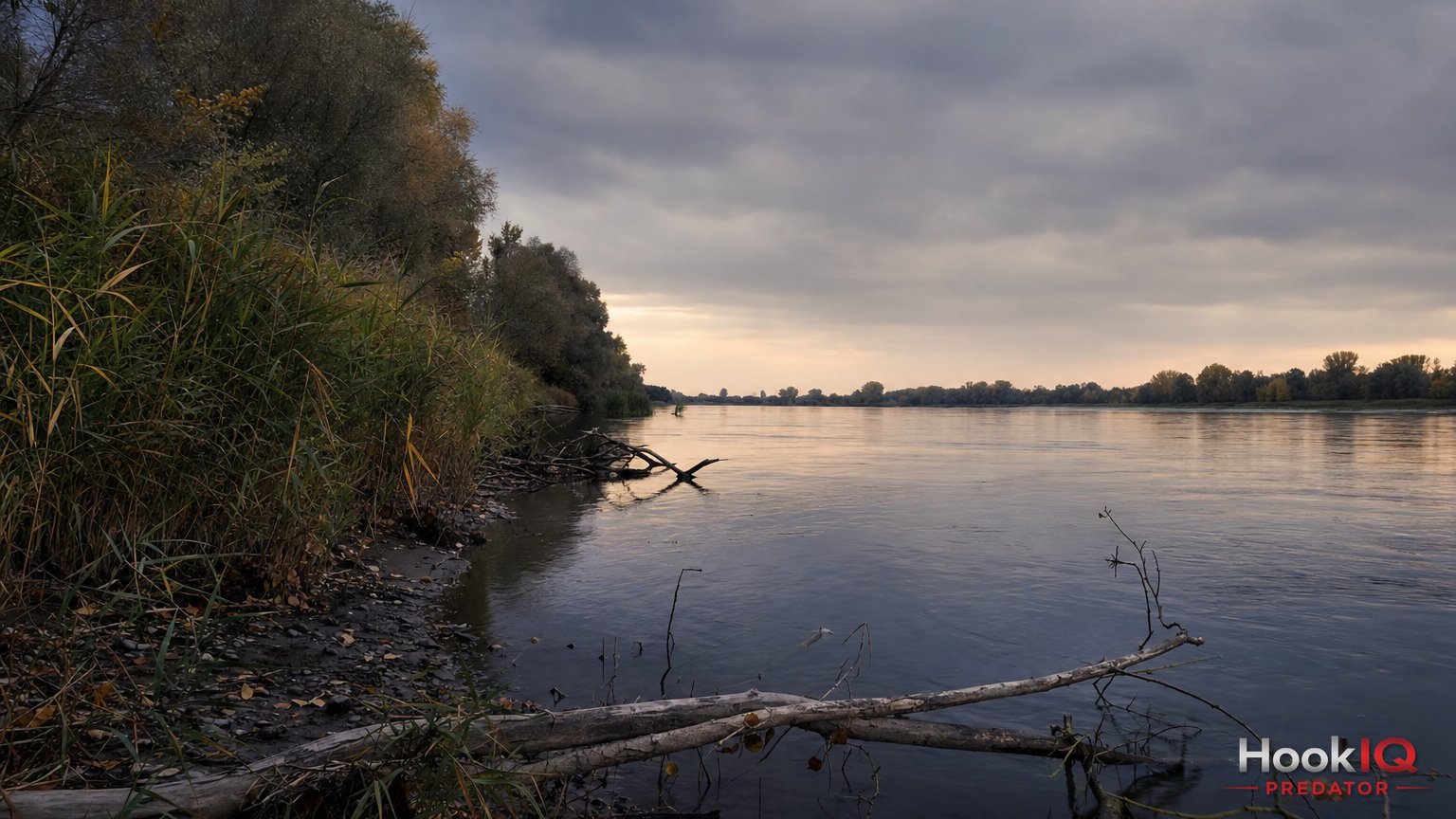
Over the years I've dug through probably a hundred tackle boxes, hunting for that one color that makes the difference on a stained-up fall afternoon. Here's the honest truth: it's often not the color itself that matters, but how well the lure stands out against the background. That sounds unremarkable at first, but it completely changes how I sort my tackle box once I've taken a look at the water.
How Predators Actually See in Dirty Water
Pike, zander and perch perceive color fundamentally differently than we do standing on the bank. Water filters light, and it doesn't do it evenly. Reds fade out almost completely within the first few feet of depth, orange follows shortly after, while blue and green stay visible the longest. In clear water under a high sun, none of this matters much, because enough light gets through. But the moment turbidity or dusk enters the picture, a rich red turns into a dull gray fast — and that's exactly the mistake I made myself for years. I used to reach for loud, unnatural colors because they looked the most eye-catching to me on land, forgetting that the fish underwater is seeing something completely different from what I see standing on the bank.
Zander have an extra edge here: a tapetum lucidum, a reflective layer behind the retina that bounces residual light back through the light-sensing cells a second time. That makes them true low-light and night hunters, able to pick out shapes even in near-darkness. Pike and perch lean more toward daytime activity, but they still hunt hard during dusk and dawn, because that's when their prey gets careless and more active too. For all three species, the same principle holds in low light: what matters most is whether the lure reads as a clean silhouette against the brighter background above.
Contrast Beats Color, Almost Every Time
If you photographed a lure from below against the surface, in murky water with the sun low on the horizon, in most cases you'd see nothing but a dark outline — barely any detail. That's exactly how a predator perceives its prey under those conditions. That's why dark, almost black lures work surprisingly reliably for me in heavily stained water. Black produces maximum silhouette against the lighter sky above, and it's that sharp outline a predator picks up from below, long before it could ever make out color detail.
In moderate turbidity — say, visibility still sitting around twelve to twenty-four inches — I like to switch to combinations of dark and a bright accent. A soft plastic shad with a black back and a chartreuse belly, for example, delivers two effects at once: a clean upper silhouette and a bright flash that stands out on every twitch of the lure. Chartreuse, that toxic yellow-green, happens to be one of the last colors still perceived as color in murky water before everything collapses into pure contrast and shadow. That's exactly why this shade has become a staple stained-water color in pretty much every fishing culture — and that's no coincidence.
The opposite holds true in clear water with plenty of light. There, I want natural, understated colors, because too much contrast tends to spook wary fish rather than draw them in. But that's a topic for another day.
UV Light: An Underrated Factor
Here's something I never used to think about: water doesn't just filter visible light — in shallow, murky water, UV radiation can still punch down surprisingly deep. Whether predators can actually perceive UV light directly is still debated among anglers and biologists; it's been confirmed in some fish species, but there's no clear evidence either way for pike, zander or perch. What I can say from experience, though: lures with UV-reactive pigments that fluoresce faintly under low light often produce an extra layer of contrast that standard colors simply can't deliver. Under overcast skies and at dusk, I regularly reach for UV-coated models — less because I'm convinced the fish sees the UV light as such, and more because the resulting brightness contrast is measurably more noticeable.
Glitter and flake particles in soft plastics work in a similar way. In low ambient light, it often only takes a single beam of light breaking through the water to make a lure flash for a split second. That brief flicker can be exactly the trigger that pulls a zander out of cover when it would otherwise have sat tight and ignored everything else.
Natural Finishes: When Subtle Wins
Now for the part where I sometimes contradict myself — and that's fine, because fishing isn't an exact science. At dusk, over shallow water that's still reasonably clear, I land fish surprisingly often on understated natural finishes: motor oil, baitfish, or a muted brown with fine glitter. The reason is simple: in that specific light, right after the sun has dipped below the horizon but while a bit of brightness still lingers over the water, predators see remarkably well — almost as well as during the day. Baitfish schools often sit tight just under the surface in this window, moving over shallow flats, and that's exactly when a lure that looks like a real roach or a small bleak often outperforms anything flashy or loud.
My rule of thumb, proven out over the years: the murkier the water and the deeper you're working the lure, the more contrast you can get away with — all the way to solid black or black-and-chartreuse. The clearer the water and the shallower your retrieve during dusk, the more a natural finish pays off, one that mimics the silhouette of real baitfish instead of throwing an artificial signal. In between those two extremes lies a wide gray zone where I just experiment until the first bite tells me I'm right.
What This Means for Your Tackle Box
In practice, for sessions with changing visibility, I now always pack three base types. A very dark, almost black lure for heavy turbidity and deep presentations; a contrast lure with a dark back and a bright, UV-reactive belly for medium conditions; and a naturally colored lure with fine glitter for the clear dusk window over shallow water. Size-wise I mostly stay in my usual range — four to five and a half inches for zander and pike in the fall — but I decide on color fresh every time, based on how much visibility I can judge at the surface when I hold a white rod tip or a light-colored object just under the water. If I can still see it at around sixteen inches, I go with contrast. If it disappears by eight inches, I go straight to dark or UV.
One thing I no longer leave purely to gut feeling is pinpointing exactly when those dusk windows kick in on a given day — especially now in fall, when they shift almost weekly. For that I use the HookIQ app, which pulls together light levels, turbidity trends and the usual activity windows for my water, so I can rough out my lure choice before the first cast instead of improvising once I'm already out there.
The Bottom Line
In low light and murky water, contrast against the background is what decides the outcome — not color in the classic sense. Dark lures deliver the cleanest silhouette in heavy turbidity, UV-reactive accents and glitter add extra trigger power in medium visibility, and subtle natural finishes surprisingly often win out during the clear dusk window over shallow water. Sort your tackle box by that principle instead of by looks alone, and you'll make the right call far more often than gut feeling ever could.