
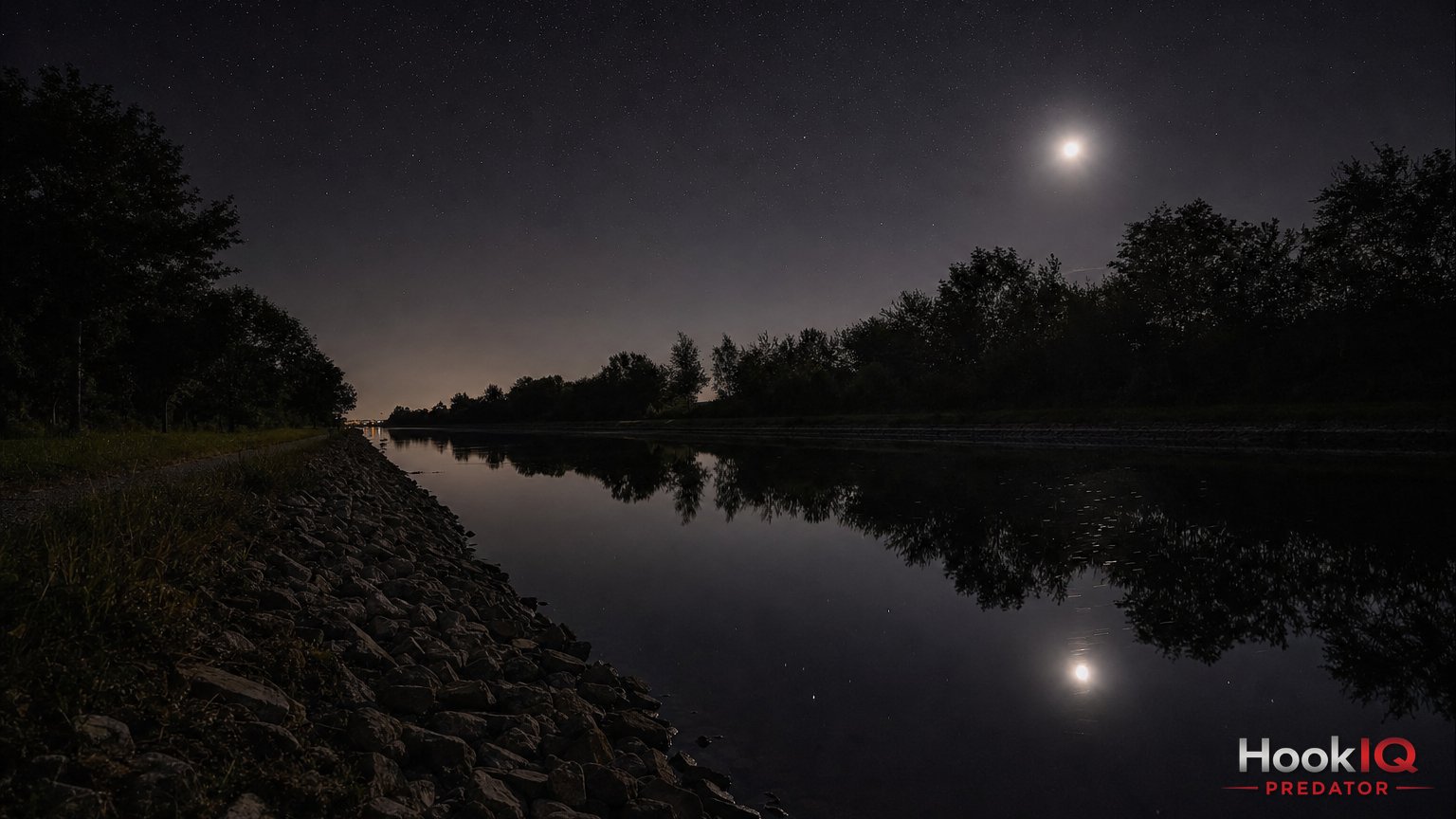
Just before ten, the last streaks of daylight fading over the canal. Next to me, two lure anglers are packing up. "Nothing doing today," one of them says. I nod politely but say nothing. Because I know: my fishing day is only just beginning.
Why the Night Belongs to Zander
In summer, everything changes for zander. During the day, the heat pushes water temperatures into ranges that even these hardy predators can't handle. 22 degrees, sometimes 24. The fish hold deep, lethargic, almost impossible to tempt. But as soon as the sun drops below the horizon, something shifts. The zander wake up. Not all at once, not like flipping a switch, but gradually. One moves first, then the others follow. Within an hour of sunset, the entire game relocates — not deeper, but shallower.
This is the point most anglers underestimate. At night, zander don't hold on the deep channel anymore. They push onto the shallow plateaus, onto the ledges between one and three metres of water. The kind of spots where no sensible angler would cast during the day. The kind of spots where baitfish gather in the warm upper layers. And that's exactly where you need to be.
The Shallow Ledge: A Zone Most Anglers Ignore
I remember a June evening on the Mittelland Canal a few years back. I'd spent the entire afternoon fishing the deep side — riprap, channel, classic spots. Nothing. Not a tap, not a touch. When dusk set in, I switched to the shallow side almost out of spite. The sheet piling on the far bank, maybe a metre and a half of water, weed beds on the bottom. Not a spot where I'd normally look for zander.
Third cast. The shad sank slowly, almost touching the bottom, and then came that telltale stop. Not hard, not aggressive — just a pause, as if someone had grabbed the lure. Strike. The rod buckled, and what was on the other end was no schoolie. 67 centimetres, thick and solid, caught in a metre and a half of water. At half past ten in the evening.
Since then, I deliberately target shallow areas on summer nights. Plateaus behind groynes, gently sloping riprap, ledges between the shallows and the first drop-off. Zander move there because their prey is there. Small roach, bleak, gudgeon — species that hang in the upper water layers at night. Zander follow the food. It really is that simple.
Slow, Slower, Slowest
Lure presentation at night is fundamentally different from what works during the day. Forget your fast jigging, forget aggressive hops and sharp rod snaps. Night fishing demands patience — the kind of patience many anglers struggle with.
My setup for a summer night session is simple. A 10 cm shad in natural colours, preferably ayu or green pumpkin. Paired with a jighead just heavy enough to find the bottom, but light enough to sink slowly. In a metre and a half to two metres of water, I'm talking 5 to 7 grams maximum. It feels wrong at first because the lure takes an age to reach the bottom. But that's exactly the point.
I cast out, let the shad sink, and then work it across the bottom with minimal movement. No jigging in the traditional sense. More of a gentle lift of the rod tip — maybe 20 centimetres — then let it drop again. Pauses of three to five seconds in between, sometimes longer. The lure shouldn't hop. It should creep. Like a small fish drifting aimlessly across the bottom in the dark. Sometimes it's enough to simply reel the shad in ultra-slowly with no action at all. The paddle tail does the rest.
What happens next is interesting. The bites almost never come during the movement phase. They come on the pause. The zander watches the lure, positions itself, and strikes when the shad comes to rest. That's why the pauses are so critical. Retrieve too fast and you never give the fish a chance to commit.
Noise Discipline: The Underrated Factor
Now we come to something hardly anyone talks about, yet it makes the difference between a great night and a blank. Noise. During the day, it doesn't matter if you clang your landing net against the riprap or drop your tackle box on the ground. At night, it absolutely does.
The silence on the water during a summer night is deceptive. To us, it feels peaceful, almost serene. To a zander sitting on a shallow ledge, noise is an alarm signal. Footsteps on gravel, a heavy rucksack thumping onto the ground, the snap of a tackle box closing. All of it transmits through the bank into the water, and at a metre and a half deep, the fish feels every vibration.
So I've trained myself into a few habits that make all the difference in the dark. First: I find my spot in daylight and set everything up before the fish move shallow. Second: everything I need is within arm's reach. No fumbling with a headtorch, no rummaging through bags. Third: I move along the bank like a heron. Slowly, deliberately, no unnecessary steps. It sounds over the top, but I've seen it too many times — a solid bite run killed stone dead because I stomped carelessly to the next spot.
I pay attention to noise on the cast, too. A heavy jighead hitting 1.5 metres of water sounds like a depth charge. That's why I use light weights. A 5-gram jighead lands softly, almost silently. And that's exactly what I want.
Best Spots for a Summer Night Session
Not every shallow area is a good one. What I look for are transitions. Points where shallow water meets a drop-off. The classic ledge — just not at 8 metres, but at 1 to 3 metres.
On canals, these are often the transitions between sheet piling and riprap, or the areas behind locks where the water runs shallow and the bottom changes from hard to soft. On rivers, it's the groyne fields — especially the shallow tail-outs where the current eases off and small bays form. On lakes and gravel pits, I look for the plateaus in front of reed edges, where the bottom gradually slopes from one metre down to three or four.
The key is to scout your spot in daylight. Study the structure, feel the bottom, memorise where the ledge runs. At night, you then work the ledge systematically — cast by cast, metre by metre. No rushing, no switching spots every ten minutes. The zander will come to you if you're in the right place and give them time.
Making the Most of the Feeding Windows
Not every hour of the night is equally productive. In my experience, the window between one and two hours after sunset is the absolute prime time. In late June, that means roughly between half past ten and midnight. During this window, the zander are at their most active, most aggressive, most reckless.
After that, things quieten down — but it's far from hopeless. Between one and three in the morning, there's often a second phase. Shorter and less intense, but sometimes that's exactly when the big fish show up. The advantage of these late hours: you're guaranteed to have the water to yourself. No dog walkers, no other anglers, nothing. Just you, the night, and the soft plop of a zander snatching prey off the surface.
If you have the stamina to stay until dawn, you often get a third window. When the first light appears on the horizon, some zander make one last pass across the plateau before retreating to the depths. But I'll admit: I don't manage that every time. At some point, tiredness wins.
What a Hundred Nights on the Water Have Taught Me
At night, you catch zander in shallow water that you'd never encounter during the day. Fish that move into areas no fish finder would flag as a hotspot. That's what fascinates me most about night fishing. You don't need a boat, you don't need sonar, you don't need high-tech gear. You need patience, quiet footsteps, and a lure that moves slowly enough to give the zander a chance.
If you want to give it a go this summer, just start. Pick a canal stretch or a groyne you know well. Stay two hours after sunset. Fish the shallow side you'd normally ignore. Work your lure so slowly it almost feels boring. And be quiet. When that first tap comes at half past ten, in a metre and a half of water, on a warm summer night — you'll know exactly why staying up was worth it.