
A folding bike, a rod bag over the shoulder, a small sling box with a few bags of soft plastics. That is all I need when I head down to the Rhine-Herne Canal in August. No landing net on my back, no rod rest, no clutter. Streetfishing in the old industrial heartland is mobile fishing in its purest form, and the perch that patrol these endless concrete edges are the reason I keep coming back.
Why the Canal of All Places
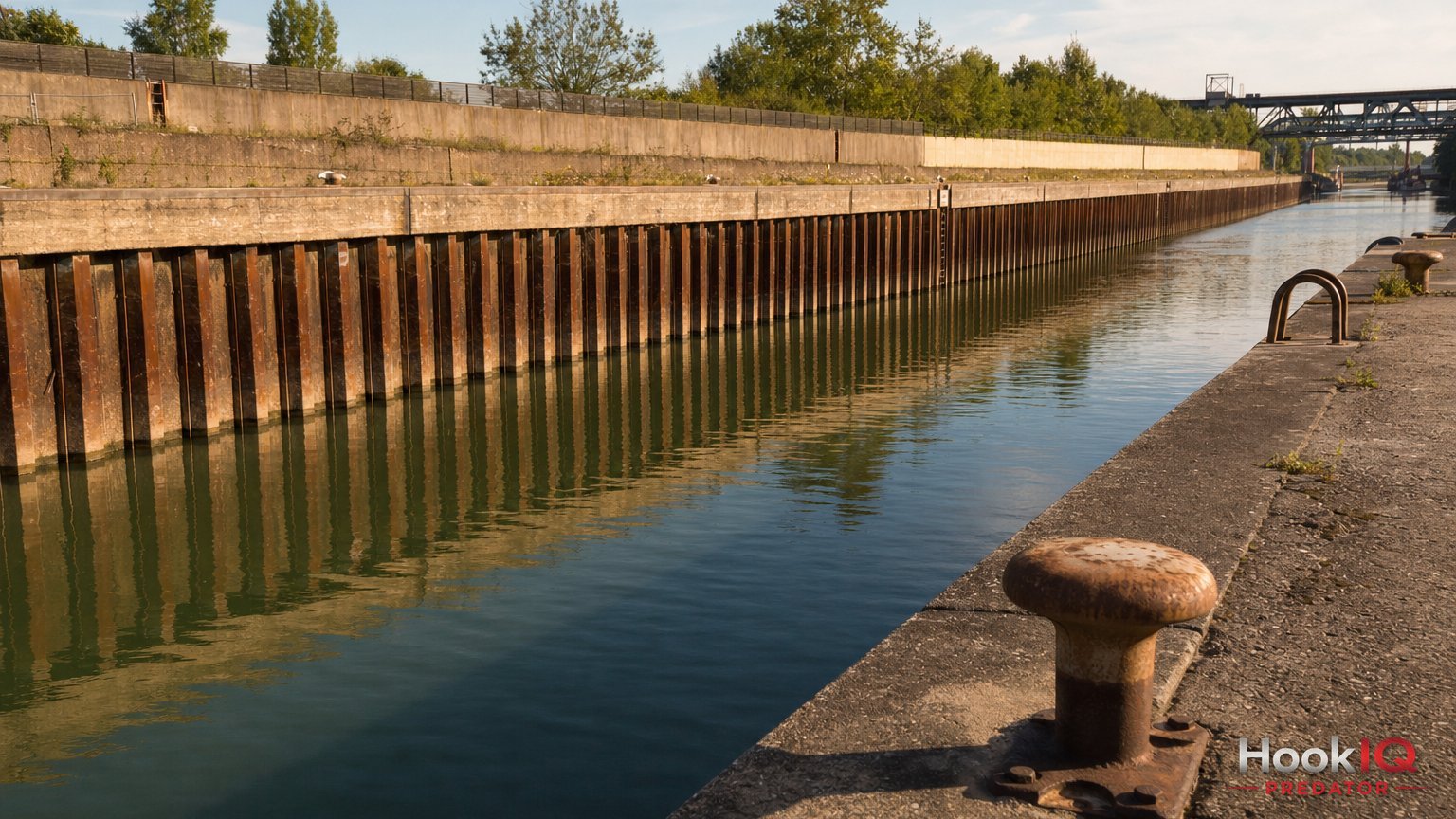
Plenty of anglers drive straight past the Rhine-Herne Canal and see nothing but grey water between grey walls. I see structure as far as the eye can reach. The canal is an industrial waterway through and through, and that is exactly what makes it so good for perch. Steel sheet piling runs for kilometre after kilometre, broken up by old loading quays, bollards, ladders, mooring dolphins and the remains of long-forgotten landing stages. Every one of those edges is an address. Perch are edge fish. They love hard transitions, shade and cover, and there is more of it here than on almost any natural water.
On top of that, the water in the canal barely moves. No heavy current, no floods to rip your spots away. That makes the fish predictable. If I found a shoal on a ladder back in June, their descendants are usually holding within ten metres of the same spot come August. The canal does not forget its good places.
The Gear: As Light as You Can Get
Streetfishing is all about travelling light. On the canal I fish a rod around 2.10 metres with a casting weight up to roughly 15 grams, paired with a small 2500-size reel and a thin braid around 0.08 millimetres. Up front I tie on a good two metres of fluorocarbon leader in 0.20 to 0.22 millimetres. That handles most perch with ease, and if the odd zander or a small pike muscles in, it copes with that too. The steel edges chew through line in no time, so I check the leader with my fingers after every decent fish and cut back at the slightest sign of roughness.
Everything else fits into one flat bag. A few jig heads, two or three bags of soft plastics, a pair of pliers, a tape measure. Anyone who rolls up here with a carp barrow has missed the point. The whole appeal is that in two hours I can work a couple of kilometres of quay wall, always on the move, always heading for the next edge.
Small Soft Plastics, Worked Properly
On the canal I fish small. My standard size for perch sits between five and seven centimetres, often smaller still. A slim five-centimetre shad on a three-to-five-gram jig head is my bread-and-butter lure, backed up by little creature baits and slim worm imitations that I fish on the dropshot or a light jig. I keep the colours simple. On dull days or in the shade of the walls I reach for something loud in chartreuse or white; in clear water and bright sun I switch to natural tones — motor oil, brown, a subtle perch pattern.
The most important thing is how you work the lure along the wall. The classic mistake is casting too far out. The fish are not sitting in the middle of the canal, they are holding on the edge, often no more than half a metre off the sheet piling. So I cast flat and parallel to the wall, let the lure sink right against the steel face and count it down. That way I remember the depth at which I got the first contact. Then I work it slowly, with short twitches and long sink phases. Ninety percent of the takes come during that fall — that brief stall in the dropping line that lights you up. Set the hook, and there is the perch, sitting broadside like a little rugby ball.
On vertical sheet piling it also pays to fish straight down, dropping the lure right against the wall from above, centimetre by centimetre, tapping the rod tip as it falls. Especially for the bigger perch that press deep into the shade, that is often the only presentation that convinces them.
Stay Mobile, Hunt the Shoals
The biggest difference between a good canal day and a lean one is your willingness to keep moving. Canal perch travel in shoals, and those shoals are not everywhere. I give a spot three or four casts. If nothing happens, I move twenty or thirty metres to the next edge, the next ladder, the next bollard. Anyone who gets stuck on one spot just because it looks nice throws away the whole advantage of streetfishing.
When it finally goes off somewhere, I stop dead and work the area thoroughly. One bite almost always means more fish are holding there. I have stood at a single old loading edge for a quarter of an hour, catching perch after perch, while two hundred metres either side not a single tap came. That is exactly the game: find the active fish, don't fish the prettiest spots.
The best edges, by the way, are the unremarkable ones. A lone bollard where the water swirls just a touch differently. A ladder with mussel growth showing beneath it. An outfall where a drainage pipe pushes in slightly warmer water. Little details like that gather the baitfish in a canal, and that is where the predators sit too.
A Bit of Grit Comes with the Territory
Streetfishing on the Rhine-Herne Canal is not postcard angling. A bridge might rumble overhead, a cycle path runs behind you, and every so often a freighter pushes through and slaps its wake up the quay wall. That is exactly what I love about it. You are right in the middle of the city and still catching genuinely good fish, often right under the feet of people who have no idea.
A few things are worth keeping in mind. Watch your footing, especially on wet concrete edges with no railing, and keep well clear of shipping traffic. A good polarised look at the surface will often tell you more about a spot than any expensive kit. And pack out your rubbish — someone else's too, if it is lying next to you. Streetfishing has a reputation to lose, and we are the ones who shape it.
My Verdict
The Rhine-Herne Canal is a perfect perch venue for anyone who wants to travel light and stay mobile. Stick to the edges, fish small soft plastics around five to seven centimetres on light jig heads, work them slowly and tight to the wall, and above all: keep moving until you find the shoals. You don't need a boat, a fish finder or half a car load of gear. A light rod, a handful of lures and a few kilometres of sheet piling are enough for a day that will surprise you. Grab your mobile setup and get out there.