
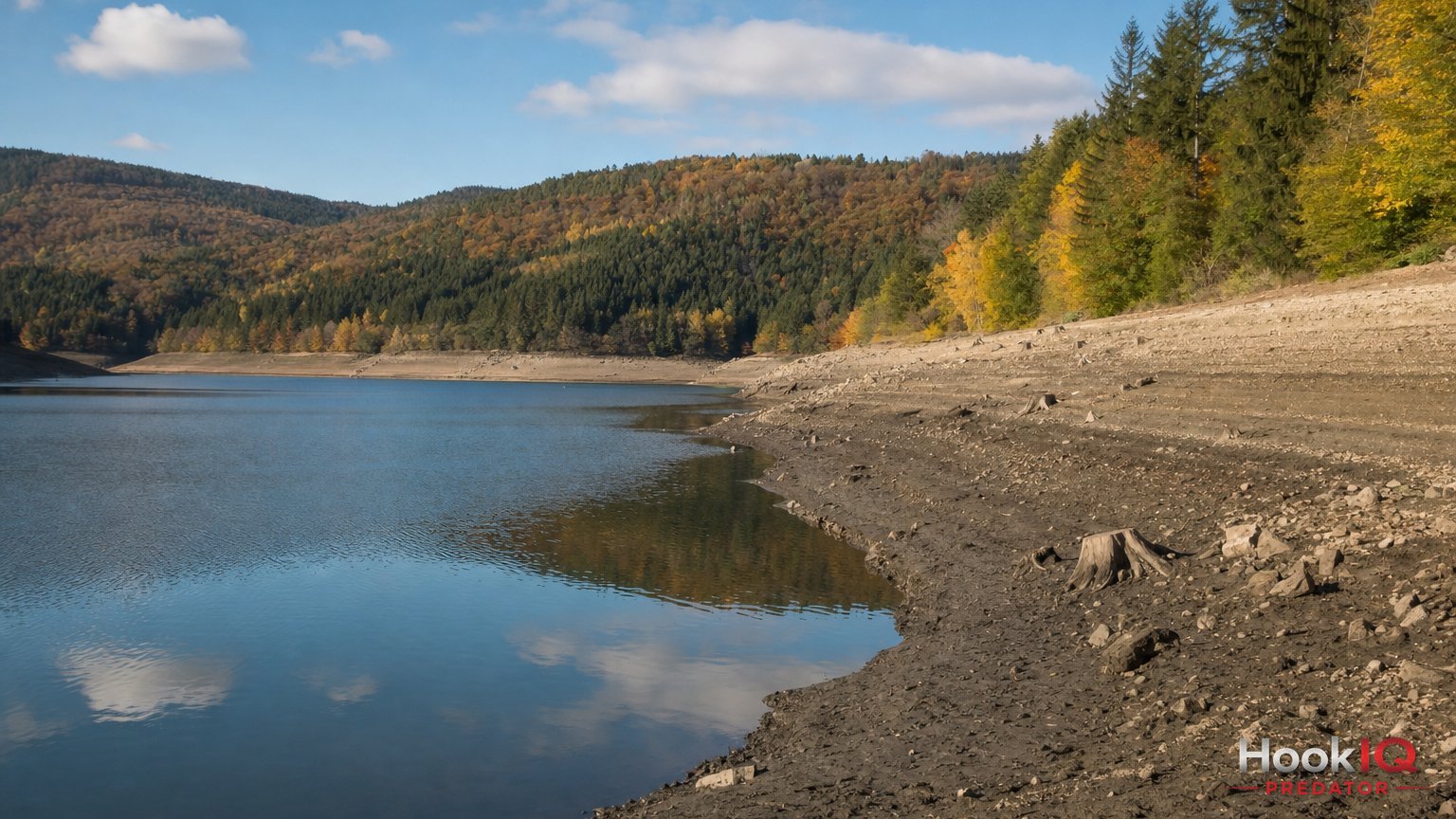
I'm standing on the bank, looking at a ridge that was still two metres underwater three weeks ago. An old track that used to lead down into the valley before this reservoir was dammed is now etched into the mud as a clear line. These are exactly the moments I love about autumn at the reservoir. The water level drops, and with it a whole new topography is exposed — one that suddenly gives the pike out in open water a completely new set of reference points.
Why the Water Level Drops in Autumn
At many reservoirs, water is deliberately released in autumn to create flood storage capacity ahead of winter or to allow maintenance work on the dam wall. For us anglers, that means the water we fished all summer no longer exists in that form. Shallow bays dry out, flooded footpaths and old wall remnants resurface, and the entire weed zone that was full of perch and small pike back in July is suddenly exposed to the air or sitting under barely twenty centimetres of water.
At first that sounds like a problem. Less water, less cover, less structure you recognise. I see it differently. Every centimetre the level drops creates a new edge, and to pike, new edges are like a freshly laid table. Fish that were spread out over hundreds of metres of shallow water all summer suddenly get concentrated. That concentration is exactly what makes autumn at the reservoir one of the most exciting stretches of the whole year for me.
Exposed Edges as New Ambush Points
When I arrive at a reservoir in October or November, the first thing I check is the shoreline, not the water. Every old bay edge, every submerged tree stump now sitting just below the surface, every old rock revetment that used to shore up the bank — all of it turns into a hotspot during this phase. Pike hold along these freshly exposed drop-offs because they offer exactly what the fish needs: cover on one side, a clear view into deeper water on the other.
The transitions I find most productive are where an old shallow shelf drops abruptly into two or three metres of depth. These edges were invisible underwater in summer; now you can often spot them with the naked eye, since the colour change in the bottom stands out clearly. I usually cast my swimbait parallel to this edge rather than across it. An 18 cm shad on a 40 g jig head, worked slowly along the drop-off with short pauses, puts more pike on the line this time of year than any other retrieve. The pause is the key part — most of my bites come at the exact moment the lure briefly sinks along the edge.
The Baitfish Move Out Into Open Water, and the Pike Follow
What a lot of anglers underestimate: when the shallows disappear, so do the roach, rudd, and young bream that spent the whole summer there. They move out into open water, gathering over the deeper basins of the reservoir in large, loose schools. I've seen almost the exact same pattern at several reservoirs. As soon as the water level has dropped more than half a metre, the sonar picture out in open water changes completely. Instead of scattered single marks, I suddenly see dense clouds between five and ten metres deep, often sitting over even deeper bottom.
That's exactly where the big pike start patrolling too, and that's what sets autumn at the reservoir apart from every other season. Instead of lying in wait along the bank, they actively hunt out in open water, often several metres below the surface. For me that means jerkbaits and spinners stay in the box, and I switch to big swimbaits or deep-diving crankbaits that I systematically work through the baitfish schools. A 22 cm soft plastic on a heavy jig rod, worked slowly down through the depths until the sonar shows I'm sitting at the same level as the school, is the most reliable tactic I know for this phase. The bites often come so hard I can barely hold onto the rod.
Why I Switch Banks More Often During This Phase
There's one thing I've noticed at reservoirs in autumn that I don't experience on other types of water in quite the same way. The bank that was red-hot yesterday can be completely dead today — and not because the fish have moved, but because of the wind. When the wind blows steadily from one direction for several hours, it pushes the warm surface water, and the small baitfish along with it, over to the downwind side of the reservoir. And that's exactly where the pike then stack up as well.
So I've made it a habit to check the wind direction first, before I even put together my first rod. If the wind has been blowing from the west since the day before, I head straight for the east side of the reservoir, even if my usual spot is on the other bank. Over the past few years, that discipline has put more good fish in the net for me than any lure choice ever has. A second reason to switch banks is the sun. On clear autumn days, the baitfish schools often retreat to the shaded side of the reservoir, while the sunny side looks completely dead. If you stubbornly stick to one bank just because it fished well last month, you'll miss the best windows of the season.
My Setup for Falling Water Levels
For this phase I use a heavy spinning rod rated for roughly 60 to 100 g, because the big swimbaits and crankbaits need the power behind them. For line, I run 0.16 mm braid paired with a fluorocarbon leader of about 60 cm, since the water tends to be clearer this time of year than in summer and the fish sitting along those exposed edges are warier. I still stay consistent with a wire leader, though — a pike on the edge doesn't care about aesthetics once it decides to bite.
For lure choice, I go by the depth of each spot. On the shallow, freshly exposed edges down to two metres, I run an 18 cm shad on a 30 to 40 g head; over the deep baitfish schools out in open water, I switch to a 22 to 25 cm model up to 60 g, so I can reliably get down to the right depth even when it's windy.
Summary
A falling water level at the reservoir in autumn isn't a disadvantage in my book — it's one of the most reliable opportunities in the whole pike season. The exposed edges create new reference points, the baitfish schools move out into open water and pull the big pike along with them, and anyone willing to switch banks based on wind and sun usually ends up on the best fish of the day. If I'm honest, these days I also use the HookIQ app beforehand to get a sense of how wind, air temperature, and water level trends are lining up that day, simply because I don't want to run all those factors through my head every time before heading out. Once I'm actually at the water, the only thing that matters is whether the edge is right and the lure's diving at the right depth.