
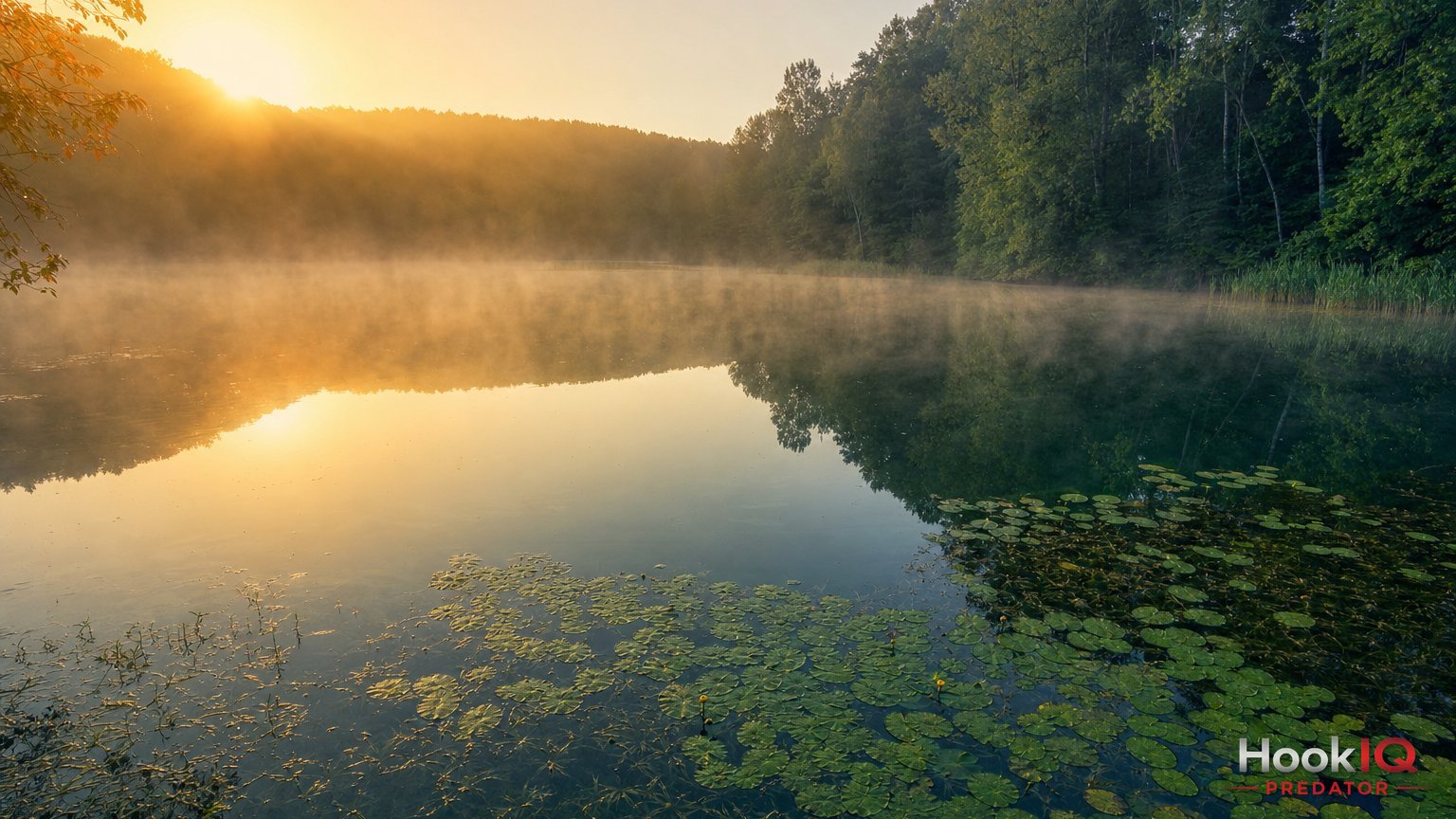
There are those August days when the water sits almost lukewarm around your legs by midday, and you'd swear there isn't a single pike left at home in the whole lake. That's exactly where most anglers get it wrong and write off high summer altogether. Over the years I've learned that August is one of the best months for a genuinely big pike — if you know where to look. And this August drove that home to me all over again.
Why pike seem to vanish in the heat
August brings the warmest water temperatures of the year. On my water, the shallow bays climbed to 23°C during the day, and one afternoon even hit 25. For a pike, that's a lot. This is a cold-water predator, and the warmer the water gets, the less oxygen it can hold in the first place. The heavy females that hunted the shallows back in spring keep a low profile in heat like this.
But that doesn't mean they stop feeding. They feed — just in measured doses, and only when the conditions suit them. Through the day, under the blazing midday sun, they hang sluggishly in the cooler, more oxygen-rich areas. Early in the morning, though, and in that last hour before dark, they switch on. This August I caught almost all my fish in the first two hours after sunrise, with a handful more at dusk. The hours in between I often spent taking a break in the shade — and that was a deliberate choice.
Finding the cool veins in a warm lake
The key in high summer comes down to oxygen and water that's a degree or two cooler. Where I find both, I find the pike. There were three types of spot I worked over and over this August.
First, the deep weed edge. Not the knee-deep shallows like in spring, but the drop-off where the green field falls away into two, three or four metres of water. Weed produces oxygen through the day, and the baitfish sit right along its outer edge. That's exactly where the pike lurks in August too — half in the shadow of the weed, facing out into open water.
The second spot is the wind-blown bank. When it's windy, a lot of anglers head for the sheltered, flat-calm side because it's more comfortable to fish. I do the opposite. The wind pushes the sun-warmed surface water away, shoves cooler, oxygen-rich water up against the margin, and drives plankton — and with it the silverfish — towards you. On one gusty morning there was a proper pack of pike stacked up along a bank like this, and I landed three fish from the same corner.
And third, there are the inflows and the deeper channels. Every little stream, every feeder brings cooler water into the lake. On hot days an inflow like that is a magnet. The deeper channels running between two weed beds, where the water holds a degree or two cooler, are reliable addresses in August too.
My lures in high summer: big and deep — and sometimes up top in the morning
With lures I ran a two-track approach in August. In that first hour of the morning, when the fish are actively hunting over the weed beds, a topwater lure is an experience in its own right. A prop bait or a big stickbait, walked in a zigzag across the weed, pulls the pike out of the green in a plume of spray. Nothing in pike fishing is as spectacular as a topwater take at first light. When the surface explodes and you see it with your own eyes, you're wide awake in an instant.
As soon as the sun climbs higher and the fish drop back onto the deeper edge, I switch to a big soft plastic. And in August it can happily be a size up. I fish 17 to 23 centimetres, because a well-fed summer pike is after a proper mouthful and will barely shift off the edge for a small snack. I pick a jig head weight that lets the lure sink nice and slowly along the edge — over the three-to-four-metre spots that's usually 20 to 30 grams for me. I work it along the edge in slow, drawn-out hops, letting it drop back down to just above the weed after every second or third lift. The takes almost always come on that drop.
With colour I keep it simple. In the often still fairly clear summer water I run natural patterns — a perch finish or a silvery roach pattern matches exactly what the pike are feeding on right now. On overcast or coloured-water mornings, a bright roach or a firetiger can happily go on the leader so the fish picks the lure out quickly.
A word on the wire trace, because with pike that's not up for negotiation. There's always a solid trace on the end of the line for me — a 30 lb titanium or wire trace with a strong snap. Anyone heading out for August pike on bare fluorocarbon will sooner or later lose a big fish to a bitten-through line, and it's just not worth it.
Fish care: in warm water, every second counts
One thing that's especially close to my heart in high summer is how you handle the fish you catch. Warm water holds little oxygen, and a pike that's had a long fight is closer to its limit at 23°C than in the cool of spring. That's why in August I deliberately play fish quickly rather than drawing the fight out. The net is within reach, the forceps too, and the fish stays in the water — or over a wet unhooking mat — as much as possible.
If I want a photo, I keep it brief and have everything laid out beforehand. The pike is back in the water within a few seconds. On really hot afternoons I'd rather skip fishing altogether and head out early or late, when the fish stands a better chance after release. A big summer pike is a valuable animal, and I want it spawning again next spring.
The bottom line
August asks you to rethink things a little as a pike angler, but it rewards you for it. Get up early, seek out the deep weed edges, the wind-blown banks and the cool inflows, and concentrate on that first hour of morning and on dusk. Start up top with a topwater over the weed and switch with the sun to a big soft plastic on the deep edge. And treat the fish with the respect it deserves in the heat.
Catching the interplay of water temperature, time of day and wind at just the right moment is half the battle in high summer — and honestly, I stopped trying to keep all of that in my head long ago. These days I let the HookIQ app pull the good windows together for me, and then all I have to do is set the alarm. When the rod hoops over at the weed edge at first light, you'll know exactly why getting up early in August is worth it.