
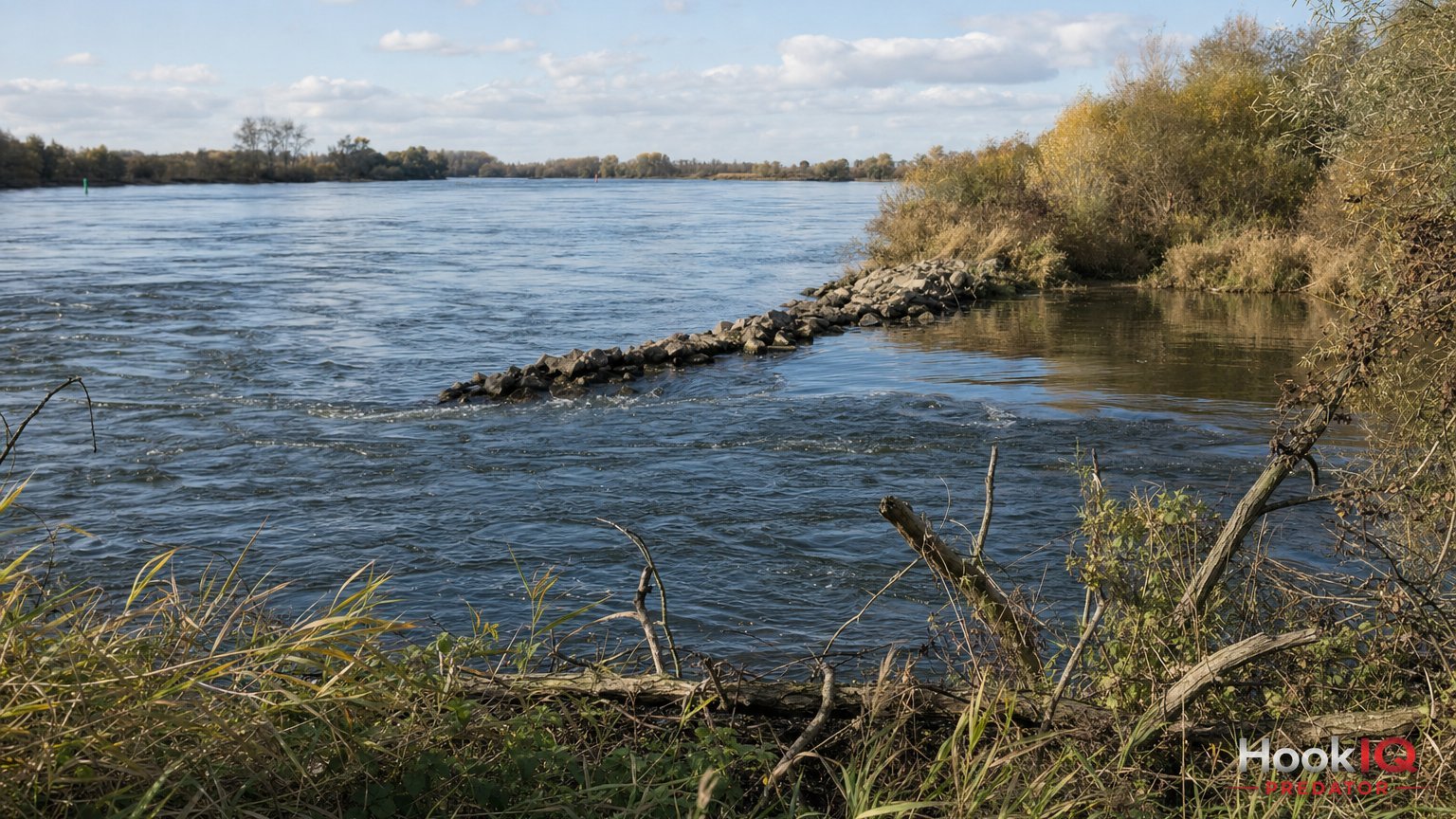
Picture a groyne, grey stone worn smooth by decades of current. Above it the flow breaks apart; behind it lies a patch of water as flat as a pond. Right in that wedge between loud and calm, a pike is holding this October, a fish that's done nothing but eat for weeks. Most anglers just cast somewhere near a spot like this. I've been casting into that exact wedge for more than three decades, and that's precisely why I catch more consistently on rivers than on stillwaters.
Autumn on a river is when everything concentrates. Baitfish pull back out of the shallow bankside vegetation, and the water temperature drops below the point where pike can still doze lazily in weed cover. Suddenly it's the groyne fields, current seams, and harbor mouths where all the river's life gathers. Understand that, and you can walk a river in twenty minutes and narrow it down to three or four genuinely promising spots instead of blind-casting miles of bank.
Learning to Read Current Shadows
A pike is a hunter built for explosive bursts, not sustained effort. That's why it almost never sits directly in full current. It picks a spot where it can hold with minimal energy and still rocket into the flow in a split second when a baitfish drifts past. I call that spot a current shadow, and groynes offer several of them at once.
Right behind the groyne tip, where the water swirls and briefly settles, you'll find the classic shadow. A bit further downstream, where two current lines meet again and form a fine seam on the surface, there's a second shadow that's often overlooked. And at the root of the groyne, right where it meets the bank, a third calm pocket forms at many water levels. I fish these three zones in order before moving on to the next groyne, and I'd say at least sixty percent of my autumn river pike have come from exactly these three zone types.
The same principle applies at harbor mouths, just on a bigger scale. The breakwater breaks the river's main current, and in its lee a calm tongue often forms, reaching far out into the river. Right along the line where that calm zone meets the passing current, pike patrol in autumn like cars merging onto a highway. They don't wait just anywhere — they wait on the edge, because that's where baitfish traffic is thickest.
Working the Lure With the Current, Not Against It
The biggest mistake I see other river anglers make is a retrieve that completely ignores where the water actually wants to go. Many cast across the current and crank back at a stubborn, constant speed, whether the lure is working with the water or against it. The result is a presentation that feels unnatural to a pike, because no real baitfish fights the current like that.
At groynes I almost always cast at an angle upstream, let the lure drift with the current into the target zone, and only start cranking once it reaches the shadow. With a 15 cm soft plastic on a 14 to 18 gram jig head, depending on flow speed, it looks like this: cast upstream, keep the rod tip low, let the lure sink in free fall with the current, and only once it arrives in the calm water behind the groyne, work it with short, sharp jig strokes. That exact moment, when the lure shifts from fast to slow, is where most of my bites happen.
In clearer autumn water I like to switch to a jerkbait in the 18 to 22 cm range, worked with long, soft twitches instead of hard snaps. The same principle applies here too. I position myself so the lure runs along the current seam instead of crossing it head-on, because a baitfish moving along such a seam looks like an easy meal to a waiting pike. Cast straight across the seam instead, and you show the fish your lure for maybe a second before it's gone. That's rarely enough.
At harbor mouths I fish a bit differently. There you ideally cast parallel to the dividing line between calm and moving water and run the lure right along that seam. A spinnerbait or a mid-weight soft plastic worked along that line for ten or twenty meters covers more active pike than any cast that only touches a single point.
Water Level Decides Where the Pike Hold
What many river anglers underestimate is how radically spots shift with the water level. Before every session I check the current level, not out of curiosity, but because it tells me which of my proven groynes are even in play right now. On falling water after an October rainy spell, pike often pull back out of the shallow groyne fields and gather at the deeper transitions, where the groyne drops off into the main channel. On rising water, almost the opposite happens. Freshly flooded groyne heads and newly submerged weed debris suddenly become feeding grounds, and the pike follow the baitfish there, sometimes literally within hours.
A water level that's actively changing is almost always more interesting to me than a stable one. Falling water concentrates baitfish into a tighter space, and that's exactly what draws pike to current seams they might otherwise ignore. I remember an October afternoon on the Rhine when the level had dropped a good forty centimeters over two days. A groyne I normally ignore because it's too shallow at normal water levels suddenly had exactly the right depth at its outer tip. Three casts, three bites, and in the end a 94 cm pike that was only holding there because the falling level had pushed baitfish right onto that edge.
On heavily fluctuating levels, as you often get on navigable rivers from lock operations and shipping traffic, it pays to keep several groynes at different depths on your list and switch between them depending on the current level, instead of stubbornly sticking to one spot. Stay flexible and sort your spots by water level instead of habit, and you'll catch far more consistently on rivers in autumn.
My Takeaway
Groynes, current seams, and harbor mouths aren't a nice bonus on rivers in autumn — they're the backbone of every successful pike session. Target the current shadows right behind the groyne tip, along the seam where two currents meet, and in the groyne's root; work your lure with the water instead of against it; and check the level before every trip, and you're no longer fishing on a hunch. You're fishing with a clear plan. Get out there, read the current before your first cast, and give the edge the time it needs.