
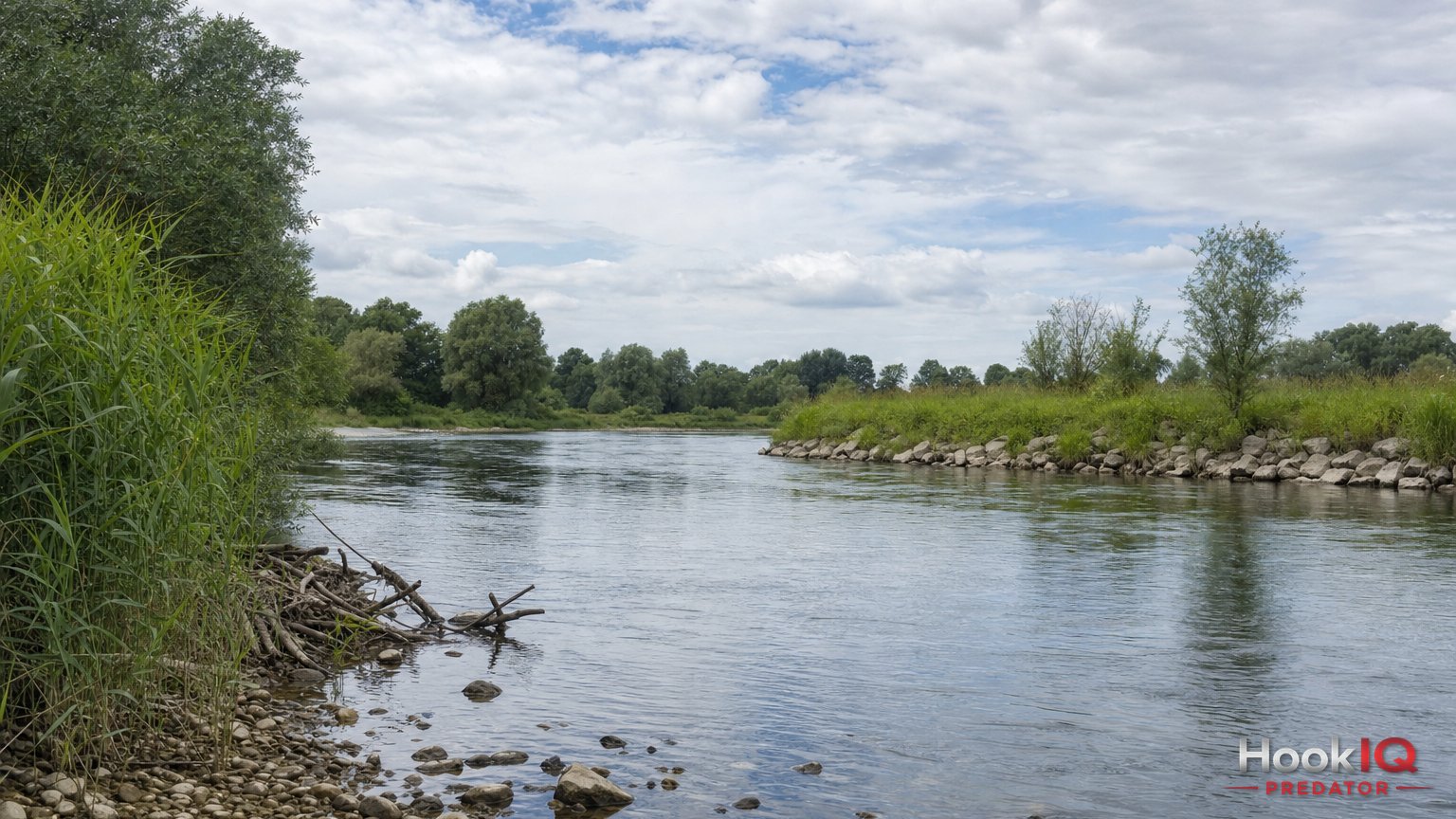
A few weeks ago I was fishing by a lock and landed a zander of 43 centimetres. A fishing buddy from the next county over could have kept that exact fish. I had to put mine back. Same fish, same day, different rulebook. This is exactly where anglers trip up when they arrive on unfamiliar water and simply assume the rules back home apply everywhere else.
Why there's no single size limit across the board
Fishing law isn't set nationally in Germany, where this example comes from — each of the sixteen federal states writes its own fisheries act, and that's where you'll find the size limits and closed seasons for every species. It sounds messy at first, but there's a sound reason behind it. A pike in a nutrient-poor foothill lake grows at a completely different rate than a pike in a nutrient-rich, shallow lowland lake. The waters differ so much that one blanket number for the whole country would either protect plenty of stocks far longer than necessary, or open them up to harvest far too early. If that sounds unfamiliar, think of the patchwork you already get between US states, or between England, Scotland, Wales and Northern Ireland — each region setting its own numbers, usually for the same biological reasons.
On top of that there's a second layer. Above the legal minimum, whoever actually controls the water — usually a club or association — is allowed to set stricter rules of their own. The legal minimum size is only ever a floor, never a guarantee that you're actually allowed to take a fish home. I've fished waters myself where the law would have allowed zander from 40cm, but the club's own rules required 45cm, simply because the local population was still rebuilding. If you only check the regional law and never read your permit, you can end up fishing illegally without ever meaning to.
How the numbers differ from region to region
For pike, legal minimum sizes in most German states sit somewhere between 45 and 50cm, with outliers higher still on waters under particularly heavy fishing pressure. For zander the typical range is 40 to 45cm, and some states even draw a line between still and running water. Perch doesn't get its own minimum size at all in many states; where it does, it's usually somewhere between 20 and 25cm. Catfish varies the most of all, since some states have no minimum size whatsoever while others set a limit around 70 to 80cm.
I'm deliberately giving ranges here rather than hard numbers, because that's the whole point of this piece. The exact figure for your water isn't sitting in an article on the internet — it's on your permit, or in the fishery's current rules. I read through those for every new water before I put a rod up, and that's something every angler should do, no matter how long they've been at it. Rules vary by country and by region, so whatever water you're fishing, treat the local regulations as the only source that counts.
The slot limit: more than just a single number
Alongside the classic minimum size, some waters now use a concept that still trips a lot of anglers up: the slot limit. Instead of just setting a lower bound, a whole range gets defined inside which a fish has to go straight back. Only fish below or above that window may be kept.
Parts of northern Germany have implemented exactly this for pike on certain waters — pike between roughly 50 and 80cm have to go back, while smaller and noticeably bigger fish can be taken. At first glance that looks backwards. Why would you protect the mid-size, trophy-looking fish specifically, and not the small ones?
Why the mid-size and big fish matter most
The answer lies in reproductive biology. Large, old female pike don't simply produce more eggs than small females — they produce disproportionately more, and bigger, stronger eggs with better survival odds for the offspring. Fisheries biologists have taken to calling these fish, almost fondly, the "big old fat fecund females" of a population, and they're exactly the fish that keep a water stable over the years. Take them out consistently once they hit a certain size, and a fishery's reproductive output can collapse far faster than you'd think. At the same time, nobody wants a rule that means no one can ever take a fish home for the pan again. The slot limit resolves exactly that trade-off. Small, mostly male, not-yet-mature fish can be taken, which takes pressure off the population. The especially large, usually very old individuals — already rare, and with comparatively little statistical influence on the overall stock — can also be taken, since their removal barely dents the bigger picture. But the middle, most fertile class stays in the water and keeps the next generation coming.
This idea changed how I think about it. For years I assumed that the bigger the fish, the more it "deserved" to be taken out for the good of the fishery. Often the exact opposite is true. The 65cm pike I caught off a groyne last autumn would, under my old logic, have been a dream fish to keep. Knowing what I know now about slot limits, that's exactly the fish the system needs the most.
What this means for you on the bank
In practice it boils down to one thing above all: measure, don't guess. A tape measure or measuring mat belongs in my kit just as much as a net and forceps. Right around a limit, a few millimetres decide whether a fish has to go back. I measure from the tip of the snout to the end of the tail fin, with the fin gently closed, never rounded generously in my favour.
Even more important is the release itself. A fish that has to go back should spend as little time out of the water as possible. I keep air exposure under ten seconds whenever I possibly can, for both legal and undersized fish, and lower the fish back in supported under the belly with both hands rather than just dropping it. Especially with big slot-limit pike, which are meant to keep contributing to the fishery for years to come, a clean release isn't a nicety — it's the entire point of the rule.
And before you fish a new water, whether on holiday or just a day trip, take five minutes to read the fishery rules. Most run-ins with a bailiff aren't down to bad intent — usually it's simply that someone still had last week's rules in their head instead of this week's.
The key takeaways
Size limits are set regionally rather than nationally, and can even differ from one water to the next within the same area, because clubs are allowed to set stricter rules than the law requires. Slot limits flip the classic logic on its head, specifically protecting the mid-size, most fertile fish in a population while still allowing small and very large fish to be taken. Anyone who wants to fish responsibly checks the exact numbers before fishing any new water, measures their catch properly, and treats every release with the same care as the fish they take home. Regulations vary by country and by region, so always check your local rules before you go. In the end, we all benefit if a trophy pike is still coming out of the same water in twenty years' time.