
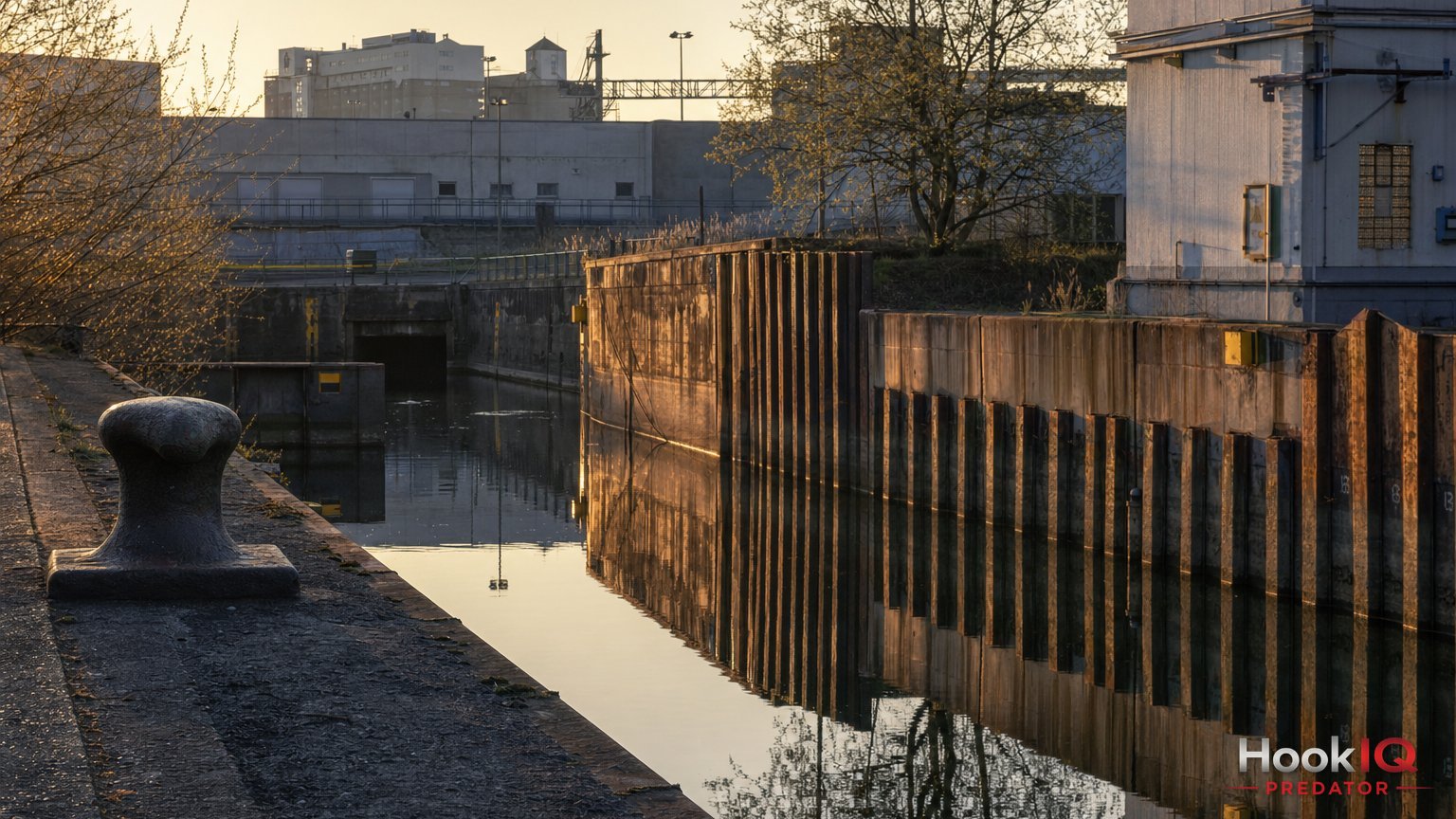
There are those spring mornings when you head out with a single short rod and a handful of soft plastics in your jacket pocket, straight through the middle of town, past shuttered pubs and steaming bakeries, until you're standing at the harbour basin and the first cast lands sweet. No boat, no waders, no gear war. Just you, a sheet-pile wall, and perch that are slowly getting their appetite back after spawning. For me, spring street fishing is the most honest kind of angling there is. And urban harbours and canal mouths are the ground where it works best.
Why the Harbour Beats the Open Water in Spring
The perch have finished spawning through April and into the first weeks of May. They drape their egg strands over roots, brushwood, sheet-pile profiles and old branches, and afterwards they're spent. Drained, tied to their spot, in no mood to hunt far. That's exactly where a lot of anglers get it wrong and push out onto the big open water. I do the opposite. I go where the water warms up faster and where the worn-out fish have short distances to cover.
In spring, an urban harbour is a heat trap. The water sits calmer than in the main flow, the concrete walls and the dark bottom soak up the sun, and just two degrees more than out in the canal makes a difference you'll feel instantly in the bite rate. Canal mouths, in turn, are collecting basins for everything spring brings to life. Freshly hatched coarse-fish fry, small crustaceans, insect larvae, all flushed on the current out of the feeder canal and into the harbour. Where the food gathers, the perch hold. It's that simple.
Last spring I fished an old industrial harbour in the Ruhr region, a basin nobody else bothers with because it simply looks unremarkable. Grey concrete, a few bollards, a canal inlet at the far end. One morning in May, with the water barely at eleven degrees, I landed over twenty perch in two hours. Not all of them were big, but six or seven were past the thirty-centimetre mark. They all held on the same structure, and they all wanted the same tiny lure.
Reading Vertical Structure: Where the Fish Really Hold
The most important thing in harbour street fishing is that you stop thinking in terms of the flat and start thinking vertically. A sheet-pile wall isn't a boring straight line. It's a vertical face full of edges, profiles and transitions, and the perch uses every single one of them.
The corrugated profile of a steel sheet-pile wall creates alternating ridges and recesses. In those recesses the perch sits sheltered from wind and current, waiting for the prey to drift past. That's exactly where you have to present your lure, so tight to the wall it almost hurts. A hand's width too far out and you're fishing past the fish. I often drop the lure straight down the wall, centimetre by centimetre, counting off the ledges where the profile changes.
It gets even more interesting at the transitions. Where the vertical wall meets the bottom, there's almost always a little step of silt, stones and old branches. That edge at the foot of the wall is the ultimate perch magnet. Add to that the hard structure people have left behind. Old mooring rings, sunken ladders, lengths of chain, pipe outlets. Every one of those spots throws a shadow and offers cover, and in spring, when the perch are sluggish, cover with a short trip to food is exactly what they're after.
At canal mouths you get the current seam on top of all that. Where the inflowing water meets the still harbour water, a clear seam forms. On the calm side of that seam, in the lee of the current, the perch park up and let the food be served to them. Cast lightly into the current and let the lure drift over the edge into the quiet zone. The bite almost always comes at the exact moment of the transition.
Small Lures: Why Five Centimetres Is Plenty Now
After spawning the perch are weakened, and they feed selectively. They don't want to chase big prey that costs a lot of energy. They want small, light mouthfuls they can hoover up with a short suck. That's why I shrink my entire lure arsenal in spring.
My standard is small soft plastics and creature baits between four and six centimetres. On sluggish days I'll even drop down to a two- or three-centimetre nymph imitation or a tiny craw on a micro jig. I usually keep the colour natural — translucent browns, motor oil, a touch of glitter, plus a dab of UV or chartreuse on the tail tip on murky days. In clear harbour water, and in spring it's often gin-clear, the subtle, natural colour wins almost every time.
With the jig head the rule is: as light as possible, as heavy as necessary. In the mostly shallow harbour basins, between one and a half and four metres deep, one to three grams is plenty for me. The light head gives a long, seductive drop phase, and it's precisely during that phase that the bite comes from exhausted perch. Only when the wind and current pick up at the canal mouth and I lose bottom contact do I climb to five or six grams. Fish too heavy here and you rip the lure too fast through the layer the fish are holding in, then wonder why you blanked.
For this delicate fishing you need the right rod. A BFS or ultralight combo with a casting weight up to around seven or ten grams, matched with a braided mainline around six hundredths of a millimetre and a fluorocarbon leader of two to three metres in 0.16 to 0.20 millimetres. This light setup transmits every twitch right into your fingertips, and with post-spawn harbour perch the bite is often nothing more than a faint nod in the line.
The Right Retrieve: Slow, Vertical, Patient
You can more or less forget the classic jig retrieve with wide hops in the spring harbour. The perch want it slow. My favourite technique is a fine dropshot right against the sheet-pile wall. I let the weight settle at the foot of the wall and simply let the lure quiver, with minimal movements from the wrist, almost on the spot. This vertical presentation, this patient provoking at a fixed point, is worth its weight in gold in spring.
When I do fish the jig, it's with very short, soft twitches and long drop phases in between. Cast, let the lure pendulum down the edge, twitch briefly, wait, twitch again. Count to three in your head before you give the next impulse. In nine cases out of ten the bite comes while the lure is sinking still, not while it's moving. So keep contact with the line at all times and watch it like a hawk. A short twitch, a stall on the drop, the line pulling off to the side — that's your cue to strike.
And keep walking. Street fishing lives on staying mobile. Three, four casts to a spot, to a recess, a bollard, a pipe outlet, and if nothing comes you move twenty metres on to the next piece of structure. On a single morning I've sometimes worked half a kilometre of quay wall. In spring the perch hold in tight groups on a few good edges. Your job is to find those edges, and that only happens if you keep moving.
My Verdict
Spring perch street fishing isn't a game of chance, it's structure fishing in its purest form. Find yourself an urban harbour or a canal mouth where the water warms up and food collects. Read the sheet-pile wall as a vertical landscape and fish your lure so tight to the edge it makes your skin tingle. Stay on small lures between four and six centimetres on light one- to three-gram heads, work them slowly and patiently, and walk one metre too far rather than one too few. The fish are there, in the middle of the city, right at your feet. You just have to go and find the right edge.