
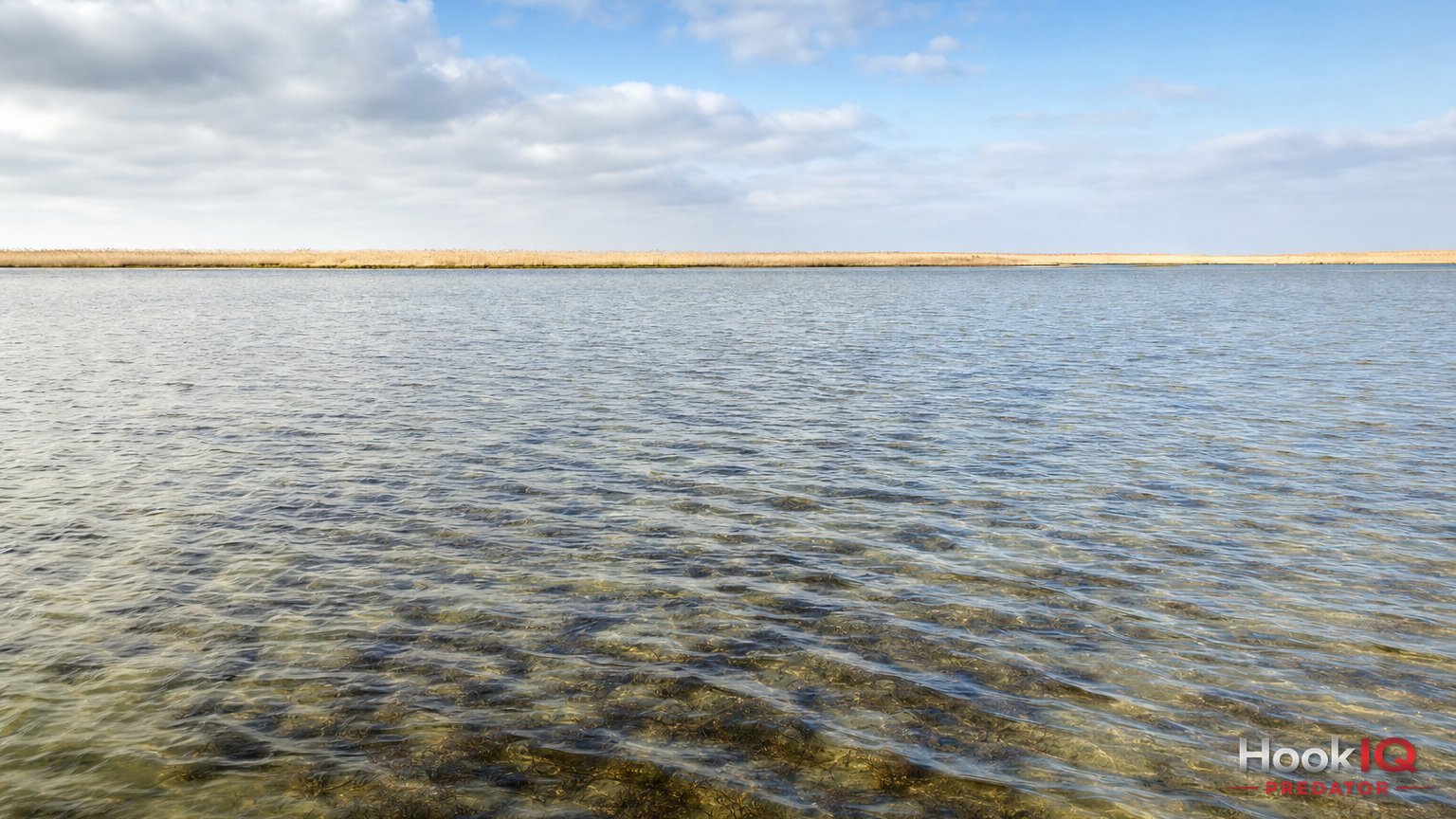
There's one moment every spring that I save up for, year after year. The boat sits on the edge of a huge shallow flat, barely two metres of water under the keel, the wind coming in clean over your shoulder, and eight hundred metres of untouched water stretched out in front of you. No engine noise, just the water lapping against the hull. And somewhere out there, over pale sand and old weed beds, sits a pike wider than your forearm. Welcome to the Bodden.
Why the Bodden Waters Tick Differently in Spring
The Bodden waters along the Baltic coast are neither lake nor river. They're brackish — slightly salty, enormous, and in places shallow enough to wade for miles. That's exactly what makes them so special in spring. Once the cold months are behind us and the sun brings the first warm days, the big shallow zones heat up far faster than the deeper water around them. A dark bottom, old vegetation, a bit of shelter from the wind, and suddenly that water sits two, sometimes three degrees warmer than the rest. For a pike that's just come through the hard graft of spawning, that's a warm bath with dinner already on the table.
The salt-water pike of the Baltic have a reputation, and they've earned it. They're thick, powerful, and they fight differently to their cousins from a gravel pit. A Bodden pike of a metre feels like a metre-ten fish from freshwater on the rod. These fish feed themselves properly fat in the brackish water, and in spring the big females are in prime condition. These are the weeks when the truly big girls become catchable, before they slip back into their quiet hiding spots.
The Long Drift: Cover Water Instead of Hopping Spots
The key difference from normal pike fishing is the sheer scale of these flats. On the Bodden you're not hunting a single ambush point next to a weed bed — you're hunting a pattern spread over hundreds of metres. And there's no better method for that than the controlled drift. I set the boat on the windward edge of a shallow flat, let the wind push me across it, and fan the water in front of and beside the boat with long casts as I go. In a single drift I cover more water than a bank angler manages in a whole day.
The trick is in the speed. If the boat drifts too fast, the lure races over the fish before they can commit. That's why a drift sock is standard kit for me. It's a simple drogue you hang in the water to slow the drift down. On a day with a decent breeze, a drift sock is the difference between a clean, fishable speed and a frantic slide across the flat. I'd rather run the drift slow and thorough than fast and shallow. Once you've found a drift line that produces, motor back to the starting point and run exactly the same line again. Bodden pike hold in groups, and where there was one, there are often three more.
The wind is your most important ally and your boss at the same time. It decides which flat is even fishable. An onshore wind pushing into a shallow bay drives the warmed surface water — and the baitfish with it — right to where the pike want it. Those wind-facing edges are often the absolute hotspots in spring. Too much wind, though, and the drift becomes uncontrollable; in a dead calm there's no drive at all. My favourite conditions sit around a steady Force 2 to 3 from a consistent direction.
Lures and Setup for Shallow Salt Water
On the shallow Bodden I fish big. These pike are proper predators, and in spring they want a solid mouthful, not a snack. My standard is a big soft plastic between fifteen and twenty-three centimetres, rigged on a fairly light jig head. That sounds contradictory — big lure, little lead — but in shallow water I want a long, slow sink phase, not a lure that ploughs straight into the mud. Ten to fourteen grams is plenty over a metre or a metre and a half of water. The lure should hover and flutter enticingly, not race.
With colours I keep it simple and let the water clarity decide. If the water's clear, which it often is in early spring, I reach for natural tones that mimic herring and small silverfish — silvery, whitish, with a hint of blue or green over the back. If wind stirs it up and it colours, out come the stronger, brighter tones: firetiger, bright white, or a dirty red-orange. On some days it's the big glide baits or a shallow-running jerkbait that make the difference, especially when the fish are sluggish and you need a lure that still works even at the slowest retrieve.
I make no compromises on the leader. Bodden pike grow big, and a fish that size will shred any fluorocarbon. A seventy-centimetre titanium or wire leader is a must, along with a powerful spinning rod with plenty of backbone, because the casts are long and the lures are heavy. Run a braided mainline with enough breaking strain so you can still set the hook cleanly at distance. And since we're talking genuine specimens here, a big rubber-meshed landing net and a good pair of pliers belong permanently in the boat. These fish deserve fast, careful handling and then straight back into the water — especially the fat females in spring.
In Spring, Timing Is Everything
As neat as the theory sounds, on the Bodden it's timing that decides between success and a blank day. The water has to be the right temperature for the big fish to move onto the flats. Too early in the year, when it's still bitterly cold, they hold deeper and feed cautiously. But when the first stable warm spell arrives — a few days of sun, mild nights, a light wind from a favourable direction — the shallows can absolutely explode. These windows are short and hang on a whole bundle of factors at once: wind direction, hours of sun, water temperature, air pressure — and all of it shifts from one day to the next.
Keeping that interplay straight in my head used to cost me a few good days, because I'd be out on the wrong weekend. These days I let HookIQ pull those factors together, so I can see at a glance when the favourable windows are opening up on the shallow flats, instead of juggling every single value in the back of my mind. It doesn't replace time on the water, but it helps me decide whether the long trip out to the Bodden is worth it on that particular day.
My Take
Spring fishing on the Bodden is water-covering fishing. If you're willing to run long drifts with the wind — slow and thorough, instead of gluing yourself to one spot — you'll be rewarded with salt-water pike that don't let go of you in a hurry. Run the drift under control with a drift sock, fish big and shallow, and time it to the first warm weather window. And when the line suddenly goes heavy over a metre and a half of pale bottom and a broad head lies in the net, you'll understand why I keep coming back to these endless shallow waters every spring.