
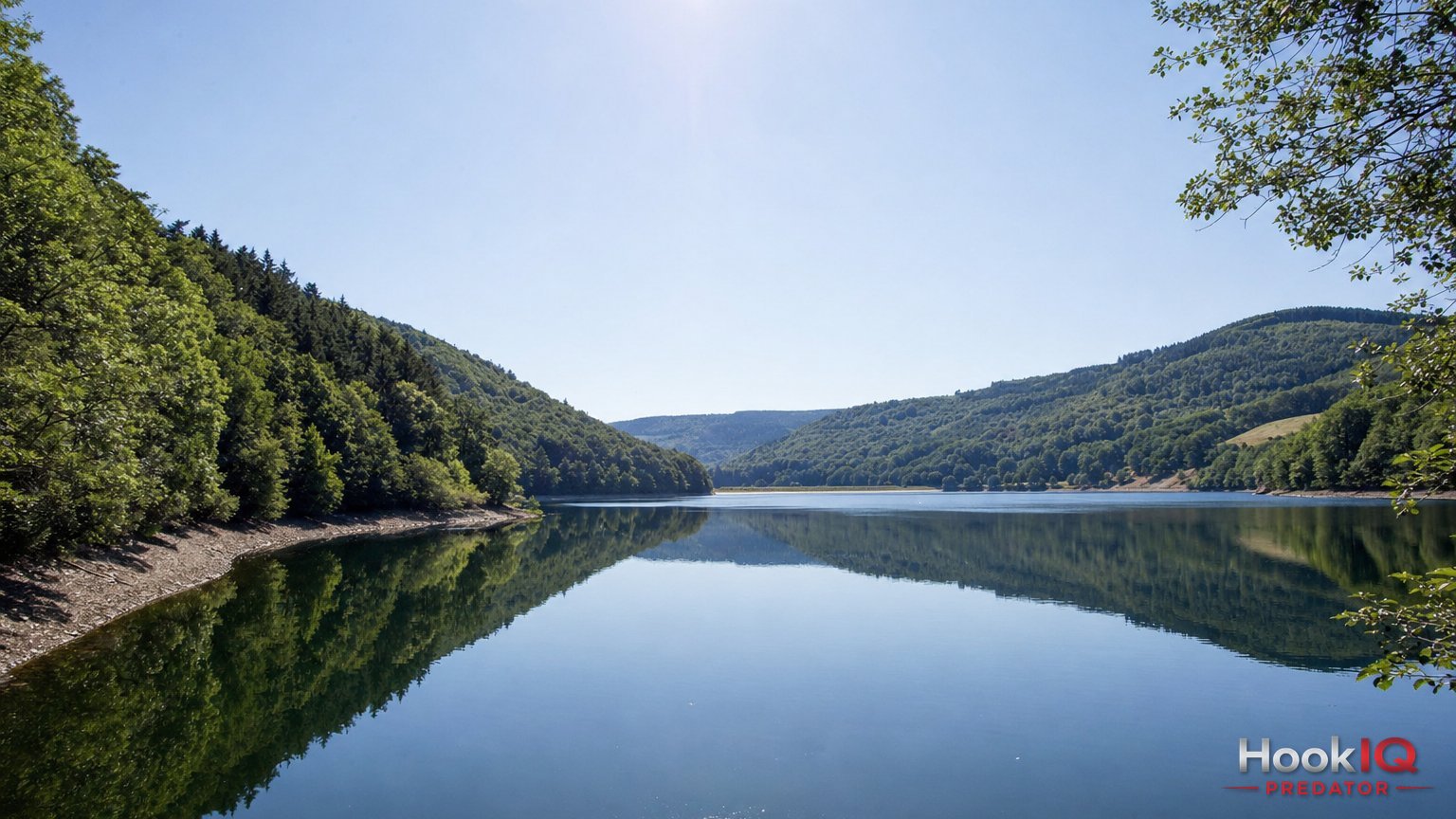
Twenty degrees water temperature, blazing sun, not a breath of wind. Most anglers pack up the spinning rod and wait for autumn. I head out onto the reservoir and look for the spots where the good perch stack up. Not along the bank, not on the riprap. Down deep, at eight to twelve metres, on the plateaus that barely anyone has on their radar.
Why Perch Go Deep in Summer
It comes down to comfort. When surface temperatures climb above 20 degrees, a thermocline forms — a distinct layer separating warm surface water from cooler depths. Above it, conditions are too warm, too bright, and often too oxygen-depleted in the shallows for big perch. Just below this layer, usually somewhere between six and twelve metres, they find a zone with stable oxygen levels and comfortable temperatures around 15 to 17 degrees. That's exactly where the reservoir plateaus sit like natural gathering points.
A plateau in a reservoir is simply a flat elevation on the bottom that rises distinctly from the surrounding depths. Think of it as an underwater mesa. The edges of these plateaus are worth their weight in gold because they serve as waypoints for roaming baitfish. And where baitfish travel, perch line up.
You Need a Fish Finder — No Way Around It
I don't like making blanket statements, but for this type of fishing, a fish finder isn't a luxury. It's your most important tool. You're searching for structures you'd never guess from shore, targeting fish you can't see with the naked eye. Casting blind out here is a waste of time.
You don't need a five-figure forward-facing sonar system. A solid 2D unit with CHIRP technology is more than enough. What matters is learning to read bottom structure. You spot a plateau when the bottom suddenly gets shallower, then drops off again. On my sonar, I trace the contours and look for two things: edges and contact points.
Contact points are spots where something changes. The transition from hard to soft bottom. A cluster of rocks on an otherwise sandy plateau. A submerged log. A small depression in an otherwise flat area. On the sonar, you recognise hard bottom by a strong, narrow return signal. Soft bottom produces a wider, more diffuse echo. Once you can read these differences, you already have a huge advantage.
My approach is always the same: I run the entire plateau first without fishing. Slowly, on the trolling motor, sonar on high frequency. I locate the plateau edge, mark the most interesting contact points as waypoints, and check for fish arches above the structure. Only when I have a mental picture do I pick up the rod. Those ten minutes of preparation often save me two hours of aimless casting.
The Plateau Edge as a Hotspot
Not every part of the plateau fishes equally well. By far the most productive zone is the edge — the transition from the flat plateau into the deeper surroundings. This is where baitfish travel, and this is where the perch ambush. In my experience, the best fish almost always hold on the edge facing the deepest part of the reservoir. The perch have the shortest escape route into safe depth there, while still having access to the food on top of the plateau.
Within the edge itself, there are differences. A steep drop-off fishes differently from one that tapers gradually over several metres. Steep edges concentrate fish in a tight area. You can position directly above the break and drop your dropshot right into the zone. Gradual edges spread fish out, forcing you to cover more water. Both situations have their appeal, but if you're starting out, look for the steep breaks. Bite rates tend to be higher there.
Dropshot as the Key Technique
Why dropshot and not a jig, not a Carolina rig, not vertical jigging? Because dropshot gives you three decisive advantages on these plateaus. First, you keep the lure consistently at the right depth, just above the bottom. Second, you can make the lure dance in place without moving it horizontally. Third, the taut leader transmits even the subtlest contact straight to your rod tip.
Especially in summer, when perch often hold lethargically right above the bottom, this stationary presentation makes all the difference. A jig that keeps hitting bottom and lifting off can be too much action. The dropshot lure hovers enticingly in the water column, quivering at the slightest rod movement. That's exactly the kind of subtle trigger that gets a well-fed summer perch to commit.
My Setup for Deep Plateaus
The rod is the most critical factor. I fish a 2.40 metre spinning rod with a fast tip action and a casting weight up to 14 grams. The tip needs to be sensitive enough to impart those micro-vibrations and detect bites, while the backbone needs enough power to drive a solid hook set at eight metres of depth.
For my mainline, I use a thin braid in 0.06 to 0.08 mm diameter. The near-zero stretch is essential at this depth — you need to feel what's happening down there. For the leader, I run fluorocarbon in 0.20 to 0.22 mm, about 60 to 80 cm long. Fluorocarbon has two advantages: it's virtually invisible underwater, and it sinks on its own, which benefits the dropshot presentation.
I choose my weight based on depth and current. In reservoirs, 5 to 10 grams usually does the job. At eight metres with no wind, I often find 7 grams to be the sweet spot. Too heavy, and you feel bottom contact too harshly, masking subtle bites. Too light, and you can't reach bottom or you drift off target in the wind. It pays to carry several weights and experiment on the water.
Lure Selection: Less Is More
On the deep plateaus, I fish almost exclusively with slim finesse worms and small creature baits between 5 and 7.5 cm in length. Natural colours are my first choice. A translucent worm with green or brown glitter flakes works brilliantly on clear reservoirs. On murkier days, I switch to subdued tones like motor oil or pumpkin. Chartreuse tails can add an extra trigger point when bites slow down.
Less is more applies to hook size too. A size 4 or 6 offset hook is plenty for these lures. Oversized hooks alter the lure action and make perch suspicious. My standard hook placement sits 20 to 30 cm above the weight. When perch hold tight to the bottom, I drop it to 15 cm. When they're suspended higher in the water column — which the sonar tells me — I raise it to 40 or even 50 cm.
The Retrieve: Patience as a Weapon
Let the dropshot sink until you feel bottom contact. Then lift the rod tip slightly, maybe ten centimetres, and begin with minimal quivering. No big sweeps, no frantic shaking. Imagine you're holding a cup of coffee and don't want to spill a drop. These micro-movements travel down the line to the lure and make it look alive.
Between the quivering phases, I deliberately pause. Three to five seconds where the lure simply hovers. Most bites come during these pauses. You feel them as a light tap in the rod tip, sometimes just as a slight weight increase, as if someone is gently pulling the line. In both cases: take up the slack and set the hook with a controlled sweep. At eight metres of depth, you need to strike a bit more firmly than in shallow water, because line stretch and water pressure dampen the hook set.
If nothing happens at a contact point, stay for at least three to four minutes anyway. Perch sometimes need a moment to commit to the strike. Move on too early, and you miss the fish that was still making up its mind. I've caught perch that didn't bite until five minutes at the same spot. Patience on the deep plateau isn't a virtue — it's your most important tool after the fish finder.
What I Learned This Summer
Last weekend I was out on the reservoir at 24 degrees air temperature. The sun was hammering down, not a breeze, and the bank anglers had already packed up. My sonar showed me a plateau at nine metres with a sharp edge dropping into a twelve-metre channel. Right on the edge, a few arches in the water column, just above the bottom.
First cast with a 6 cm finesse worm in green pumpkin, 7 gram weight. The lure sank, I felt the weight touch down on hard bottom. Two gentle quivers, pause. Nothing. Quiver again, pause. On the third pause — that unmistakable tap. Hook set. The rod buckled, and what came up was a perch of 38 centimetres. Broad as a handball, with bright red fins. Exactly the kind of fish that makes the patience worthwhile.
Over the next hour I caught four more perch between 28 and 35 centimetres, all on the same edge, all on the same lure. The key was the same every time: read the sonar, approach the contact point, place the dropshot precisely, and be patient.
My Takeaway
The deep plateaus in reservoirs are your summer ticket to trophy perch. You need a fish finder to locate them, a finesse dropshot setup to fool them, and above all the willingness to work slowly and methodically. Scout the plateau first, read the structure, mark your contact points, then fish them one by one with calm and precision. Master this, and you'll be catching perch while everyone else complains about dead water.