
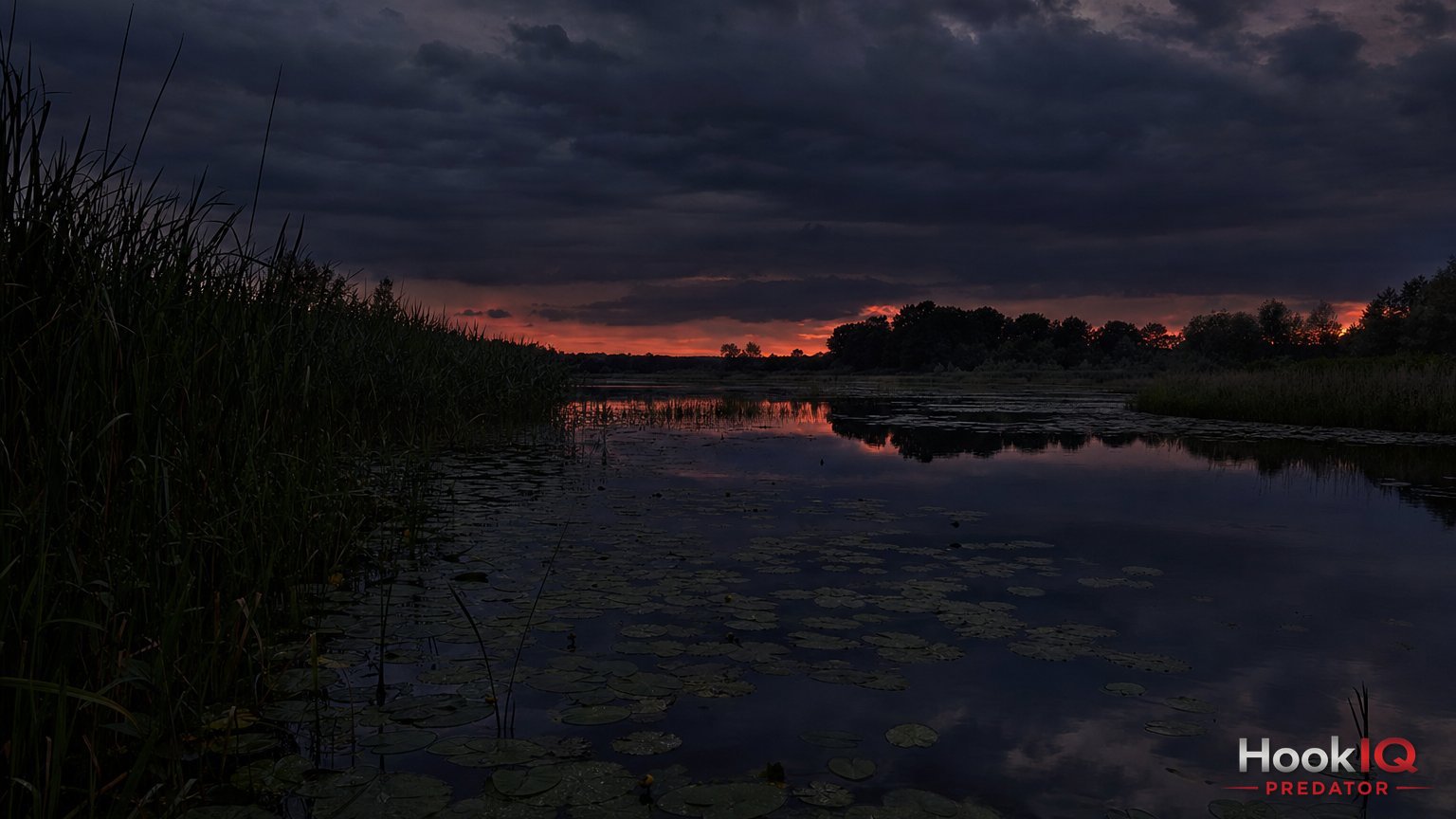
It's just past eight on a July evening, the air sits heavy at 28 degrees, and over the backwater hangs that thick, sweet smell of warm water and reeds. I'm standing knee-deep in shoreline mud, casting a frog across the lily pads, and then it happens. The water explodes. No warning, no tap, no tentative nibble. A detonation. Anyone who has ever seen a pike smash a topwater lure from below will never forget it.
Why Topwater Works in Midsummer
Most anglers associate pike fishing with heavy soft plastics, jerkbaits, or trolling lures. And yes, all of that works. But there's a window in the year when nothing matches the effectiveness — and above all, the pure adrenaline rush — of a surface lure. That window is right now, in the height of summer.
The reason is simple. When water temperatures climb above 20 degrees, many pike move into shallow, weed-choked areas. Lily pad fields, weed beds, reed edges. The water here is warm, but it offers two things pike need: cover and food. Frogs, small baitfish, fry of all kinds swarm these zones. And the pike sits right in the middle, often just inches below the surface, motionless as a log. Until it strikes.
Frog Lures: The Weapon for Heavy Cover
My absolute favourite lure for these situations is the frog. Not the live one, but its imitation — a soft, hollow-body rubber lure with two upward-facing single hooks that sit flush against the body. The genius of these lures is their ability to come through the densest weed fields virtually snag-free. You cast it right into the lily pads, onto the leaves, between the stems, across weed beds that would instantly snag any other lure.
For the retrieve, I rely on two approaches. The first is a slow, steady retrieve with short pauses. The frog glides across the leaves, plops from one lily pad to the next, and during the pauses it ripples the surface. It's precisely during those pauses that most strikes come. The pike is lying beneath the leaves, feels the vibration, sees the shadow, and then rockets upward.
The second approach is more aggressive. Short, quick pops that make the frog splash and spit across the surface. This mimics a panicking frog and can be the trigger on days when the slow retrieve isn't getting it done. I switch to this method especially when I know pike are there but they're ignoring the slow presentation.
As for size: I fish frogs between 6 and 10 cm. The smaller ones on pressured waters, the larger ones when I'm specifically targeting big fish. Colour-wise, I keep it simple. Green with a brown back best imitates a natural frog. On overcast days or at dusk, I go with black — the silhouette against the bright sky is the most visible.
Walking Baits: The Art of Walk the Dog
Besides the frog, there's a second lure type that has increasingly won me over in recent years: the walking bait, also known as a stickbait. These cigar-shaped hard baits have no diving lip and are worked across the surface in a zigzag pattern through rhythmic rod twitches. Walk the dog — that's what the technique is called, and once you've got the rhythm down, it's almost meditative.
The walking bait is my first choice along the edges of weed beds. Right where the dense green stops and open water begins, pike patrol. They sit in the weeds and ambush, and a lure tracking along that edge is like a written invitation. I cast parallel to the weed line, as close to the green as possible, and work the bait in a steady rhythm. The twitches come from the wrist, not the arm. Light, rhythmic, with a low rod tip.
The strikes on walking baits are different from frog strikes. With the frog, it's an explosion. With the walking bait, you often see a wake building behind the lure, the water bulging upward, and then comes that moment when you know: it's about to happen. The pike follows, builds speed, and then rips the lure under. Sometimes it shoots out sideways from the weeds and the bait vanishes in a swirl. I've been startled so many times that I've botched the hook set. No joke. That moment of shock is as much a part of topwater fishing as the mosquitoes are to a summer evening.
For sizes, I fish walking baits between 10 and 15 cm. A 12 cm model in perch pattern is my standard — the first thing I tie on in almost any conditions. The rod should have a moderate tip action, not too stiff, so you can dose the twitches cleanly without ripping the lure out of the water.
Timing: Why the Evening Hours Are Worth Their Weight in Gold
Topwater pike fishing works all day, but the truly magical phase starts in the late afternoon. From around 6 pm, when the shadows lengthen and the temperature slowly drops, activity picks up noticeably. The best sessions of my life have been between 7 and 10 pm on muggy summer evenings. When thunderstorms were in the air, the cloud cover hung low, and that oppressive stillness settled over the water — I knew: tonight it's going to kick off.
There are evenings when you can catch six or seven pike on topwater along a single weed edge in two hours. Not all big, but every one with the same explosive strike that sends a shot of adrenaline through your system. And then there are those quiet evenings when you work the frog over the lily pads for an hour and nothing happens. Until you want to stop. Until you want to pack up. And then comes that one strike that makes it all worthwhile.
I remember an evening in mid-July at a gravel pit lake. It was past nine, nearly dark, bats already swooping low over the water. I'd only caught two smaller pike around 60 cm all evening and was ready to call it a night. One last cast, right to the reed edge, where a fallen tree lay half submerged. The frog landed on a lily pad, I pulled it into the water, a short pause, and then came the strike. Not loud, but massive. The water opened up like a whirlpool, the rod buckled into the butt section, and whatever was on the end of my line was no 60 cm fish. After a fight where I thought three times the fish would bury itself in the weeds and it would all be over, a 98 cm pike lay in the net. On the frog. On the surface. At half past nine in the evening.
Responsibility on the Water: When You Should Leave Pike Alone
As much as summer topwater fishing excites me, I have to be honest at this point. Pike fishing in the height of summer demands a certain level of personal responsibility, and this is a topic that genuinely matters to me.
Pike are cold-water fish. Their bodies aren't built to handle sustained high water temperatures. From around 22 to 23 degrees water temperature, they come under increasing stress. Dissolved oxygen levels drop, their metabolism runs at full tilt, and a fight that a pike shrugs off at 18 degrees can become a serious threat to the fish at 25 degrees. Even if you do everything right — land the fish carefully, remove the hooks quickly, release it cleanly — the combination of warm water and fight stress can cause a pike to die hours later. And none of us wants that.
My personal rule is clear: once the water temperature hits 23 degrees, I leave the pike rod in the car. That's not a law, it's not in any fishing regulations, but it's a matter of respect for the fish. I check the water temperature before every session with a simple thermometer, and if it's at or above 23 degrees, I target other species or don't fish at all. On many gravel pit lakes and shallow waters, that can easily mean a week or two in midsummer when I'm not pike fishing. You have to accept that.
The shallow, weedy areas that are so perfect for topwater fishing are precisely the ones that heat up fastest in midsummer. A lily pad field that fishes fantastically on a cool June evening at 19 degrees can easily hit 25 degrees and above by late July or early August. Then it's time to take a break, even if the conditions look tempting.
If you want to pike fish in summer, target the cooler windows. After a cold front, in the early morning hours on deeper waters, or on days when the water temperature stays below the critical mark. The evening hours I described earlier as the best bite window are also good partly because the water is often one to two degrees cooler than in the afternoon. But even that doesn't exempt you from the duty of dipping the thermometer in the water first.
I don't like saying it, but I'll say it anyway: a pike that doesn't survive the fight because the water was too warm is not collateral damage. It's preventable. And that's exactly why the responsibility lies with us anglers to make the right decisions. Better to skip an evening than to have a dead fish on your conscience.
Tackle and the Small Things That Make a Big Difference
For topwater fishing, I use a rod rated 20 to 80 g with a length of around 2.10 m. Shorter than my usual pike rod, because lure presentation is more precise with a shorter rod. For line, I run 0.17 mm braid with a wire leader of at least 30 cm. Fluorocarbon isn't an option for topwater. When fishing a frog through heavy cover, you need the abrasion resistance of wire, and pike in surface-feeding mode aren't leader-shy anyway.
One point that's often underestimated: the hook set. With the frog, you need to wait one second. I know — that sounds like an eternity when the water just exploded in front of you. But the pike needs to fully engulf the frog first. If you set the hook immediately, you'll rip the lure right out of its mouth. I count in my head: one — then I strike. Hard, with the whole rod, because the hooks lying flush against the soft body need to be pressed free first. With the walking bait, it's different. The treble hooks are exposed, and you strike immediately when you feel the pull. Not on sight, but on feel. That's important, because the strikes are often so visually spectacular that you react too early.
Best Spots: Where to Fish the Frog and the Walker
The weed edge is the classic spot, and I've mentioned it several times already. But there are more places that hold topwater pike. Fallen trees in the shallows are fantastic, especially when lily pads or pondweed grow around them. Reed belts with weed beds in front of them are another hotspot. And then there are those small pockets in the weeds — open spaces in the middle of a lily pad field where the dark water glimmers through. If you can drop a frog right into one of those pockets and let it sit for two or three seconds, the chances of a strike are enormous.
On canals and rivers, topwater works too, but the spots are different. Shallow bays with weed growth, backwaters, quiet stretches behind groynes with vegetation. The walking bait is often the better choice here, because the current can drift a frog too quickly.
My Verdict
Topwater pike fishing in midsummer is, for me, the most thrilling way to catch this fish. No other lure type delivers this visual spectacle, this adrenaline rush, that pounding heartbeat when you see the wake behind your lure. Frog lures for heavy cover, walking baits for the edges. Warm evenings, low clouds, a weed-choked lake. But never forget the thermometer, and have the courage to leave the rod at home when the water is too warm. Better to wait for a cooler evening. The pike will thank you for it, and the next surface strike is never far away.