
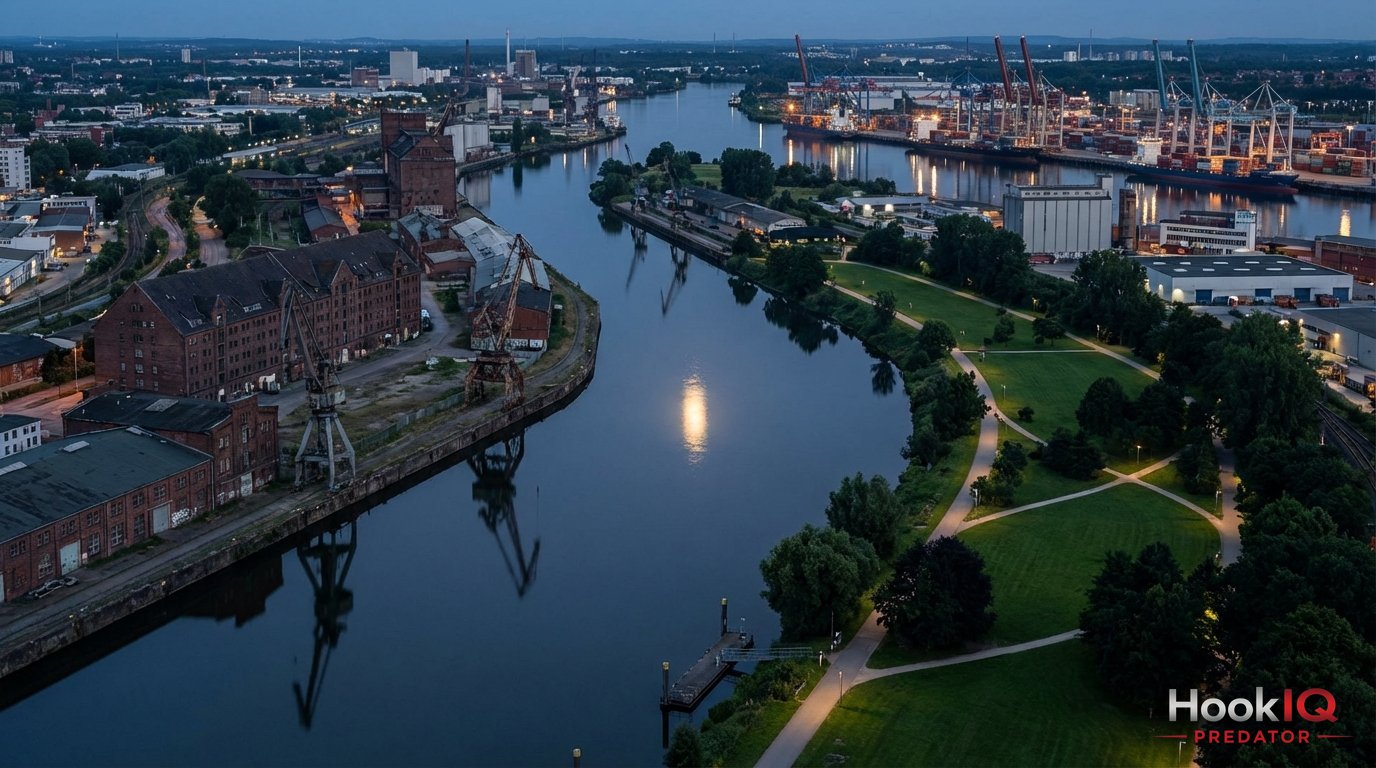
As I write this, my zander rod is still sitting in the basement. The closed season runs until the end of May, and honestly, that's fine. The zander have more important things to do right now than chase my soft plastics. But in my head, I'm already back on the groyne, feeling that tap through the braid, planning my first nights on the Rhine. Seven weeks to go. Here's what I'm preparing for.
Why the Weeks After the Closed Season Are So Special
If you've fished for zander on the Rhine, you know — those first sessions from June onwards have something magical about them. The fish are there, they're hungry, but they're no longer holding where you caught them last autumn. Everything has shifted. Spring floods have altered the current patterns, sediment has been redistributed, and the zander have left their spawning grounds to find new holding spots near food.
Last June I was standing on a groyne on the Lower Rhine that had produced three zander over 60 cm the previous October. The water was still slightly coloured, temperature sitting just under 16 degrees. Perfect season opener. In my bag I had four packs of soft plastics and half a dozen jig heads in various weights. That's all I needed, and that's exactly how I'll approach it again this year.
The Mistake I Make Every Single Year
My first instinct after the long break is always the same: fish too heavy. After weeks away from the water, I want to feel the bottom, want to know what's going on down there, and reach straight for the 21 g jig head. A mistake I'm well aware of by now — yet I make it every single year.
Last year started exactly the same way. The shad hit the bottom like a stone. I felt every bump, every rock, every mussel. It feels reassuring after weeks of abstinence. But after twenty casts without a touch, I remembered what I already knew: early-summer zander don't want it aggressive. They sit right on the current seams, often just a few metres from the groyne's spine, and they respond to lures that drift slowly and enticingly through their field of vision. Not to projectiles that slam into the riverbed right in front of their nose.
Switching to 12 g changed everything last June. The 10 cm shad in a natural perch pattern sank noticeably slower, almost pendulating through the water column, and on the drop after the second lift came that moment every zander angler knows. That subtle pause in the line, as if someone had gently tapped it with a finger. Strike. The rod bent over, and seconds later a zander of maybe 55 cm slid across the rock armour. The first fish after the closed season. A special moment, every single year. I remember that feeling vividly, and it's exactly what I'm looking forward to.
Reading Current Seams: Where the Zander Will Be in June
On the Rhine, early-summer zander fishing is all about one thing: current seams. Those invisible lines where faster water meets slower water are the highways for baitfish. And where the bait is, the zander won't be far.
The classic spots are the groyne fields. At the groyne head itself, where the current deflects and creates an eddy, small fish gather in the calmer zones. The zander typically don't hold in the middle of the eddy but right on its edge — exactly on that seam between current and slack water. From there, they can ambush prey carried past by the flow with minimal effort.
What many anglers underestimate: these seams shift with the water level. At low water, the interesting zone is often only ten to fifteen metres from the bank. At higher levels, it pushes further out — sometimes to thirty or forty metres. That's why I always plan to fan-cast systematically at the start of a session. Not stubbornly aiming for maximum distance every time, but deliberately covering short, medium, and long range.
In recent years, the fish have been surprisingly close at the season opener. Last June my second zander hit on a cast of maybe twenty metres, right on the inner current seam of the groyne. A fish just under 50 cm that had taken the soft plastic during an extended pause on the drop. That's exactly the zone I'll target first this year.
Soft Plastics and Jig Heads: My Season-Opener Setup
After more than thirty years of zander fishing on the Rhine, I've settled on a setup for those first post-closed-season sessions that consistently delivers. The soft plastic should be between 9 and 12 cm. Not too big, because zander fresh off the spawn often aren't keyed in on XXL prey yet. And not too small, because on the Rhine you still need enough presence to get noticed in the current.
For colours, in the still slightly coloured early-summer water I rely on two variants: natural tones like perch pattern or greenback for the twilight phase, and brighter colours like white or chartreuse once full darkness sets in. The switch often happens at the exact moment you can no longer see your rod tip from the bank. That's when it's time for the more visible lure.
Jig head weight is the decisive factor — and as I said, this is where I make the same mental error every year before correcting myself. On the Rhine, many anglers instinctively reach for 18 or 21 g because the current demands it. But right inside the groyne, in the eddy, you don't need that. Here, 10 to 14 g is plenty. The lure shouldn't be dragged along the bottom — it should seduce on the drop. Every extra second the soft plastic takes to reach the bottom after a lift is another second of bite time.
Only when I'm deliberately targeting the current seam outside the groyne — the transition between the eddy and the main flow — do I step up to 16 to 18 g. There, the lure needs more weight to avoid drifting uncontrollably. It sounds like a small detail, but this adjustment has consistently made the difference between one fish and five fish per night in recent years.
The Magic of the First Hour After Dark
What I've experienced time and again during past season openers: the best phase doesn't start at dusk but roughly an hour after complete darkness falls. On a June evening, that means around half past ten, eleven o'clock, when everything has gone completely quiet and the last dog walkers have long gone home. During this phase, it's as though someone flips a switch.
Last June I had three takes within forty minutes in exactly this window. I landed two, lost one right after the strike. Every contact came on the drop, all between fifteen and twenty-five metres out, all on the bright shad with a 12 g jig head. The zander had set up on the inner seam and were picking off the small roach that occasionally flashed at the surface in the beam of my head torch.
After midnight, things went quiet. Another two casts, then ten, then twenty. Nothing. The bite window had closed as abruptly as it had opened. Four zander on the first night after the closed season, the biggest just over 60 cm. No record fish, but that wasn't the point. It was about that feeling of finally being back on the water, feeling the bottom, feeling that tap through the line. And that's exactly the feeling I'm expecting again this June.
My Takeaway
The zander closed season runs until the end of May — regulations vary by country, so always check your local fishing laws — and until then, it's all about preparation, not fishing. Three things I'm taking from recent years into the coming season opener. First, fish lighter than you think. 10 to 14 g inside the groyne is almost always enough, and the longer drop phase produces significantly more bites. Second, look for current seams close to the bank. In early summer, zander often hold closer than you'd expect, especially in the groyne fields on the Lower Rhine. And third, be patient until it's properly dark. The first hour after nightfall is worth its weight in gold. Come June, I'll be back out there.