
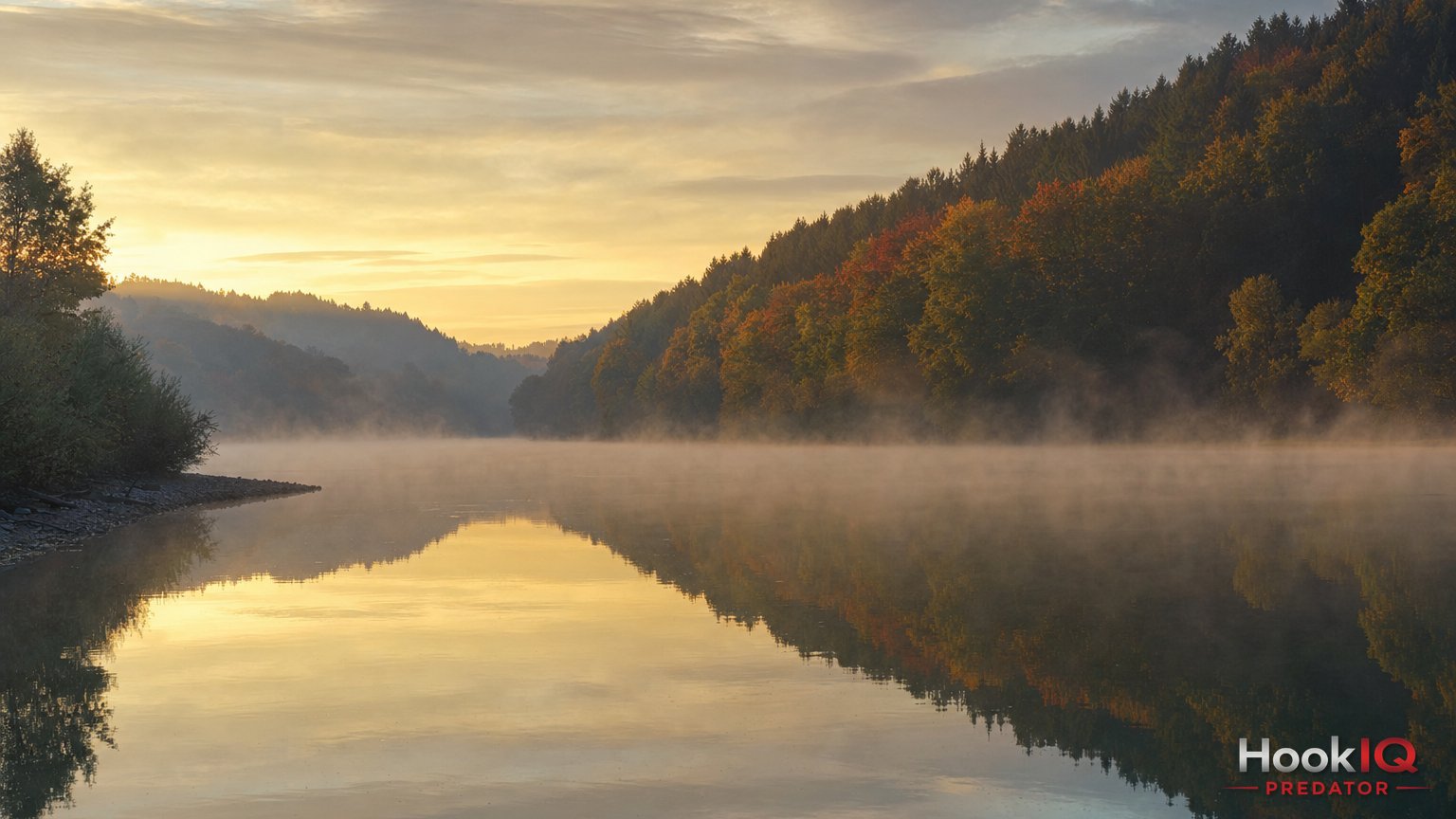
I'm standing at the bow, the engine idling, and in front of me lies a stretch of water that looks like a lake. Flat, wide, almost sleepy. And that's exactly the trap so many anglers fall into on their first Danube impoundment. They see calm water and assume nothing's home. But under that surface sits one of the most exciting zander fisheries the Danube has to offer, on both the German and Austrian stretches. I've been running multi-day trips to different impoundments on the Danube for years, and every single time I come home having learned something new about this river system.
What an Impoundment Actually Is — and Why Zander Love It
An impoundment is the stretch of river between two weirs or hydropower stations, where the natural flow has been artificially backed up. The water sits noticeably higher than it used to, the current slows down, and in places the river looks almost like a chain of lakes strung together. For zander, that's a gift. They don't like a ripping main current, but they don't want dead-still water either. An impoundment delivers exactly that middle ground.
What matters most is that the old riverbed survives beneath the new surface. The former shipping channel, old bank lines, former groyne fields — all of it now sits deeper underwater, but it still forms edges, troughs, and transitions. Zander hold on exactly these structures, because they give them orientation and because baitfish stack up there. Treat an impoundment as one big, uniform body of water and you'll wait a long time for your first bite. Read it as a drowned river landscape instead, and you'll find fish within hours.
The power station's operating schedule matters just as much for tactics. When the turbines run at full load, a noticeable surge builds at the outflow and pushes several hundred meters downstream. When the turbines shut down, that same stretch goes nearly still, like a quiet pond. For me, that swing within a matter of hours is the real key to fishing an impoundment, and I build my entire daily schedule around it.
Trip Planning for the Multi-Day Tour
In my experience, an impoundment deserves at least four days, five if you can manage it. A single day rarely gives you enough time to read the power station's rhythm and locate the best zones. That's why I never fish on the first evening — I run the stretch instead, roughly mapping the weir, power station, groyne fields, and tributaries with the chartplotter and sonar.
As a base, I always try to book lodging close to a lock or marina, ideally a short run from the actual stretch I'm targeting. Long runs eat up an hour fast on the Danube, since impoundments often stretch twenty to thirty kilometers and the next launch point isn't always nearby. If you're bringing your own boat, find out in advance which ramp you're actually allowed to launch from. Not every stone bank on the Danube is open for launching, and some impoundments have only one official slipway for the entire stretch.
For paperwork, I always build in a buffer day before departure. For the Austrian and Bavarian stretches of the Danube, you'll typically need a valid permit from the local fishing authority, sometimes on top of a guest license available online or directly through the local angling club. I once showed up with a fully packed boat only to find the permit office open just two mornings a week — and the door locked. Since then, I sort this out in writing at least two weeks before departure.
For gear on a multi-day impoundment trip, I wouldn't skimp, but I wouldn't overpack either. Two rods per angler is plenty — one for vertical jigging with head weights between 15 and 30 grams, a second, slightly lighter rod for working the shallower edges. I also bring a portable sonar unit as a backup in case the one built into the rental boat is weak, plus weatherproof clothing for several days, since the temperature on the Danube in September can easily swing ten degrees between morning and midday.
Spot-Hunting on the Impoundment
For me, the best starting points for spot-hunting are always the water directly around the weir and power station. Below the turbine outflow, the constant current carves out deep troughs that often run several meters deeper than the surrounding riverbed. That's where baitfish hold, and that's where the zander hunting them hold too. I always run this stretch systematically with the sonar before I even rig a rod, marking the deepest points along with the transitions to the shallower water around them.
A second reliable zone is the old shipping channel running through the middle of the impoundment. It rarely runs dead straight — it meanders gently, just as the river did before it was dammed. Along the outer edges of that channel, where the depth drops from two meters to six or seven, I especially like jigging a 12-centimeter shad on an 18-gram head. That weight sits deliberately on the heavier end of what most anglers would use on water that looks this calm, but once the turbines start running, you need that contact with bottom, or the bait just drifts uncontrolled.
Groyne fields left over from before the river was dammed are the third piece of my spot-hunting puzzle. Many of these stone structures now sit completely underwater, but they're still marked on older river charts or in historical survey data. Wherever a groyne sits across the old flow direction, it still creates a small current-shadow and edge zone today, even where the main current is barely noticeable anymore because of the impoundment. It's exactly these transitions from stone to sand or gravel where I regularly land my best fish of the day.
I also wouldn't underestimate the mouths of small tributaries feeding into the impoundment. Even an unremarkable creek brings in cooler, more oxygen-rich water and often nutrients that draw in baitfish. Over the past few years, I've reliably pulled zander between 55 and 70 centimeters from two such tributary mouths, usually at dusk, when the predators move up out of the deep main channel to feed.
Renting a Boat Locally
If you're doing a multi-day trip without your own boat, it's worth researching rental outfits right on the impoundment. Most of the larger Danube landings now have operators renting small aluminum boats with electric motors or light outboards, typically in the six-to-ten horsepower range, since many impoundments enforce a horsepower cap. When I book, I always ask explicitly whether a sonar unit is built in, since that saves me hauling extra gear around for days.
When choosing a rental, I look at three things. First, the motor's range and whether you can refuel along the way — a 25-kilometer impoundment burns through more fuel than you'd expect at first glance. Second, whether the area directly in front of the weir is off-limits, since many operators impose a 100-to-200-meter no-go zone around the power station for safety reasons. That's not red tape for its own sake — the water level near a turbine outflow can change within minutes once it spins up, and you can get caught in some nasty turbulence fast. Third, I always check the cancellation terms for high water, since heavy rainfall upstream can make an impoundment unnavigable within a single day.
Day-boat rentals on the Danube usually run between 60 and 120 euros, depending on horsepower and season. For a five-day trip, I always ask the operator for a multi-day discount up front — it often knocks a quarter off what you'd pay booking day by day. I've also had good luck timing my boat booking to the power station's operating schedule, when the operator is willing to share that information. If I know the turbines run at high load in the morning, I book the boat for exactly that window, because that's when zander pull into the deep channels and really switch on.
My Verdict
A zander trip to a Danube impoundment pays off if you're willing to invest more than a single day and read the water like a drowned river instead of a calm lake. Sort your paperwork early, book lodging close to a lock or marina, and build your spot-hunting around the old channel, the groyne remnants, and the turbine outflow. Factor the power station's rhythm into your daily plan on top of that, and you won't just catch more zander on the impoundment — you'll catch the bigger ones too. I'm already packing the tackle box for the next trip.