
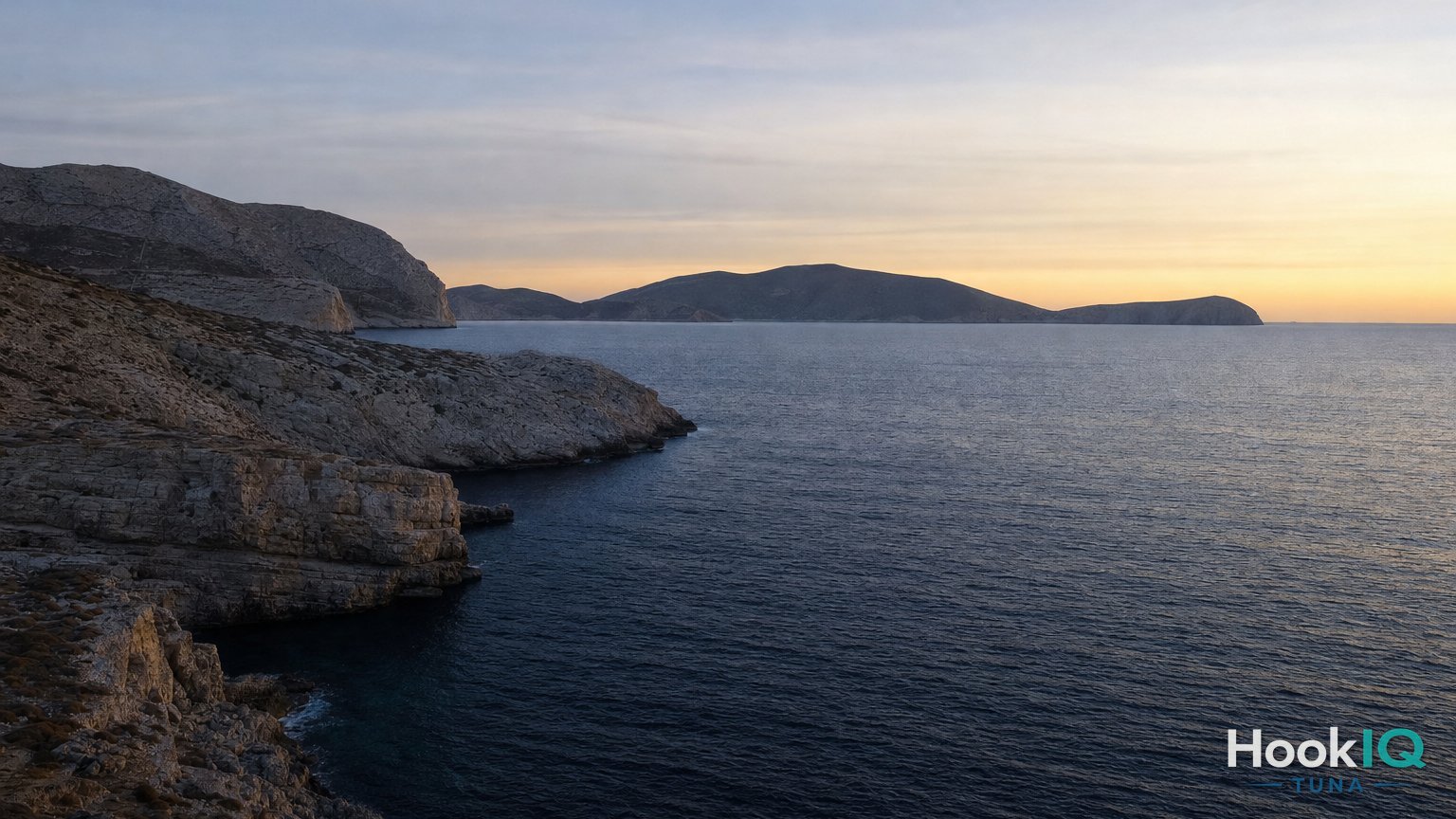
Half past four in the morning, the quay at Naxos still lies in darkness, and the only sound is the halyards tapping against the masts of the sailing yachts. The skipper doesn't look at the plotter — he looks north, out over the rooftops of the town. "If the wind stays like this today, we've got a window until noon," he says. In the Aegean, every bluefin trip starts with that glance to the north. Here it isn't the water temperature that decides things first, nor the current, but a wind that carries a name of its own.
The Meltemi Decides When You Go Out
Anyone who wants to hunt tuna in the Cyclades in high summer has to understand the Meltemi first. This dry northerly sweeps across the Aegean from July into September, often for days on end, and it can freshen from a gentle breeze to a force six or seven within a few hours. Between the islands, in the funnels of Andros, Tinos and Mykonos, it accelerates even more. What still looks fishable out on the open sea turns into a white hell inside a channel.
That sounds like a drawback, but it's actually the key to the whole fishery. The Meltemi pushes cooler deep water up onto the edges and keeps the system moving. After two or three hard days of wind there's almost always a lull, and those windows are worth their weight in gold. I never plan my Aegean trips by the calendar — I plan them by the wind. A calm morning after a Meltemi spell is often the best day of the entire week, because the schools that held deep during the blow come back up to the surface.
Where the Bluefin Move Through the Cyclades
The Cyclades aren't the shallow island maze many people imagine. Between the islands the bottom drops away steeply, and to the south the Cretan Sea opens up to over two thousand metres. It's along exactly these edges, and in the deep channels between the islands, that the bluefin follow their prey. Bluefin tuna have made a noticeable comeback in recent years, ever since the Mediterranean stock recovered, and the Aegean sits right on their old routes.
The water between Andros and Tinos is, for me, one of the most reliable corridors. Here the current squeezes through a narrows where bogue, sardines and flying fish gather — and where the bait is, the tuna are. Further to the south-east, in the deep trench between Naxos, Amorgos and the Lesser Cyclades, you'll find a similar picture. Amorgos falls almost vertically into the blue along its eastern side, and that edge is a gathering point for anything with an appetite. If you've got the time and a seaworthy boat, you'll also find good activity around the remote rocks of Donousa and Koufonisia, simply because hardly anyone fishes there.
The movement of the schools follows no rigid timetable, but it does follow a pattern. The tuna push the baitfish onto the current edges and into the eddies behind the islands, where two bodies of water meet. At seams like these, on the best days, you see the thing every big-game angler dreams of: a boiling patch on the surface, birds dropping vertically into the water, and beneath them the dark shadows of the hunting fish.
Run and Gun: When the Surface Boils
In the Aegean I rarely fish bluefin by grinding out blind trolling passes. This fishery rewards the angler who searches. I work the edges and channels with a reduced spread — two rods running small squid chains in purple and green at six and a half to seven and a half knots — while keeping a constant eye out for birds. The moment a school rips open on the surface, the trolling turns into a sprint. Rods in, throttle up, and close to the edge of the boiling water at casting distance — never straight into the middle, or you'll scatter the school.
Then it comes down to speed. A stickbait or a heavy popper of 40 to 80 grams, worked fast and aggressively, triggers the reaction. These fish feed in a frenzy, and you often get only one or two casts before the school comes up again a hundred metres away. I've had days when almost every school meant a hookup, and others when the sea went glassy calm by midday and the fish turned suddenly wary. Then only thinner leaders, smaller lures and an even faster retrieve will do. Whoever keeps their nerve and keeps working gets their chance in the end.
When it comes to the fight, the same applies in the Aegean as everywhere in the Mediterranean, except that here you're usually reckoning with mid-sized fish between fifteen and fifty kilos, occasionally with a good deal more. Stand-up with a decent gimbal belt is plenty for most of these fish. Set the drag cleanly, let the fish work against the gear, and pump steadily. Circle hooks in 8/0 or 10/0 are a must — not just for the better hook-up rate, but because most of what you catch here goes back anyway.
The Charter Scene: Small, but Honest
Greece is not Malta and not Spain. The bluefin charter scene in the Aegean is modest, and there's a good reason for that. Recreational tuna fishing here falls under ICCAT and EU rules, and anyone targeting bluefin needs the appropriate authorisation. Most reputable operators work catch-and-release, with their tags and paperwork on board, and that's something you should always clear up before booking. A skipper who promises you big fillets is, if in doubt, not the one you want to be heading out with.
The good charters mostly run from harbours on the larger islands or from the mainland. From Paros and Naxos you can reach the central channels; from Lavrio on the mainland you work the western Cyclades. Book early, because the number of properly equipped boats is limited, and in August you're competing with the tourist trade for every free day. Reckon on flexibility, too. A good Aegean skipper will cancel a booked day when the Meltemi is raging and shift it to the next weather window. That's not poor service — that's experience.
Timing the Heat: The Grey Light Is Yours
In high summer the surface temperature in the Aegean climbs to 24 to 26 degrees, higher still in sheltered bays. For bluefin that's the upper edge of comfort. During the day, when the sun stands overhead and the water heats up, the fish pull back into cooler layers and turn sluggish. Anyone expecting surface activity at eleven in the morning in the full heat will usually be disappointed.
That's why the grey light is yours. The first hour after sunrise and the last before sunset are the most productive windows in August, often by a wide margin. At first light the air is still cool, the Meltemi often hasn't got going yet, and the baitfish are holding high. I'd rather be on the dock at half past four and fight my fish in the first light than wait for a miracle on deck at forty degrees. On days with thin cloud cover or a light ripple from a soft breeze, the window sometimes stretches into the late morning.
The art in high summer lies in thinking all these factors through together. A wind window after a Meltemi spell, the cool fringe hours of the day, a current edge between two islands, and birds to give away the bait. When all of that lines up, a window of maybe ninety minutes opens up in which everything happens. Keeping an eye on exactly this interplay is the reason I run the HookIQ app before an Aegean trip. It pulls wind, temperature trend and time of day together in one place, so at a glance I can see when tomorrow's window is likely to open, instead of cross-checking five separate sources.
My Takeaway
The Cyclades aren't a fishery for anyone who wants their fish guaranteed. They're a fishery for anyone who can read — the wind, the edges, the light. Plan your trip around the Meltemi and not around the weekend, find yourself a skipper with the right paperwork, and be on the water in the first grey of morning. When the surface then rips open between Andros and Amorgos and the birds start falling, you'll understand why the early alarm is worth it every single time.