
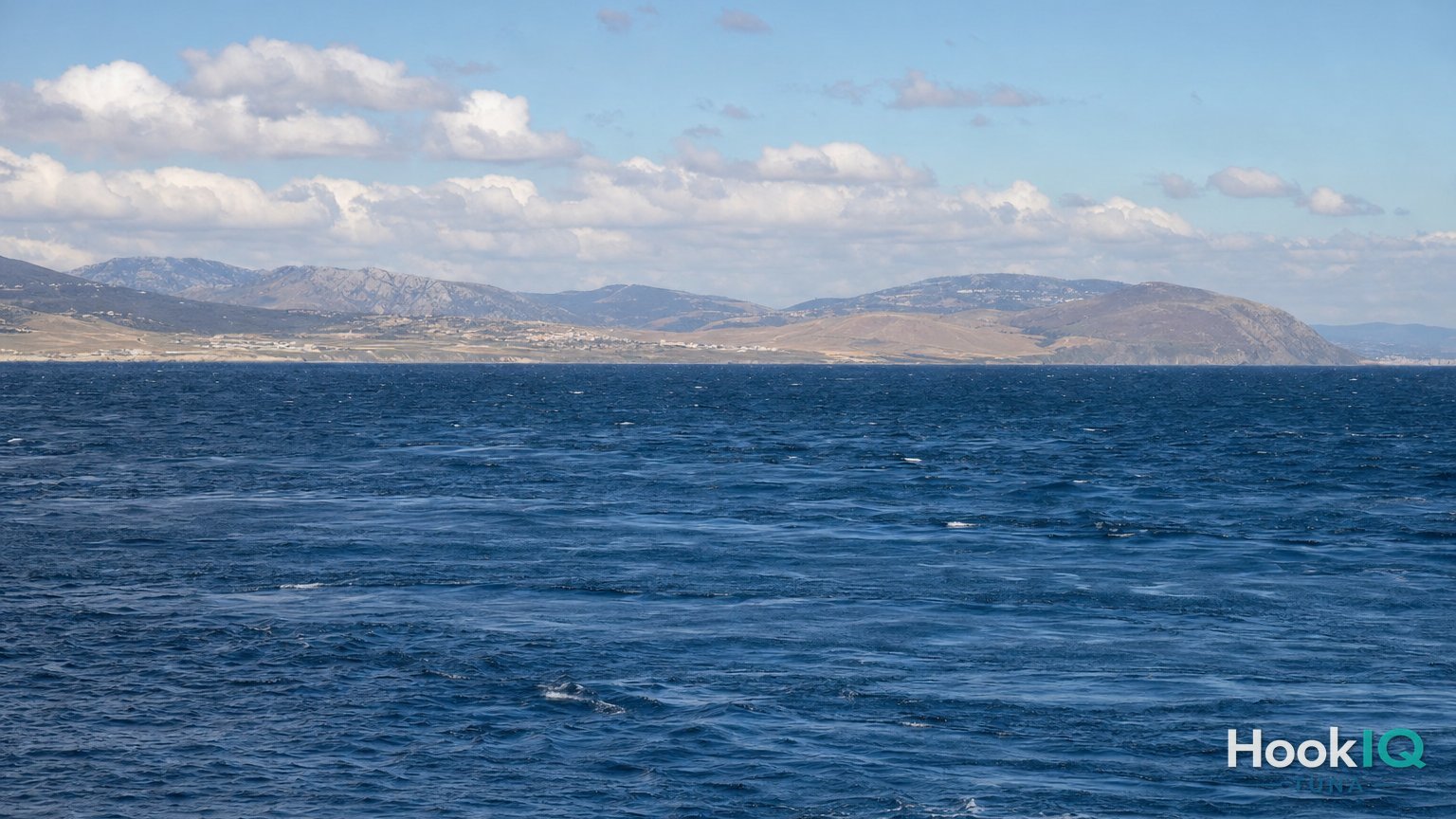
Five in the morning, the harbor at Tarifa is still dark, but the sounder is already painting the first wreck outlines on the plotter. The wind is howling through the rigging like it almost always does here, and when I look over the rail, I can see the water actually moving — pulling, almost boiling. This isn't the calm Mediterranean or a sluggish stretch of Atlantic. It's a current fighting its way between two continents. And right here, in this pinch point, wait the biggest amberjack I've seen in three decades of big game fishing.
Why the Strait of Gibraltar Fishes Differently
The Strait of Gibraltar isn't a normal fishing ground. This is where the Atlantic meets the Mediterranean, and the two bodies of water are locked in a constant exchange. On the surface, the lighter Atlantic water pushes east; underneath, the heavier, saltier Mediterranean water shoves back west. Add the tide on top of that, funneled and amplified through this narrow gap like water through a nozzle, and you get a current that regularly runs four to six knots — more at some marks, and more still on a spring tide.
For amberjack, that's exactly home. They sit where current meets structure and bait gets concentrated. Over the years I've come to see that current as the real reason the fish here grow so big. The constant water exchange is what creates the bait concentration in the first place, and that bait is what builds amberjack of this size.
The Tide Window: When the Current Becomes Your Ally
Show up here without a tide plan and you'll be heading back to the harbor frustrated. At full current — usually two to three hours after the tide turns — the boat sits over the wreck like it's on a leash, and no jig on earth is still falling straight down. You need lead by the kilo just to get in touch with the bottom, and even then the jig is drifting sideways more than it's sinking.
My window is usually one hour either side of the slack. That's when the current is just turning, or still running weak, and you can actually work a jig with some control. That's also exactly when the wrecks come alive, because the baitfish briefly regroup and the predators underneath wake up. Dead-flat slack water with zero movement, by the way, barely produces for me. Amberjack want to feel some current under them — just not so much that you lose control of your gear. These days I plan my trips almost entirely around that narrow window, and when I'm laying tide, wind, and moon phase over each other the night before, I've started running it through the HookIQ app, simply because it shows me that whole interaction at a glance instead of me cross-checking three different tables by hand.
Finding the Right Wreck — and Approaching It Correctly
The Strait of Gibraltar is littered with wrecks — old freighters, plus wreckage from two world wars that never left the bottom. Not every wreck holds fish, but the ones lying across the main current build a current shadow on their downstream side, and that's where sardine and mackerel bunch up. Right in that lee — usually off to one side, rarely directly over the highest point of the structure — is exactly where the amberjack sit.
I never run straight onto a mark. I always make a wide pass over it with the sounder first, to see how the wreck sits relative to the current direction. Then I position the boat so I can hold lightly against the current with the trolling motor while still dropping the jig almost straight down the edge. Pure anchoring doesn't work on most of these spots — the current's too strong, and setting the anchor usually costs you position instead of gaining it. If you're not running a boat with good position-holding, drift the wreck under control instead and drop the jig the moment you're still over the structure.
Vertical Jigging Against the Current
In this current, light tackle is a waste of time. I fish knife jigs between 200 and 400 grams depending on depth and current strength, and at the marks sitting in 60 to 90 meters, during the stronger phases I'll go as heavy as 500 grams just to hold vertical contact with the bottom at all. Shape matters here — a slim, asymmetric jig cuts through the current, while a wide-bodied jig just gets swept away and loses its action.
The rod is a slow-pitch-capable jigging rod rated PE6-8, short, with plenty of backbone in the lower third so I can immediately drive the fish away from the wreck. The reel is spooled with PE6 braid — roughly 80-pound class — to an 80-100lb fluorocarbon leader. That sounds like overkill to a lot of people until they've watched a big amberjack bolt straight back into the wreck the instant it feels the hook. The jig carries a heavy-duty assist hook on a short, extra-stiff trace, because first contact with rusted steel otherwise ends the fight immediately.
I keep the retrieve itself deliberately simple in strong current: drop the jig to the bottom, three to five fast cranks with a short upward rod snap, then let it sink back down to the bottom again. Complicated slow-pitch sequences with long pauses don't do much here, since the current keeps the jig moving on its own anyway. The bite almost always comes in the first ten to fifteen meters off the bottom, often right on the first or second lift after it touches down.
The Fight: Get Them Off the Wreck Immediately
The strike from a big amberjack feels like someone poured concrete into your drag. No soft taps, no testing the bait — just a hard, violent pull, and then the fish puts everything into getting back to the structure it just got pulled off of. The first few seconds decide the fight. I immediately pump the fish up and away from the bottom with the drag locked down and full rod pressure, before it can cover the two or three meters back to the steel. If that doesn't work, the leader is usually cut on an edge within seconds.
Survive that first phase and you've got a fish that still pulls brutally hard in open water, but becomes more predictable. Amberjack love to turn broadside during the fight and use their wide body like a sail against the current, which can make the fight long and grinding. Ten to twenty minutes for a fish over twenty kilos is nothing unusual in this current, and your arms will absolutely be shaking by the time a good one comes up.
My Takeaway
The Strait of Gibraltar demands more respect for the current than most other Mediterranean amberjack grounds, but that same current is exactly what makes the fish here so big and so uncompromising. Know your tide window, find the right wreck, and stay vertical with enough lead on the jig, and you're in with a shot at one of the toughest fights European big game fishing has to offer. Plan around the tide, not the calendar, and you'll find out fast how often that's the difference between an empty fish box and a bent rod.