
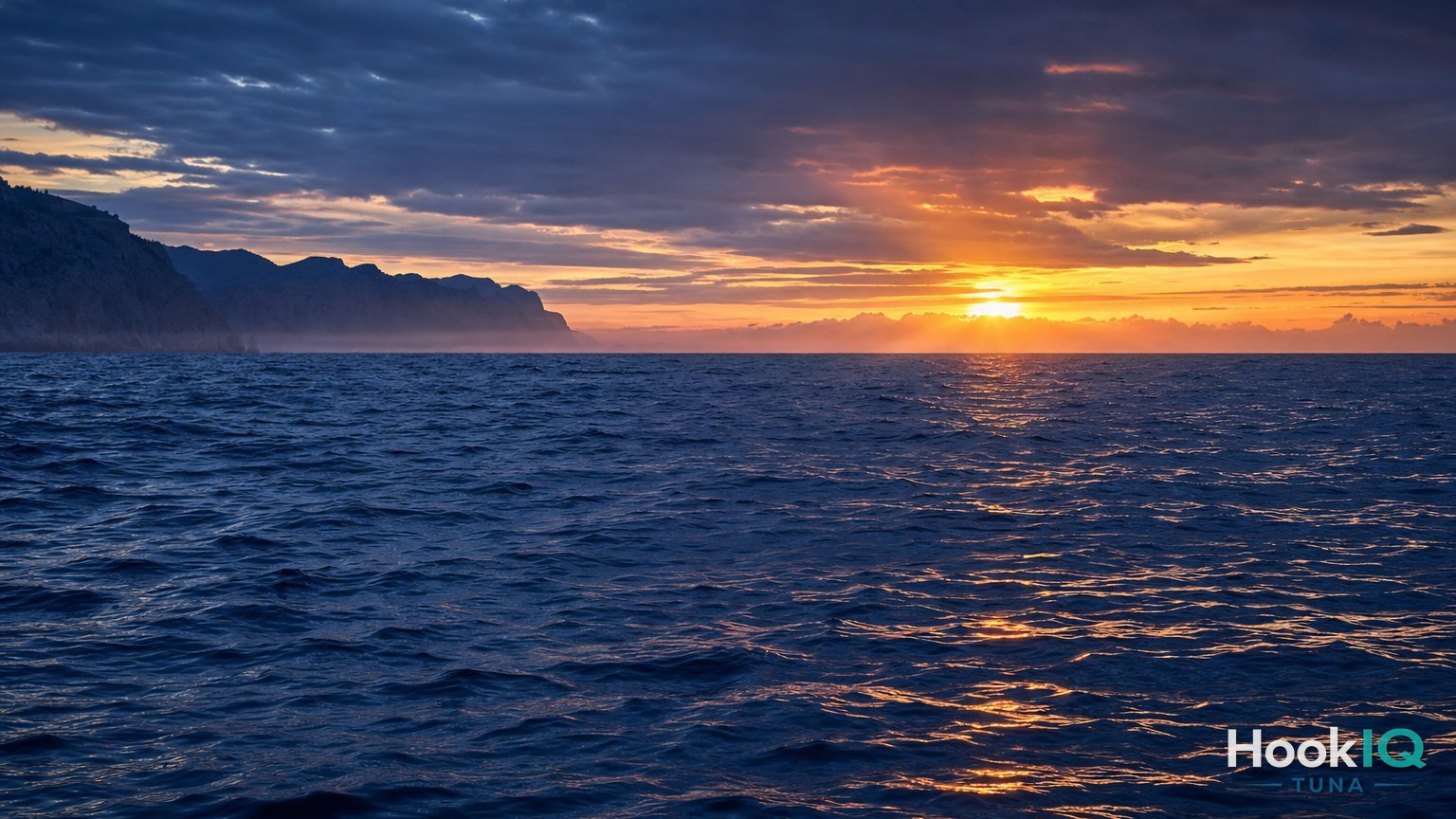
Six in the morning. The harbour of Cartagena is still wrapped in half-light. The skipper hands me a coffee and points at the plotter. Three temperature lines converge twenty nautical miles offshore, right where the shelf drops to 800 metres. "They were there yesterday," he says. "And if the current holds, they'll be there again today." That moment triggers the same rush every single time — the same rush that has been pulling me offshore for over three decades. The hunt for Atlantic bluefin tuna, the undisputed king of the Mediterranean.
A Fish That Shaped the Mediterranean
The bluefin tuna is no ordinary fish. It is a warm-blooded apex predator capable of maintaining its body temperature up to twenty degrees above the surrounding water. That ability makes it one of the fastest and most enduring predators in the ocean. Mature specimens exceed three metres in length and can tip the scales well beyond 400 kg. In the Mediterranean, fish of that calibre have been landed off the Balearics, off Sicily, and in the Strait of Messina.
The Mediterranean is not just any habitat for the bluefin. It is its spawning ground. Every spring, vast schools migrate from the Atlantic through the Strait of Gibraltar to reproduce in the warm, nutrient-rich waters within. This migration follows ancient routes that have barely changed over millennia. The Phoenicians knew about them. The Romans built their tuna traps along these very corridors. And as anglers, we still benefit today — provided we understand where and when those routes run.
Where the Bluefins Hold: Grounds and Hotspots
The Mediterranean is vast, but bluefin tuna do not use it evenly. Some areas hold fish reliably year after year. Others are enormous stretches where you can troll for days without a single strike. The difference comes down to seafloor topography, water temperature, and current patterns.
The Balearic Islands rank among the best bluefin grounds in the western Mediterranean. The reason is subsurface topography: between Mallorca and the Spanish mainland, the seabed plunges to over 2,000 metres. Along the shelf edges — where shallow coastal water drops into the abyss — baitfish congregate in dense schools. And where baitfish stack up, bluefins follow. I have caught my best fish off Mallorca's southwest coast, in a corridor between Cap de Cala Figuera and the island of Cabrera, typically 15 to 30 nautical miles offshore.
Sicily and the Strait of Messina are another classic. The current dynamics between Sicily and Calabria force nutrient-rich deep water to the surface. That creates a food chain attracting sardines, mackerel, and horse mackerel in massive schools. The bluefins follow these baitballs and tend to congregate along the current edges — the boundaries where two water masses of different temperature collide.
Off the Spanish coast near Murcia and Alicante, there is another productive corridor. Underwater mountains — seamounts — rise from the deep ocean floor to within a few hundred metres of the surface. These structures deflect currents and create upwelling zones that draw baitfish and, in turn, bluefins. If you have the positions of these seamounts plotted on your chart, you hold a decisive advantage.
France's Côte d'Azur and Corsica also offer first-rate conditions, particularly in high summer when surface temperatures push past 24°C. The canyons off Nice and the Ligurian Sea are known for strong tuna activity from July through September.
What Water Temperature Tells You
If there is one single variable that determines success or failure when targeting bluefin in the Mediterranean, it is water temperature. Bluefins are warm-blooded and can hunt across a broad temperature range — but their prey cannot. The baitfish that tuna feed on are extremely sensitive to temperature boundaries.
In the Mediterranean, the sweet spot for surface bluefin activity lies between 19°C and 24°C. Below 18°C, the fish hold deeper and are virtually unreachable by trolling. Above 25°C, they retreat into cooler layers as well. The most exciting spots are the temperature breaks — where warm surface water meets cooler currents. On modern SST charts, you can identify these breaks as tightly compressed colour gradients.
Every evening before a trip, I check the latest SST data. There are excellent apps and websites now that deliver satellite imagery of sea surface temperature in near real-time. If you find a clean temperature break between 20°C and 22°C running along a shelf edge or a seamount, you have your starting point for the next morning.
Chlorophyll charts are another key piece of the puzzle. High chlorophyll concentrations indicate plankton blooms, which in turn attract baitfish. The combination of a temperature break and a chlorophyll gradient over a bottom structure is what I call the holy trinity of bluefin fishing. When all three factors align, the odds are stacked firmly in your favour.
Trolling Setup: What I Run Behind the Boat
Trolling is the classic method for locating and catching bluefin in the Mediterranean. The concept is simple: you run the boat at moderate speed through promising water, dragging an arrangement of teasers and lures behind you. In practice, there is a universe of detail packed into that setup.
My standard spread for Mediterranean bluefin consists of four to six positions behind the boat. Down the centre, right in the wake, I run a large squid chain in purple and black — 24 inches long — on the long rigger, about 60 to 80 metres behind the transom. Flanking it, I deploy two daisy chains in green and yellow on the middle positions, roughly 40 to 50 metres back. The short positions — shotgun and flat lines — get skirted lures in blue and white, or an artificial flying fish.
Trolling speed is critical. In the Mediterranean, I troll for bluefin between 6.5 and 8.5 knots, depending on sea state and lure size. In calm conditions with large teasers, I push 7.5 to 8 knots. In a swell, I drop to 6.5 to 7 knots to keep the teasers tracking cleanly in the water rather than bouncing out of the surface. A teaser that constantly pops out of the water spooks more fish than it attracts.
My hookbaits are skirted lures rigged with 10/0 or 12/0 circle hooks on 200 to 300 lb fluorocarbon leader. Circle hooks have the enormous advantage of almost always setting in the corner of the jaw, which dramatically improves survival rates on release. I no longer use J-hooks for bluefin trolling — the fish gut-hook themselves far too often.
The Fight: When the Reel Screams
There are moments on the water you never forget. The instant a bluefin charges your spread is one of them. You hear it first. The drag screams — a sound that electrifies every big-game angler alive. Line peels off the reel at 60 to 80 metres per minute. Then you see the fish for the first time: a silver torpedo crashing out of the water 200 metres behind the boat.
A big bluefin is not a fish you subdue quickly. A specimen of 150 kg or more can keep you locked in battle for well over an hour. In my thirty years on the Mediterranean, I have endured fights lasting more than three hours. The bluefin uses its sheer mass and endurance. It sounds deep — 100 metres, 200 metres — and stays there. You pump and wind, gain five metres, and it takes back twenty. It is a war of attrition that tests your arms, your back, and your mental resolve.
My number-one tip for the fight: let the fish do the work, not you. Set the drag just below the breaking strain of your line — depending on line class, between 15 and 20 kg of drag pressure. Pump smoothly and deliberately. Frantic cranking achieves nothing except exhausting you and losing pressure, which hands line right back to the fish.
The choice between stand-up and a fighting chair depends on expected fish size. Up to around 100 kg, I prefer stand-up with a gimbal belt — you are more mobile and can manoeuvre the fish more effectively. From 150 kg upwards, I sit in the fighting chair, because the leverage through your back and legs makes the critical difference.
Catch and Release: Respect at the Boat
In recent years, I have released more bluefins than I have kept. The moment that silver giant lies alongside the boat and you watch it breathe — that is worth more to me than any fillet.
For catch and release to work, it has to be done properly. The most important factor is fight time. The longer the fight, the more exhausted the fish, and the lower its chances of surviving after release. Circle hooks are the first building block, because they almost always set in the jaw hinge and prevent serious internal injury. Barbless hooks make unhooking at the boat significantly easier.
Never lift the fish out of the water. A bluefin forced to support its own weight out of the water suffers internal damage that is invisible from the outside. Instead, remove the hook in the water alongside the boat. Stabilise the fish briefly until it rights itself, then let it go. If it does not swim off immediately, hold it by the tail wrist in the water and move it gently back and forth so water flows over the gills. In most cases, it only needs a few minutes before a powerful tail beat sends it surging back into the deep.
Seasonal Patterns: When to Fish Where
The bluefin season in the Mediterranean follows a clear rhythm governed by water temperature and the fish's migration cycle. From May, as water temperatures climb above 18°C, the first schools begin pushing through the Strait of Gibraltar into the Mediterranean. At this stage, the western grounds — Andalusia, the Balearics, and Sardinia — are the first ports of call.
In June and July, the migration peaks. Fish spread across the entire Mediterranean, and spawning activity begins. During this phase, bluefins frequently push to the surface and respond exceptionally well to teaser work. The waters off Sicily, Malta, and eastern Spain are at their prime.
From August, the picture changes. Spawning is over, and the fish begin feeding aggressively to rebuild depleted reserves. This is when the biggest specimens are caught, because they react less cautiously to lures. Autumn — September and October — brings the return migration towards the Atlantic. In the western grounds, especially off the Balearics and Spain's east coast, the big loners move through now. Fish beyond the 200 kg mark, gorging on everything they find on their way back to Gibraltar.
November and December mark the end of the season for most anglers. But those willing to stay flexible and work the weather windows can still encounter bluefins off the Balearics and along the North African coast well into late autumn. The fish hold deeper by then, and trolling becomes more difficult. Deep jigging or drifting natural baits at depth are the more effective methods during this phase.
Three Things I Tell Every Bluefin Angler in the Mediterranean
First: learn to read water temperature. SST charts and chlorophyll data are freely available today, and they are the key to productive trips. Trolling blind without understanding the thermal landscape throws away half your chances.
Second: invest in your teaser spread. The quality of your daisy chains, squid chains, and skirted lures determines whether a bluefin commits to your wake or keeps moving. Cheap teasers track poorly, lose their colour, and do not fish cleanly. Quality teasers cost money, but they catch fish.
Third: respect the fish. Whether you keep it or release it, handle it with care. A bluefin in the Mediterranean is a privilege. Stocks have recovered significantly over the past fifteen years, and that recovery should mean something to all of us.