
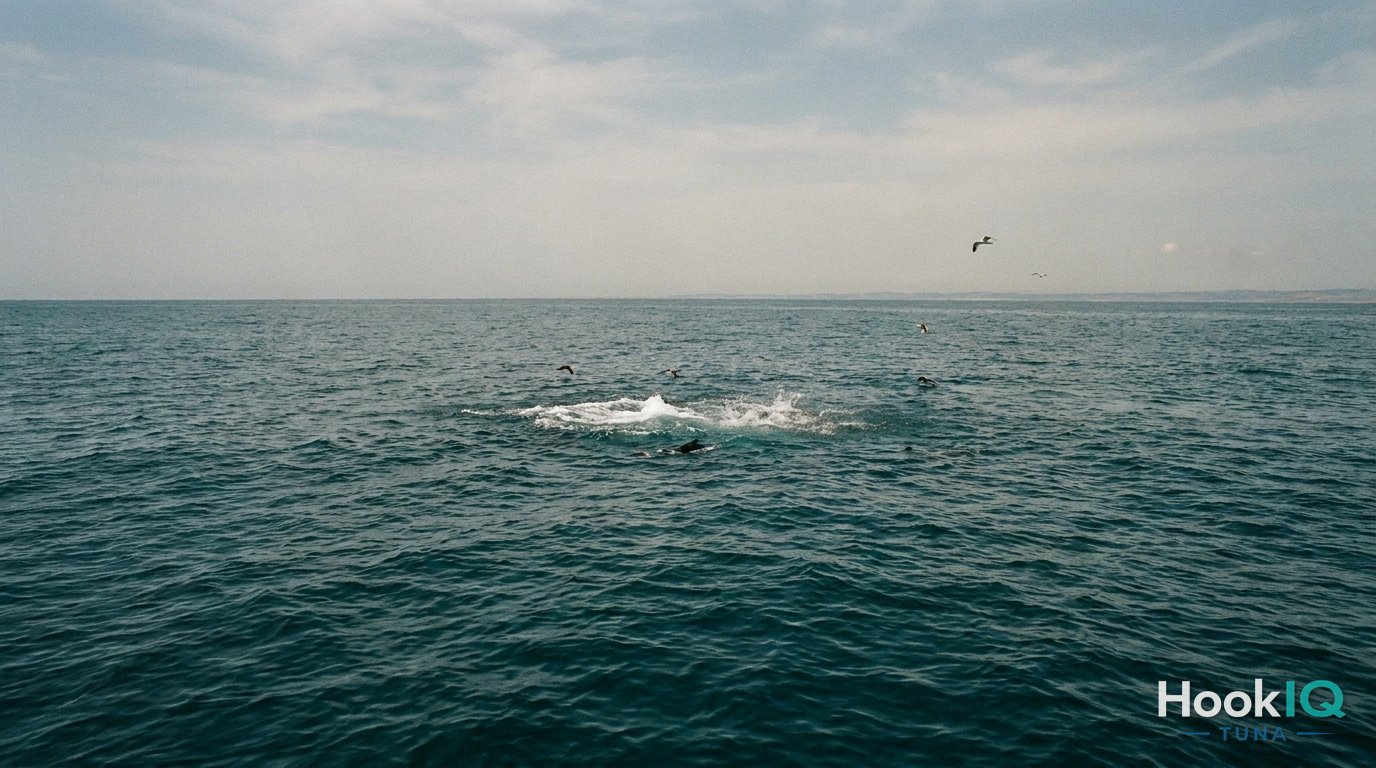
Six in the morning. The small harbour of Milazzo still lies in the shadow of Monte di Milazzo. The air smells of diesel and salt, a fisherman sorts sardines into polystyrene boxes, and ahead of us the Strait of Messina opens like a gate to the Tyrrhenian Sea. Somewhere out there, between the current lines and the sardine schools, bonito are hunting. And that is exactly what we are after today.
Why the Bonito Deserves More Respect
In the big-game world, bonito get dismissed. Too small, too common, no trophy value. Anyone who thinks that way has never fought a three-kilo Atlantic bonito on a spinning rod. The bonito is a compact torpedo with a heart that beats faster than that of any other fish its size. It punches well above its weight, peels line like a thing possessed and does not quit until it is in the net — or until it throws the hook, which happens more often than most anglers care to admit.
But for me, bonito are something else entirely: harbingers. When the first schools push into the Strait of Messina in June, the bluefin follow a few weeks behind. The bonito arrive with the sardines, and the sardines arrive with the warm water. Find the bonito, and you understand the currents, the temperature breaks and the bait movements of this stretch of water. That understanding pays dividends once the bluefin season kicks in.
The Strait of Messina: A Fishery Like No Other
The narrow channel between Sicily and Calabria is no ordinary stretch of coastline. Here the Tyrrhenian Sea collides with the Ionian Sea. Currents shift with the tides, and temperature differences of two to three degrees can occur just a hundred metres apart. This dynamic creates a phenomenon anglers the world over dream about: a natural bait trap.
The current pushes sardines and anchovies to the surface, herds them together, cuts off their escape. The bonito wait at exactly those pinch points — sometimes in schools of thirty or forty fish, sometimes in loose groups spread over a hundred metres. The pattern is almost always the same: wherever the current edge runs, that is where the fish hold.
From Milazzo, I am usually on productive water within twenty to thirty minutes. The first good zones start off Capo Peloro, the northeastern tip of Sicily. Push deeper into the strait towards Reggio Calabria and you often find less boat pressure with just as many fish. The key is not the exact spot — it is the ability to read the current lines.
Find the Bait, Find the Bonito
Before I make a single cast, I drive. Slowly, eyes open, sounder running. I am not looking for bonito on the screen. I am looking for bait. Sardines show up as dense, compact clouds in the mid-water column, usually between five and fifteen metres deep. Anchovies often sit even shallower — sometimes so close to the surface you can see the silver shimmer with the naked eye.
Birds are my second sounder. Shearwaters and Mediterranean gulls do not circle a spot for no reason. When three or four birds gather over one area and start dropping lower, there is almost always bait underneath. And where bait gathers, predators are never far behind.
A trick a Sicilian fisherman showed me years ago: watch the colour of the water. In the Strait of Messina there are visible colour breaks where cooler, greener water meets warmer, deep blue water. Plankton concentrates at exactly those transitions, and so do the sardines. The bonito patrol along these lines the way wolves patrol a game trail.
The Right Gear: Keep It Light
Anyone who chases bonito with heavy big-game tackle is missing ninety per cent of the experience. A two- to four-kilo bonito on a 50 lb stand-up rod feels like nothing. The same fish on a light spinning rod rated for 10 to 20 g turns into a serious opponent.
My setup for bonito hunting off Sicily is simple. A 2.40 m spinning rod rated 10–30 g, paired with a 3000-size spinning reel spooled with 0.10 mm braid. For the leader I use 40 cm of 0.30 mm fluorocarbon. Bonito do not have teeth that will cut through mono or fluoro, but they have eyes like a hawk. In the gin-clear water off Sicily, a leader that is too heavy makes the difference between ten strikes and zero.
The drag matters. Bonito launch explosively, and if the drag is locked down too tight, either the leader snaps or the hook pulls. I set the drag so that a firm pull by hand just barely draws line off the spool. That sounds soft, but trust me — when a bonito takes off at full speed, you will be glad the drag slips rather than having that size-6 single hook tear out of the jaw.
Metal Jigs: The Key to Bonito
There are many ways to catch a bonito. Small poppers work, stickbaits can be deadly, and a live baitfish on the hook is the ultimate weapon. But if I am honest, nine times out of ten off Sicily I reach for metal. The reason is simple: distance and speed.
Bonito schools surface and vanish. Sometimes you have thirty seconds to get a lure into the feeding zone before the school sounds again. A 20 g casting jig flies fifty, sixty metres and sinks fast enough to reach fish that are already heading back down. No crankbait and no popper can do that.
My three favourites are classic casting jigs between 15 and 30 g in a slim, elongated profile. Colours matter less than most people think. Silver always works because it imitates a sardine. Silver with a blue back is my first choice in clear water and sunshine. And a plain, unpainted jig works fine on days when the bonito feed so aggressively that they hit anything that flashes.
The retrieve is everything. Bonito chase fast prey. A slow-rolled soft plastic does not interest them. I cast the jig, let it sink for two or three seconds, then reel fast with short, sharp snaps of the rod tip. The jig should flutter, flash and change direction — like a panicked sardine swimming for its life. The strike almost always comes during the fast phase, not on the drop. And it comes hard. So hard you do not need to set the hook — the fish does that for you.
School Tactics: How to Work a Bonito School Systematically
Finding the school is half the battle. The other half is fishing it properly without spooking it. Bonito are schooling fish with short memories but a keen sense of danger. A boat that roars at full throttle into a feeding school will not see those fish again for the rest of the day.
Here is my method. As soon as I spot surface activity — splashes, birds, or that telltale boil on the water — I drop the engine to idle. Fifty metres from the action I kill the motor and let the boat drift. Then I cast. The first cast does not go into the middle of the school but to the edge. Bonito on the fringes are hungrier because they get less of the bait. They bite faster and fight harder.
After the first fish, I do something many anglers find difficult: I wait. Thirty seconds, a minute. I watch where the school moves. Bonito almost always travel into the current, following the bait. When I see the splashes shifting north, I reposition the boat to cast across the school from the side rather than chasing it from behind.
On good days a bonito school stays active for hours. On those days I land fifteen, twenty fish, and every single one fights as if its life depends on it — which, of course, it does. On bad days the school disappears into the depths after five minutes. Then it is back to searching: running current edges, watching birds, being patient. The Strait of Messina always gives up something. You just have to be willing to work for it.
When and Where: Timing in the Strait
The bonito season off Sicily runs from late May through October. The absolute peak falls in June and July, when water temperatures sit between 20 and 23 °C and sardine schools push through the strait in dense formations. In high summer — August — the action often shifts to the early morning and late evening hours, because the midday heat makes even the fish sluggish.
The best time of day for me is early morning, from sunrise to around nine o'clock. During those hours the current is often strongest, the bait is packed tightest and the bonito are at their most aggressive. A second window opens in the late afternoon when the sun drops lower and the light softens. Between eleven and three, not much happens — unless a particularly strong tidal phase pushes fresh bait to the surface.
As for tides: in the Strait of Messina the tidal change plays a bigger role than in most other Mediterranean fisheries. The switch from flood to ebb creates powerful currents that concentrate the bait. I have had the best results in the two hours before and after the tide turns. That transitional phase is exactly when the sardine schools start moving, and the bonito exploit the chaos.
What Stays With You
The bonito is no record fish and no trophy for the wall. But it is an honest adversary that teaches you more about the sea than many a bluefin ever could. Learn to read current edges, interpret bird behaviour and work a metal jig so it looks like a fleeing sardine, and you carry skills that extend far beyond bonito fishing.
For me, the June days in the Strait of Messina are among the finest of the fishing year. Light tackle, fast fish, a fishery that reinvents itself with every tide change. And the knowledge that the bonito are only the harbingers — that some time in July, when the water is warm enough and the sardine schools large enough, the first shadows of the great bluefin will glide through the strait.
Until then, I savour every single bonito. And every single one has earned it.