
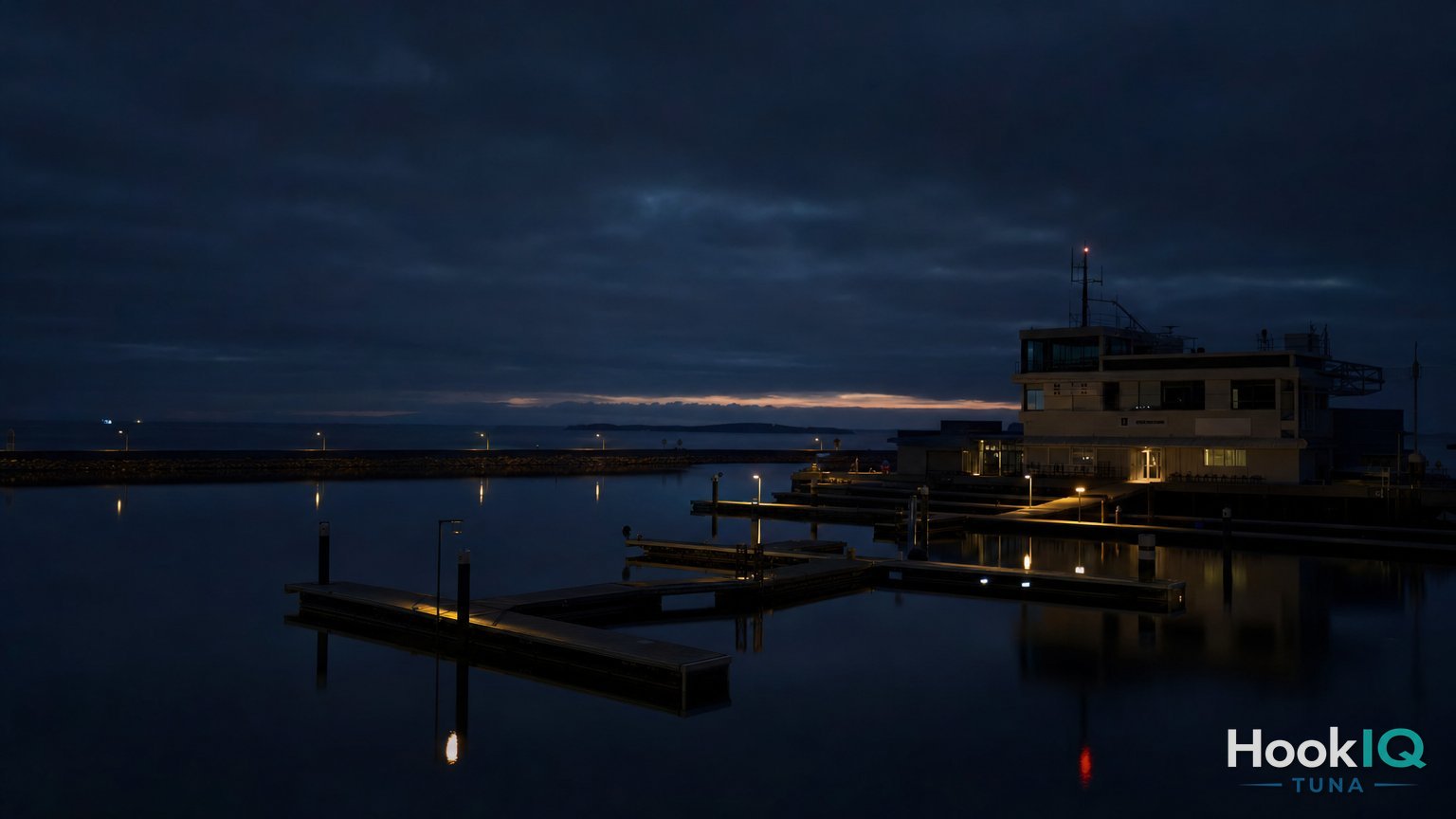
Just before six, the marina is still half dark, and somewhere a fender knocks softly against the hull. Right there, before a single line comes off the cleat, the day's fate is already being decided — whether it turns into a great story or one you'd rather not tell. In thirty years I've called off more trips than I can count, even with the boat fueled up and the crew fired up and ready. First-timers heading offshore almost always underestimate how much work happens before you ever leave the dock. The good news is that this work can be learned, and in the end it's what separates a relaxed day working the reef from a situation where suddenly nobody knows who's supposed to do what.
The Weather Window Is the First Decision, Not the Last
Most first-timers check the forecast for the day of the trip and call it done. I look at three days out, not one. Wind and swell rarely build out of nowhere — a front usually announces itself 48 to 72 hours ahead, and that's the window where I decide whether a trip makes sense at all. For an inexperienced crew, I personally draw a hard line at 15 knots of wind and 4 to 5 feet of swell. Anything above that makes trolling miserable, cockpit work at the transom dangerous, and seasickness pretty much guaranteed. Offshore, conditions can flip within hours — island chains and coastal geography generate their own local wind systems, and a forecast that looked clean the night before can turn ugly fast. On most of my bluefin runs, it's often a sudden squall or a shift in the pressure system that brings thirty knots out of a clear sky, while the app was still promising ten the day before. That's why I always cross-check at least two independent weather models before committing to a trip, and I'd rather scrub a trip the night before than turn back halfway out. Turning the boat around with a scared, green crew aboard is one of the most miserable situations I know — and a little patience the day before almost always avoids it entirely.
An EPIRB and a Life Jacket Are Not Just Paperwork
An EPIRB — the 406 MHz emergency beacon with its own built-in GPS — is as much a part of my standard kit as the rod holders. In a real emergency, it transmits your exact position to search and rescue, worldwide, independent of cell coverage, which dies a few miles off the coast anyway. Registering it with the proper national authority matters just as much — without that, precious time gets wasted in an emergency because nobody knows which boat the signal belongs to. I test the battery once a year and check the hydrostatic release unit, which fires the beacon automatically if the boat capsizes, even if nobody has a free hand left to trigger it manually. On life jackets, I don't compromise: auto-inflating vests rated for at least 33 lbs of buoyancy, one for every person aboard, with a crotch strap so the vest doesn't ride up over your head in the water. I replace the inflation cartridge every year regardless of whether it's ever been fired, because salt air and humidity wear down the mechanism more than people think. Anyone stepping aboard for the first time gets their vest properly fitted by me before we leave the dock — not just shown where it is. A vest that stays in the locker because it's annoying while trolling helps exactly nobody.
Everyone's Role Has to Be Locked In Before You Leave the Dock
On a big-game boat, several people are working at once, and when four rods go off at the same time or the weather turns, there's no time left to hand out assignments. So I settle who does what right there on the dock. The captain runs the boat and keeps an eye on the instruments — wind, heading, depth, fuel. The mate coordinates at the transom, clears lines, preps the gaff, and calls out instructions to the crew. During a fight, one person takes the chair or the stand-up harness, while a second person's only job is watching the other rods so nobody gets tangled in the lines. The same principle applies for emergencies. One person is responsible for radio contact on Channel 16, another knows exactly where the life raft is and how to deploy it, a third knows the location of the bilge pump and fire extinguisher. These roles don't shuffle mid-trip — they're locked in before you leave the dock, the same way your position at the fighting chair is locked in during a fight. I've watched a well-drilled crew get a burst fuel line under control in under two minutes, simply because everyone knew their job instantly, without anyone having to ask.
The Pre-Departure Briefing Takes Five Minutes and Decides the Day
Before the lines come off, I gather the whole crew in the cockpit — even the ones who've been out with me twenty times before. I point out the muster point in case of an alarm, where each person's life jacket is, where the life raft is and how to deploy it, the fire extinguisher, the bilge pump, and the first-aid kit. I walk through the man-overboard drill: who kills the engine, who throws the ring, who brings the boat around. And I make it clear how the boat handles seasickness, where the best seat is, and that nobody needs to feel embarrassed about speaking up early, before it gets ugly. This briefing is non-negotiable for me, no matter how experienced the crew looks or how badly everyone wants to get out on the water. I also always leave a float plan ashore — with the harbormaster or with someone who knows when we're due back and who to call if we're not. That costs five minutes at the dock. In an emergency, those are the five minutes that make the difference between a story you tell over a beer that night and one you never want to live through.
My Takeaway
Your first offshore trip starts days ahead, at the weather chart, and at the dock fitting life jackets — long before the first teaser ever runs in the wake. A clean weather window, working safety gear, clear roles aboard, and an honest briefing are the foundation every good fishing day is built on. These days, I like using the HookIQ app to plan those windows myself, since it pulls wind, swell, and current together in one place and lets me see at a glance when a trip really lines up. Once you've internalized these basics, you head out more relaxed and can focus on the part that's actually fun — at the transom, the moment the reel sings for the first time.