
Six in the morning, the sun still sitting low over the Croatian coastline, and the sounder paints a dark shadow at 38 metres. An old wreck, encrusted with mussels and algae, surrounded by clouds of baitfish. And right in the middle, glowing torpedoes of gold and turquoise — a school of dorado. This is the moment the jigging rod has been waiting for in the holder.
Why Wrecks Are the Best Dorado Spots
Dorado are nomads. They follow currents, floating debris and temperature fronts across hundreds of nautical miles. But when they find a wreck, they stay. The structure on the bottom attracts small fish, which in turn hold the dorado. A well-placed wreck in 25 to 50 metres of water can harbour a stable school for weeks — and that is exactly what makes these spots so predictable.
Over the years I have learned that the most productive wrecks are not the largest ones, but those with the strongest current edge. Where current meets structure, a vortex forms that concentrates baitfish. The dorado position themselves downstream in the lee of the wreck, waiting for anything that drifts past. That is precisely the zone where your jig needs to land.
Speed Jigs: Why They Work So Well on Dorado
The dorado is not a fish that thinks twice. If something flees, it strikes. That is exactly what makes speed jigs so effective. Unlike slow pitching, a speed jig lives on velocity and panic. You let it fall to the bottom, then wind it back up with fast, hard strokes — every crank of the handle accompanied by a sharp snap of the rod tip. The result is a wildly fluttering piece of metal that shoots through the water column like a fleeing baitfish.
My go-to size for dorado over wrecks is between 100 and 150 g. In depths under 30 metres, 100 g is enough; deeper than that I reach for 150 g, and in strong current sometimes 200 g. Colour matters less than action when it comes to dorado, but if I had to pick: blue/silver in clear water, pink/silver in murky conditions. And a green/gold jig has saved more than one day for me in the Adriatic — it almost perfectly mimics the colour of the sardines schooling in the area.
Hook configuration is crucial. I fish speed jigs for dorado exclusively with assist hooks at the head end — usually a single twin-assist on a short Kevlar leader with a sharp 2/0 hook. Dorado almost always attack from the front, and an assist hook at the head pins the corner of the jaw on the strike every time.
The Right Rod and Reel for Vertical Dorado Jigging
When it comes to tackle for dorado jigging, the rule is simple: light enough to feel the fun, strong enough to keep the fish off the wreck. Because that is the real challenge. A dorado that bolts into the wreck is a lost dorado.
My rod for this game is a dedicated PE 2–3 jigging rod, 1.80 m long with a fast action. The short length is not a drawback — quite the opposite. When you are jigging vertically straight below the boat, you do not need casting distance; you need control. A short rod gives you the leverage to muscle the fish away from the bottom the instant it bites, before it dives into the structure.
For the reel I run a 4000 to 5000 size spinning reel with a high gear ratio — 6.2:1 minimum. Retrieval speed is everything in speed jigging. You need to move the jig fast through the water column without your arm giving up after ten drops. A reel that picks up around 100 cm of line per crank is ideal.
The mainline is PE 1.5 to 2.0 braid, roughly 13 to 16 kg breaking strain. That might sound like overkill for a dorado that rarely exceeds 15 kg. It is not. You are fishing directly over a wreck with sharp edges, rusty frames and mussel growth. The braid has to survive a brief brush with the structure without snapping instantly. For the leader I use 60 cm of 0.40 mm fluorocarbon — thin enough not to kill the bite, strong enough to handle the dorado's rough lips.
The Technique: Vertical, Fast, Aggressive
Boat position is everything. I either drift over the wreck or hold directly above the structure with the electric motor. The jig drops vertically, and the moment it hits the bottom I immediately start winding with fast cranks and short upward snaps of the rod. Most bites come in the first five to ten metres above the wreck — exactly the zone where the baitfish hold.
If nothing happens after three or four drops, I change the rhythm. Sometimes dorado want a brief pause in the middle of the retrieve. Three fast strokes, then a one-second stop where the jig flutters and sinks for a moment. The strike often comes right at that instant. A dorado bite on a speed jig is unmistakable: a hard slam, then an immediate explosive run. No tentative taps, no gentle plucks. The fish commits and bolts.
Pit-Fights: When the Whole School Lights Up
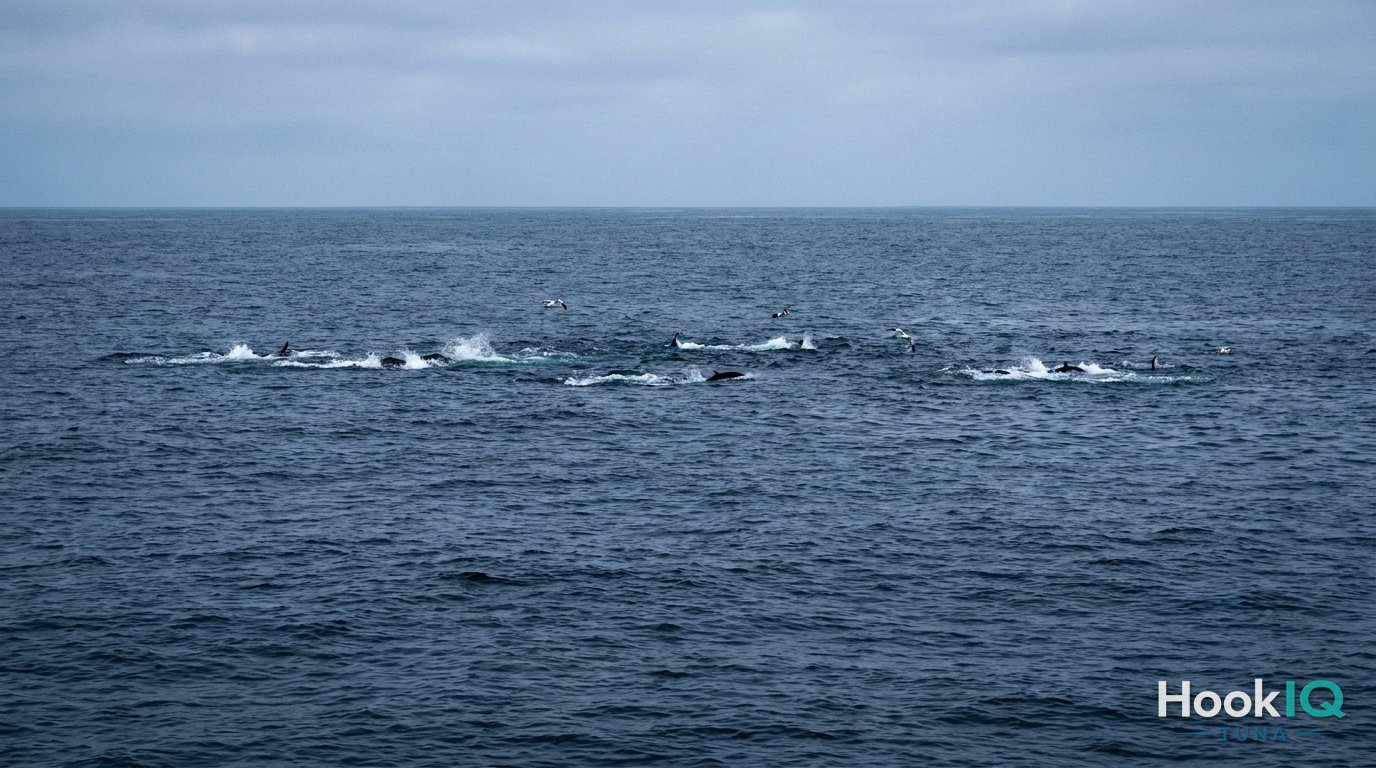
And then there are the moments you truly live for in this fishery. You are positioned over a wreck, the first dorado hooks up, and suddenly the entire school switches on. Two rods bent, then three — your mate next to you has barely dropped his jig and the reel is already locked up. That is a pit-fight, and there are few things at sea that deliver a bigger adrenaline hit.
In those situations you need to work fast and stay disciplined. Tighten the drag, pump the fish away from the wreck, then fight it with purpose. A hooked dorado in the school drags the others along, and if you are not careful you will have tangled lines within seconds. I have made it a habit to pump the fish two or three metres straight up right after the hookset, before it can get its bearings. That way it has open water beneath it instead of a steel skeleton.
Landing dorado is quick. Most fights over wrecks last between two and five minutes. The dorado is a sprinter, not a marathon runner. After the first two runs it usually gives in, and you lift one of the most beautiful fish in the ocean over the gunwale. That iridescent blue and gold that shifts colour with every breath the fish takes — that is why you get up at five in the morning.
Three Mistakes I See at the Wreck All the Time
The most common mistake is jigging too slowly. Dorado want speed. If you wind the jig up at a leisurely pace, the school will ignore you. Better too fast than too slow — the dorado will still strike.
The second mistake is running the drag too loose. Over a wreck you need to be able to stop the fish immediately. If your drag is set butter-soft like a trolling reel, you will watch the dorado dive into the steel frame with the jig still in its mouth and chafe through the line on the first rib.
And the third mistake: spooking the school. When a pit-fight is in full swing, make sure lost fish are not thrashing wildly at the surface and scattering the rest of the school. Land the fish cleanly or release it cleanly — no chaos at the rail.
Final Thoughts
Dorado jigging over wrecks is one of the most exciting things the Mediterranean has to offer in summer. You do not need heavy gear, hours of trolling runs or an expensive charter captain. A solid jigging rod, a handful of speed jigs and a wreck on the plotter are all it takes for an unforgettable day on the water. And when the whole school fires up and the boat is shaking with bent rods, you know: this is exactly why you are here.