
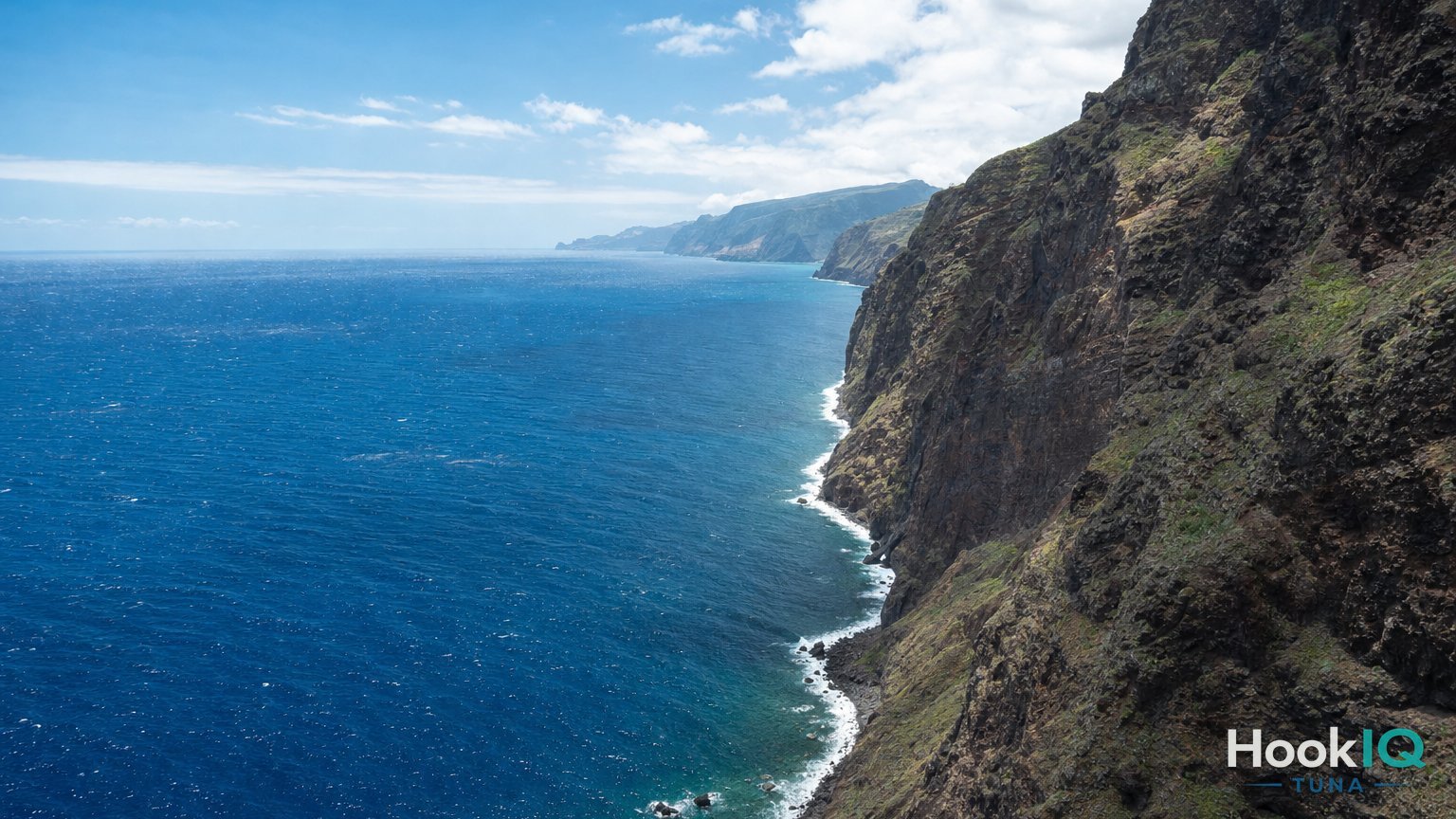
Just after five in the morning, Funchal harbor is still settling into darkness while we're long since awake. The lines sit coiled in the cockpit, the diesel is warming up, and over the cliffs of Cabo Girão hangs that blue-gray pre-dawn glow I still haven't gotten tired of after thirty-plus years. Madeira smells like diesel, salt, and cold coffee in the early morning. And anyone heading out here in August isn't hoping for just any marlin. They're hoping for a grander.
Why Madeira Fishes Differently Than Any Other Marlin Ground
I've chased blue marlin off the Azores, off Cape Verde, in the Caribbean. But nowhere else in the East Atlantic does deep water sit this close to shore. Just off Funchal, the seafloor drops from just over a hundred meters to more than two thousand within a few nautical miles. You don't have to run for hours to reach blue water. Twenty, thirty minutes out of the harbor and you're already sitting over the edge where the island drops almost vertically into the open sea.
That's exactly what makes Madeira a grander ground. The island itself is an extinct volcano rising out of the depths, and that steep underwater slope acts like an on-ramp for migrating fish. Bonito and mackerel school up against the edges because the upwelling pushes nutrients toward the surface there, and wherever baitfish stack up, the big females patrol. And in this fishery, it's almost always the females that grow into the thousand-pound class. A male blue marlin of that size is a rarity you might hear about once in thirty years.
The Edges Where I Spend My Time
I rarely troll open water off Madeira. I fish edges. The zone southwest of Funchal, where the island drops steeply toward the bank, and the water between Cabo Girão and Ponta do Pargo are among the most reliable stretches I know. Then there's the run toward Ponta de São Lourenço in the east, where a second steep flank drops into deep water and where I've had some of the biggest fish of my Madeira season in recent years.
More important to me than position alone is what shows up on the sounder between six hundred and fifteen hundred meters. If I see bonito schools stacking up against a temperature break on the way to the edge, and the water shifts from deep cobalt blue to a lighter turquoise, I know I'm on the right line. That color break often marks the exact transition from the shelf edge into open water, and it's right there, a stretch out into the deeper blue rather than in the transition itself, where the big fish like to sit.
My Lure Spread for the 1,000-Pound Class
For granders I run heavier gear than for the typical two-to-three-hundred-pound fish that are also thick off Madeira in high summer. On the long rigger I run a big Marlin Magic-style lure in purple/black rigged with a 12/0 needle-point hook on 400-pound mono leader, with a second, slightly smaller blue/white lure as the short rigger. Both center positions, short corner and long corner, I fill with a combined squid-and-daisy-chain teaser string, dyed dark so it reads as one solid silhouette from below instead of a scatter of individual shapes.
I troll between 8.5 and 9.5 knots, faster than I would for white marlin off the Azores, because blue marlin need the aggression a strong bow wake off the lure triggers. On the bridge I always keep a pitch bait ready — usually a dead mackerel or a larger bonito on a circle hook — that we throw the moment a fish shows in the teasers and doesn't commit cleanly to a lure. This bait-and-switch has put more granders in the boat for me off Madeira than any lure spread alone, because the really big females often shadow skirted lures with suspicion but can rarely turn down a real bait.
My tackle is consistently 130-pound class. Stand-up for the smaller fish, but for anything over six hundred pounds, nobody on our boat goes to the rod without a fighting chair anymore. A grander off Madeira can rip two hundred meters of backing in under a minute on the first run, and anyone standing there without a chair back and footrest either loses the fish or goes overboard themselves.
When the Season Peak Actually Starts
The real blue marlin season off Madeira kicks off in June, but I don't head out with full expectations until mid-July. The peak, for me, is clearly August, when surface temperatures hold steady at 23 to 24 degrees and the big bonito schools have settled onto the edges. Over the years, this is the window where I've hooked most of my fish beyond the eight-hundred-pound mark, and the island's famous granders — the legendary catches well over a thousand pounds — fall almost entirely within this six-to-eight-week stretch between late July and mid-September.
September gets interesting again once the first cooler nights nudge water temperatures down slightly and the fish start moving. After that, as October approaches, the numbers thin out noticeably. I always tell newcomers to gamble on one week in August rather than two weeks in June, even if June looks calmer and more predictable on paper.
If you're wondering why some days on the same edge bring three bites and the next day at the same spot goes dead, here's what I've learned: I now watch how current, moon phase, and water temperature line up on a given edge. For Madeira, I've come to rely on the HookIQ app for that. You only spot the good windows once you look at all three factors together.
My Takeaway
For me, Madeira is the most honest grander ground in the East Atlantic, because the deep water sits so close to shore that any day out can turn into a real shot at a migrating blue marlin. Fish the edges between Cabo Girão and Ponta de São Lourenço in August, run a heavy spread, and have the patience to wait on the pitch bait, and you've got a realistic shot at the fish of a lifetime. I've fought females out there that wore me down more in ninety minutes than any bluefin off Sicily ever has, and that's exactly why I keep heading back out every summer.